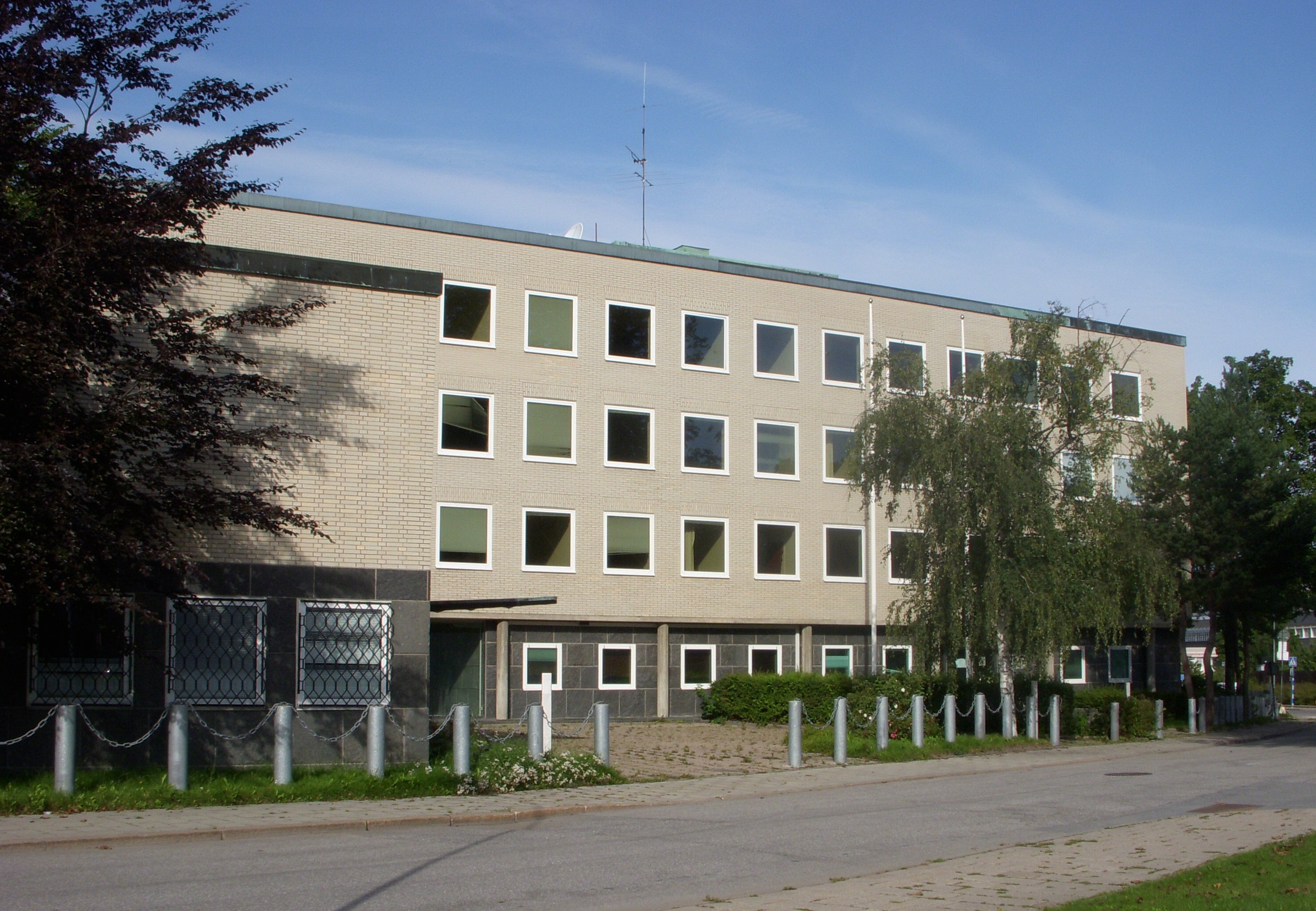
West German Embassy Siege in Stockholm
The six young radicals who burst into the West German Embassy on Djurgarden on April 24, 1975, called themselves Kommando Holger Meins, named for a comrade who had starved himself to death in prison five months earlier. They belonged to the Red Army Faction, West Germany's most notorious terrorist organization, and they had come to neutral Sweden to force the release of imprisoned RAF members back home. Within hours, the elegant diplomatic residence would become a scene of murder, explosion, and chaos broadcast live on Swedish television - a moment when Cold War-era political violence arrived with shocking force in Scandinavia.
The Takeover
The attackers moved with brutal efficiency. Karl-Heinz Dellwo, Siegfried Hausner, Hanna-Elise Krabbe, Bernhard Rossner, Lutz Taufer, and Ulrich Wessel stormed through the embassy doors and seized thirteen officials, including Ambassador Heinz Dietrich Stoecker. They occupied the upper floors and issued their demands: release twenty-six RAF prisoners from West German jails, or hostages would die. To underscore their seriousness, they announced they had planted fifteen kilograms of TNT throughout the building. Swedish police surrounded the embassy but were warned to keep their distance. The terrorists' message was stark: 'The Holger Meins Commando is holding members of the embassy staff in order to free prisoners in West Germany. If the police move in, we shall blow the building up.'
A Chancellor Who Would Not Bend
In Bonn, Chancellor Helmut Schmidt faced an agonizing decision. Just weeks earlier, he had navigated another hostage crisis, and he had concluded that giving in to terrorist demands only invited more terrorism. He refused to negotiate. The response from Stockholm was immediate and horrifying. Baron Andreas von Mirbach, the military attache, was marched onto a landing and shot dead. In a grim historical echo, his relative Wilhelm von Mirbach had been assassinated at the German embassy in Moscow in 1918. When Schmidt still would not yield, the terrorists forced economic attache Hillegaart to stand at a window and shot him three times. They announced they would execute one hostage every hour until their demands were met.
The Explosion
Swedish police prepared to storm the building, but events overtook them. Just before midnight, a series of violent explosions rocked the embassy. The TNT cache had detonated - not through any police action, but apparently because Ulrich Wessel dropped a grenade while moving through the building. The blast killed Wessel instantly and inflicted severe burns on everyone else inside, hostages and terrorists alike. Swedish television reporter Bo Holmstrom had been standing outside, preparing to broadcast, when the explosions began. After diving for cover, he jumped back up screaming 'Lagg ut, lagg ut!' - 'Put me on the air!' - and began reporting live as flames consumed what had been a center of West German diplomacy. The surviving RAF members were captured and extradited. Siegfried Hausner, badly burned, was flown back to West Germany, where he died of his wounds in Stammheim Prison.
Aftermath and Legacy
The siege's consequences rippled outward for years. Anna-Greta Leijon, the Swedish Minister of Employment who ordered the terrorists' extradition, found herself targeted by a new RAF commando named for Siegfried Hausner. The Swedish Security Service, Sapo, took over her protection. In May 1977, an RAF team led by Norbert Krocher attempted to kidnap Leijon, but her security detail prevented the attack. The failed kidnapping led to arrests across Sweden and Denmark. When Prime Minister Olof Palme was assassinated in 1986, investigators briefly considered whether the RAF might be responsible - a theory that illustrated just how deeply the Stockholm siege had scarred Sweden's sense of security. The burned embassy on Djurgarden stood as a reminder that political violence recognized no neutral ground, and that the ideological wars of the 1970s could reach even into the heart of peaceful Scandinavia.
From the Air
Located at 59.33N, 18.11E on Djurgarden island in central Stockholm. The former embassy site sits in a diplomatic quarter along the waterfront. Stockholm Arlanda Airport (ESSA) lies approximately 40 km north, while Stockholm Bromma Airport (ESSB) is about 8 km west. The area is best viewed at lower altitudes over Stockholm's central islands; Djurgarden is the large green island east of the old town, flanked by the Baltic inlet.