Westerkerk
Anne Frank could hear the Westerkerk. From the attic of the Achterhuis, two minutes' walk along the Prinsengracht, the carillon chimed every quarter hour, all day, all night, and she wrote in her diary that it comforted her. That is one thing this church does. The other, less easy to find, is hold the unmarked grave of Rembrandt van Rijn somewhere beneath its floor. The number was lost. The bones were thrown out after twenty years, which is what they did then with the bodies of poor people. So Amsterdam's most famous painter is here, the city's most famous diarist listened to it, and on top of everything it is simply the tallest church tower in town.
Built for a New Faith
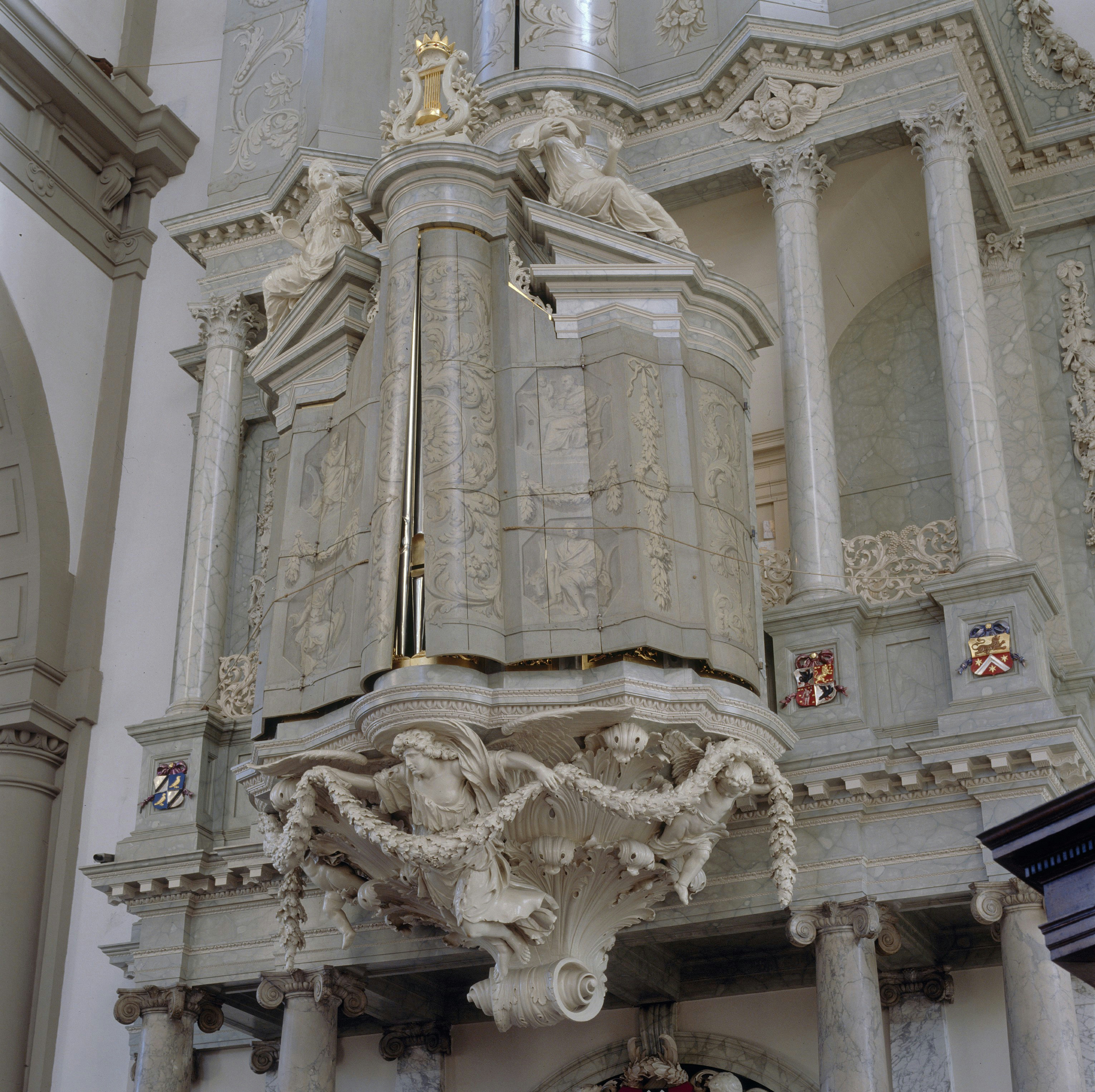
The Westerkerk went up between 1620 and 1631, designed by Hendrick de Keyser in a confident Renaissance style and completed after his death by his son Pieter. It was one of the first churches in Amsterdam built from scratch for Protestant worship rather than converted from a Catholic one, and it remains the largest church in the Netherlands built for Protestants. The floor plan, two Greek crosses joined into a patriarchal cross, makes the interior feel longer and lighter than its measurements suggest: 58 metres long, 29 wide, the nave high, the aisles modest. When it was consecrated on Pentecost Sunday in 1631, there was no organ. Calvinism in 1631 regarded instrumental music in church as profane, and it took half a century of careful argument before the congregation finally allowed Roelof Barentszn Duyschot to build one. He died before it was finished. His son completed the commission in 1686, and the case still stands today, painted with King David dancing before the Ark of the Covenant on the left shutter and the Queen of Sheba meeting Solomon on the right, by Gerard de Lairesse.
The Painter in the Floor
Rembrandt was buried in the Westerkerk on 8 October 1669. He had outlived his wife, his lover Hendrickje Stoffels, his son Titus. He had outlived his money. The kerkgraf where they put him was a numbered church-owned plot, the kind given to people who could not afford to buy a grave outright, and at some point the number was simply mislaid. After about twenty years his remains were removed and destroyed, as was customary for the poor. There is a memorial marker on the north wall, made in 1909, modelled on figures from The Night Watch. Every 15 July, on his birthday, the church holds a lunchtime concert of music from his lifetime and lays flowers on the marker. Hendrickje is here too, somewhere, and so is Titus. So is Govert Flinck, Rembrandt's most successful pupil. So is Joan Blaeu the cartographer, whose atlases mapped the world that Dutch ships were busy crossing. The floor of the Westerkerk is a slow gathering of the city's seventeenth century, mostly anonymous now, but the names are kept.
The Carillon and the Crown
The Westertoren stands 87 metres above the canal, the tallest church tower in Amsterdam, and the spire is topped by the Imperial Crown of Austria, granted to the city by Maximilian I and rendered here in heavy gilt and blue. In 2006 the crown was repainted back to its original blue, which is what makes the silhouette so recognisable on every Amsterdam postcard. Just below the clock faces hangs the carillon: 51 bells, the largest 14 of them cast by François Hemony in 1658, the smaller ones replaced after Amsterdam's coal-smoke air corroded the older bells in the twentieth century. It is the only carillon in the city that chimes around the clock, twenty-four hours a day, because the residents of the Jordaan asked the city to keep it running through the night. Every quarter of an hour a short tune plays from a brass drum first made by Jurriaen Spraeckel in 1659. The hour-strike bell, cast by Assuerus Koster in 1636, weighs 7,509 kilograms; it is the largest in Amsterdam and bears the inscription Verbum Domini manet in eternum, the word of the Lord endures forever.
Audible from the Achterhuis
Anne Frank's hiding place, the Achterhuis behind 263 Prinsengracht, stands a few dozen steps from the Westerkerk's western flank. From the small window of the attic she could see one face of the tower's clock and hear, all hours, the bells she came to think of as a friend. Today a small bronze statue of her, sculpted in a quiet, contained pose, stands at Westermarkt just outside the church doors. The Westerkerk has played other roles in modern Dutch memory. On 10 March 1966, Princess Beatrix, the future queen, married Prince Claus von Amsberg here, in this church rather than the Nieuwe Kerk on the Dam, because the usual royal venue was under renovation. It was a difficult wedding for a country that had not forgotten the German occupation only twenty-one years before. Smoke bombs went off in the street outside while the bells rang.
Still Working
The church has never become a museum. It is still in use by the Protestant Church in the Netherlands; services on Sunday include music by Bach almost every week, played by the titular organist Evan Bogerd on the rebuilt Duyschot–Vater–Flentrop organ. From April through October there are free lunchtime concerts on Fridays or Saturdays at one in the afternoon, and every August the church runs Geen dag zonder Bach, not a day without Bach, during the Canal Festival. Climb the tower if you can; the view from the crown takes in the Jordaan's tilting gables to the west, the canal ring's curve to the east, and the river of bicycles flowing along the Prinsengracht below. Climb, listen for the quarter chime, and remember who has heard this same sound from this same stone before you.
From the Air
The Westerkerk stands at 52.3745°N, 4.8839°E on the Prinsengracht in central Amsterdam, between the Grachtengordel and the Jordaan. From the air at low altitude its 87-metre spire with the gilt-and-blue Imperial Crown is the most recognisable steeple in the city skyline, second in height only to the modern towers across the IJ. Best viewed in clear conditions at low altitude; the tower lines up neatly with Westermarkt to the south. Schiphol (EHAM) lies roughly 15 km south-west; downtown approach is from the south along the IJ corridor. Useful navigation cue: from the Westerkerk, the Anne Frank House is the next door but one north along the canal.