Western Chalukya Empire
In 973 CE, a feudatory named Tailapa II watched the Rashtrakuta Empire crumble after the Paramara dynasty sacked its capital at Manyakheta. He did not wait for an invitation. Ruling from the Bijapur region as a vassal, Tailapa defeated his overlords and claimed Manyakheta as his own capital, founding what historians call the Western Chalukya Empire -- a dynasty that would dominate the western Deccan and much of South India for the next two centuries. Sometimes called the Kalyani Chalukyas after the capital to which Someshvara I later relocated the court, or the Later Chalukyas for their claimed kinship with the sixth-century Chalukyas of Badami, they are distinguished from the contemporaneous Eastern Chalukyas of Vengi, a separate lineage entirely. What Tailapa began as an opportunistic seizure of power, his successors transformed into one of the great empires of medieval India.
From Vassals to Sovereigns
The Western Chalukyas rose in a moment of imperial collapse. The Rashtrakuta Empire had controlled most of the Deccan Plateau and Central India for over two centuries, but its grip was loosening. When the Paramara ruler of Malwa invaded and captured the Rashtrakuta capital, the resulting chaos gave Tailapa II his opening. He moved quickly, consolidating power across the western Deccan and establishing a dynasty that would grow into an empire under his successors. The real expansion came under Someshvara I, who moved the capital from Manyakheta to Kalyani -- present-day Basavakalyan in Karnataka's Bidar district. From Kalyani, the Chalukyas projected power across a vast territory, contending with the Chola Empire to the south and the Paramara and Kalachuri kingdoms to the north in a shifting web of alliances, rivalries, and outright war.
Temples in Stone
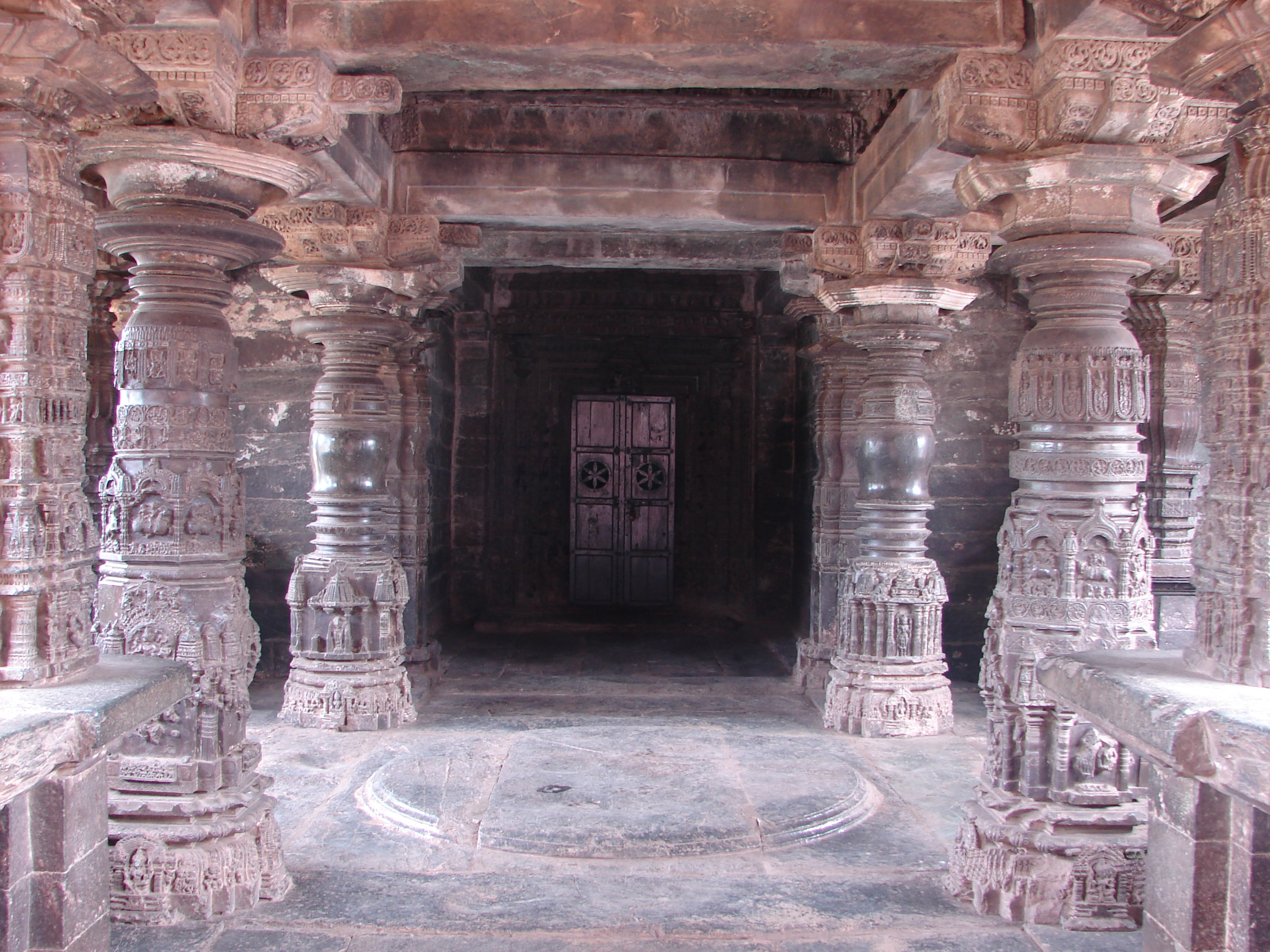
The Western Chalukyas are remembered today less for their military campaigns than for what they built. Their architects developed a distinctive temple style that art historians call the transitional style -- a fusion of the earlier Dravidian and Nagara architectural traditions of South and North India. Temples built under Chalukya patronage feature intricately carved exterior walls, lathe-turned pillars, and stepped towers that blend northern shikhara forms with southern vimana proportions. The Mahadeva Temple at Itagi, the Kasivisvesvara Temple at Lakkundi, and the Mallikarjuna Temple at Kuruvatti represent the high points of this style. These were not merely places of worship but statements of imperial ambition, each temple a declaration in carved stone that the Chalukyas stood at the crossroads of India's architectural traditions and could command both.
A Kannada Literary Flowering
The Chalukya court became a center of literary production in Kannada and Sanskrit. Under royal patronage, poets and scholars created works that shaped the trajectory of Kannada literature for centuries. The period saw a flourishing of Vachana literature -- prose poems composed by Shaiva saints associated with the Lingayat movement, which emerged in the Chalukya heartland. Basavanna, the most famous of these poet-saints, lived in Basavakalyan during the twilight of the dynasty, and his vachanas remain foundational texts of Kannada literature. The Chalukya kings also patronized Sanskrit scholarship, attracting grammarians and philosophers to their court. This dual literary tradition -- vernacular Kannada alongside classical Sanskrit -- reflected the empire's position as a cultural bridge between the Dravidian south and the Indo-Aryan north.
The Slow Unraveling
No Deccan empire held power forever, and the Western Chalukyas were no exception. By the late twelfth century, the dynasty faced threats from all directions. The Hoysala Empire was rising in the south, the Yadavas of Devagiri pressed from the north, and the Kakatiya dynasty expanded from the east. Internal feudatories grew increasingly independent, a familiar pattern in Indian dynastic history -- the same centrifugal forces that had destroyed the Rashtrakutas now consumed their successors. The last Western Chalukya king, Someshvara IV, lost his throne around 1189 CE. The empire fragmented into successor states, but its cultural legacy proved more durable than its political boundaries. The temple architecture pioneered by Chalukya builders directly influenced the Hoysala style that followed, and the Lingayat religious movement that took root in their territory remains one of Karnataka's most significant spiritual traditions. Walk through Basavakalyan today and the stones still carry the marks of a dynasty that, for two centuries, made this corner of the Deccan the center of a world.
From the Air
The Western Chalukya capital of Kalyani (modern Basavakalyan) is located at approximately 17.87N, 76.95E in the Bidar district of Karnataka, India. The terrain is the relatively flat western Deccan Plateau, marked by agricultural fields and scattered temple sites. Best viewed at 3,000-5,000 feet AGL. Nearest airports: Bidar Airport (VOBR), approximately 80 km north; Kalaburagi Airport (VOGB) to the east; Rajiv Gandhi International Airport, Hyderabad (VOHS) approximately 150 km to the northeast. Key Chalukya temple sites at Lakkundi, Itagi, and Kuruvatti are spread across northern Karnataka and may require broader aerial survey.