Western Pacific Railroad Museum
The throttle is in your hand. The locomotive - twenty-nine tons of diesel power - rumbles beneath your feet. For one hour, you are the engineer. This is not a simulator, not a video game, not a theme park ride. This is the Run A Locomotive program at the Western Pacific Railroad Museum in Portola, California, where ordinary visitors become railroad engineers on real, working locomotives. It is the crown jewel of a museum that has built one of North America's most complete collections of early diesel-era railroad equipment - and one of the few places in the world where the public can actually operate the machines that built a nation.
The Feather River Route
The museum sits where it must: at a former Western Pacific locomotive facility, adjacent to what is now Union Pacific's mainline through the Feather River Canyon. The Western Pacific Railroad carved this route through the Sierra Nevada in the early 1900s, following the Feather River through some of the most spectacular mountain scenery in California. The Feather River Rail Society, founded in 1983, established the museum to preserve the history of this legendary railroad. They chose the site at Portola because it was home to the Portola Diesel Shop, built in 1953, where Western Pacific maintained its fleet of locomotives - the same locomotives that now form the core of the museum's collection.
Hands on History
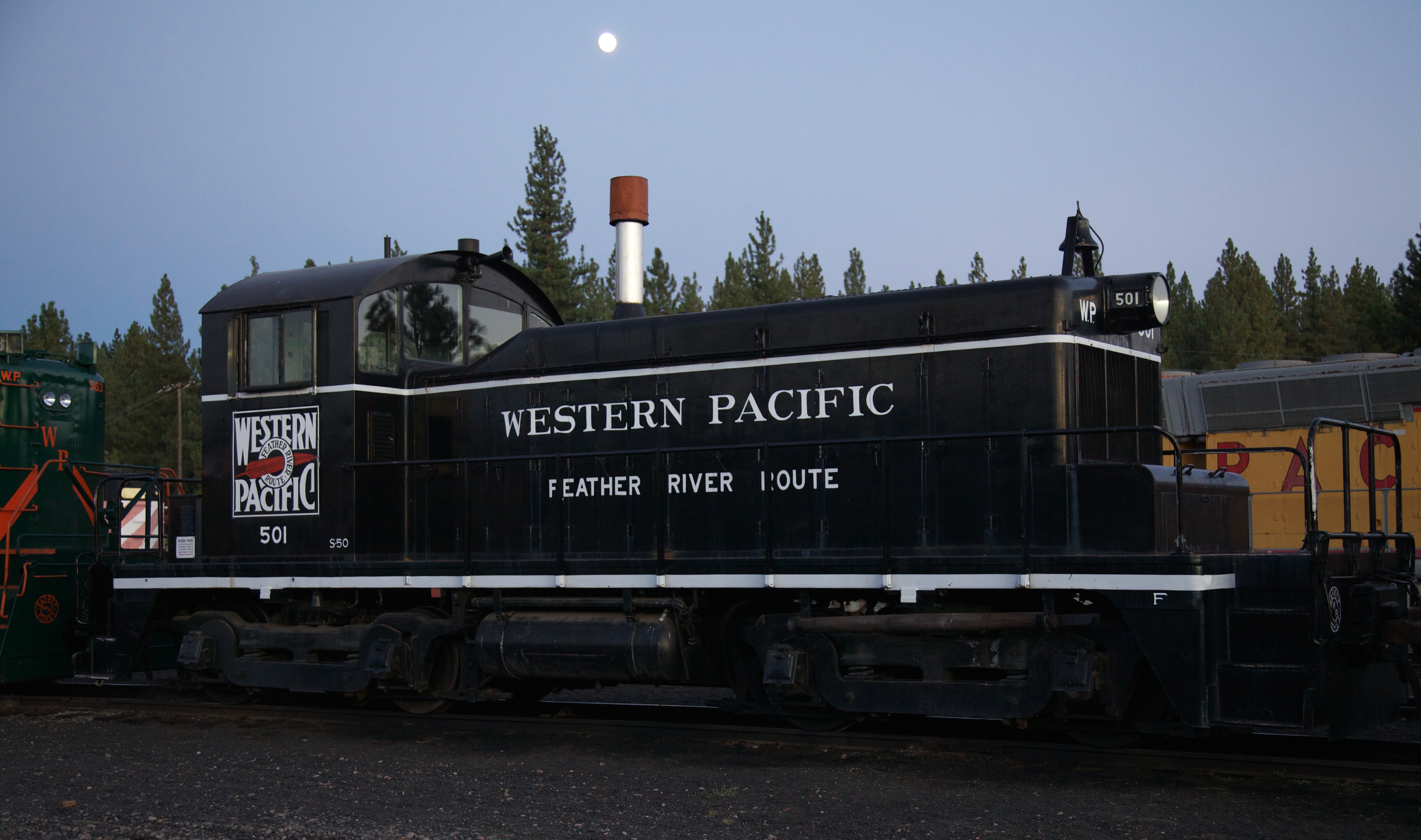
This is a museum that refuses to put its treasures behind glass. The Western Pacific Railroad Museum is hands-on by design, inviting visitors to board and explore locomotives and train cars throughout the collection. You can climb into the cab of Southern Pacific EMD GP9 #2873, nicknamed 'the Kodachrome' for its colorful paint scheme from the failed Santa Fe-Southern Pacific merger. You can examine WP 2001, the first GP20 locomotive ever built - an early turbocharged diesel that marked a new era in railroad power. You can stand beside WP 501, the very first diesel locomotive purchased by the Western Pacific. These are not reproductions. They are the real machines, preserved where they worked.
Witnesses to History
The collection spans the full sweep of Western Pacific history. Steam locomotive 165, an oil-burning 0-6-0 switch engine built by ALCO in 1919, represents the railroad's early days. WP 3051 is one of only two remaining GE U30B locomotives anywhere. Business car 'Charles O. Sweetwood,' built in 1917 and designated WP 106, served as a rolling blood bank during the Korean War. A 200-ton rail-mounted crane, track-clearing snowplows both wedge and rotary, and rare early 20th-century freight cars round out a collection that tells the complete story of a railroad from steam to diesel, from freight to passenger service, from construction to maintenance.
The California Zephyr Lives
The Zephyr Project represents the museum's most ambitious preservation effort: acquiring, restoring, and maintaining equipment from the legendary California Zephyr, the streamlined passenger train that ran from Chicago to San Francisco from 1949 to 1970. The collection includes Western Pacific FP7 locomotive 805-A, dome lounge car Silver Hostle, dome-coach Silver Lodge, and dining car Silver Plate. The dome-coach Silver Rifle joins them on long-term loan from the Golden Gate Railroad Museum. These gleaming survivors of the streamliner era offer a glimpse of an age when crossing the continent by rail was an event, not just transportation.
Loss and Legacy
Not everything could be saved. The Western Pacific Hospital, built in 1911 and one of the few remaining railroad hospitals in the country, was part of the museum until an arson fire destroyed it on September 7, 2011. The loss only deepened the museum's commitment to preservation. Today, the WPRM maintains several road diesels in mainline operating condition, occasionally making movements on Class I railroads using their own historic motive power. An interlocking tower from Oakland awaits restoration. And every summer, visitors line up for their turn at the throttle, each one-hour session preserving something more valuable than any artifact: the living experience of what it meant to run a railroad.
From the Air
Located at 39.80N, 120.48W in Portola, California, in the Sierra Nevada foothills. The museum grounds and rail yard are visible from altitude, with the active Union Pacific mainline running alongside through the Feather River Canyon. The Feather River Route itself is one of the most scenic railroad corridors in North America, following the river through dramatic mountain terrain. Nearest airports: Nervino Airport (O02) in Beckwourth is 8nm north; Reno-Tahoe International (KRNO) is approximately 50nm southeast. Mountain weather conditions apply; be aware of terrain and afternoon thermal activity in summer months.