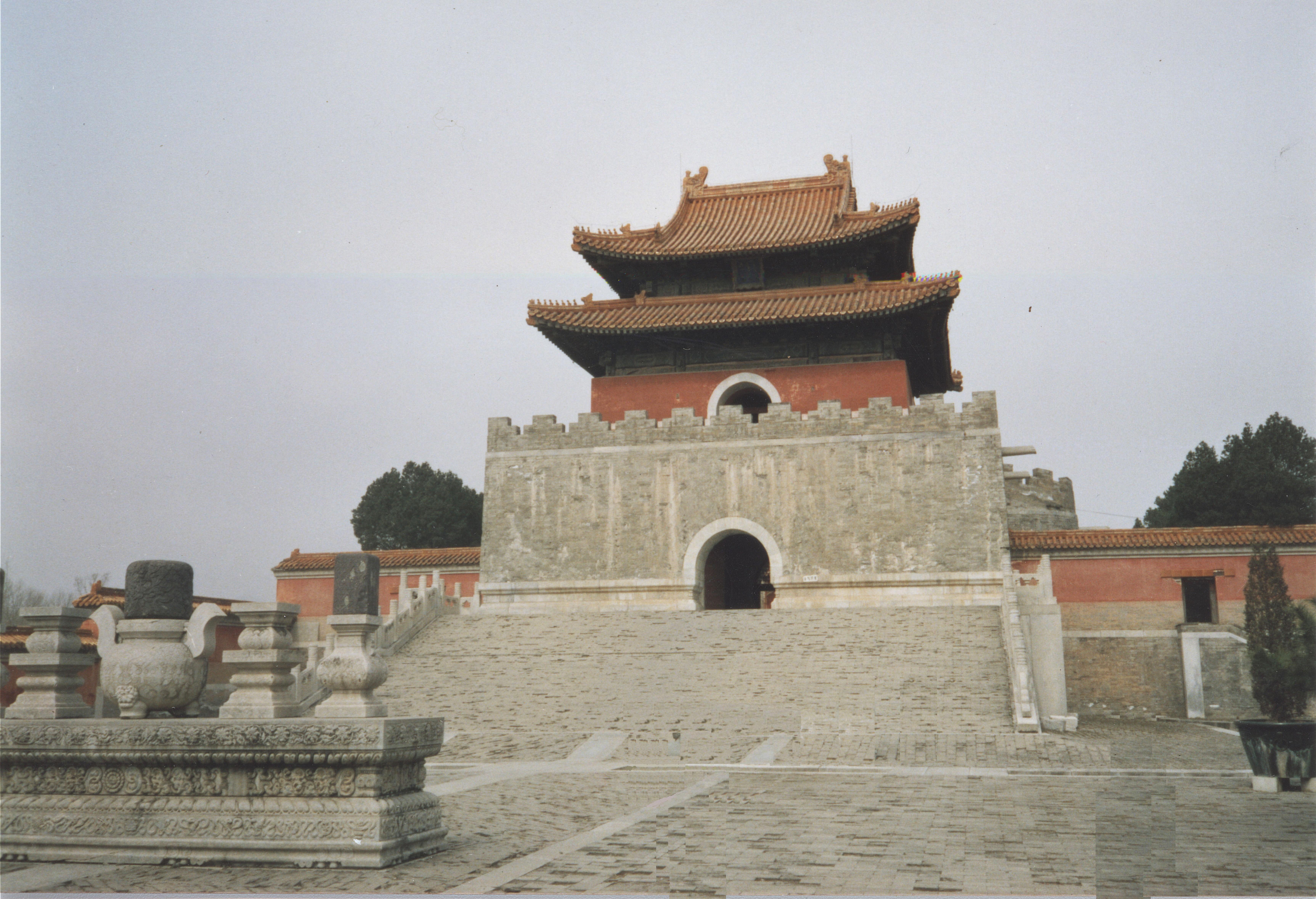
Western Qing Tombs
The Yongzheng Emperor had a problem with his father's grave. Tradition dictated that he should rest alongside the Kangxi Emperor in the Eastern Qing Tombs, as generations of the dynasty had done before him. Instead, he chose a hillside 140 kilometers southwest of Beijing, broke with centuries of custom, and built his own necropolis. Some historians speculate the reason was guilt: Yongzheng may have usurped the throne by eliminating his brothers, and the prospect of lying for eternity next to the father he had betrayed was evidently more than he could bear. Whatever his true motive, the result was the Western Qing Tombs, a sprawling complex in Yi County, Hebei, where seventy-eight members of the imperial family would eventually be interred.
A Dynasty Divided in Death
The first tomb completed here was the Tailing, finished in 1737, two years after the Yongzheng Emperor's death. His son, the Qianlong Emperor, perhaps embarrassed by his father's break with tradition or eager to restore balance, chose to be buried back at the Eastern Qing Tombs. Qianlong then decreed that future burials should alternate between the eastern and western sites, though this elegant solution was not followed consistently. Four emperors ultimately came to rest in the Western Tombs: Yongzheng, the third Qing emperor; Jiaqing, the fifth; Daoguang, the sixth; and Guangxu, the ninth. Their empresses, imperial concubines, princes, princesses, and royal servants followed them, creating a necropolis that spans nearly two centuries of imperial history.
The Last Emperor's Neighbors
The final imperial interment at the Western Qing Tombs was in 1913, when the Guangxu Emperor was laid to rest in the Chongling. It was a poignant ending: Guangxu had spent the last decade of his life under virtual house arrest after his reform efforts were crushed by the Empress Dowager Cixi. His tomb, shared with Empress Dowager Longyu, did not remain undisturbed. In 1938, grave robbers broke into the Chongling and looted its burial chamber -- an echo of the more famous looting of the Eastern Mausoleum a decade earlier. Today, the violated tomb is open to the public, its emptiness its own kind of testimony. Behind the Guangxu Emperor's tomb lies one more imperial grave, though it is technically not part of the complex: Puyi, the last emperor of China, rests in a commercial cemetery, his burial a footnote to a dynasty that had already ceased to exist.
Monuments in Manchu and Stone
Each of the four main tombs carries both a Chinese name and a Manchu designation, a reminder that the Qing were a conquest dynasty from the northeast. The Tailing is elhe munggan in Manchu; the Changling is colgoroko munggan; the Muling is gunihangga munggan; and the Chongling is wesihun munggan. The complex itself reflects the formal landscape architecture of imperial Chinese tomb design: spirit ways lined with stone figures, ceremonial gates, sacrificial halls, and the burial mounds themselves, set against the backdrop of the Yongning Mountains. The site was inscribed as a UNESCO World Heritage Site as part of the Imperial Tombs of the Ming and Qing Dynasties, recognized for its outstanding demonstration of how Chinese beliefs about the natural world and the afterlife shaped the physical landscape.
Resting Place and Reckoning
Visiting the Western Qing Tombs today is an exercise in reading power and its limits. The Yongzheng Emperor built his tomb to escape the proximity of a father whose succession he may have corrupted. The Guangxu Emperor was buried here after a reign defined more by imprisonment than authority. Puyi ended up in a commercial plot behind the walls, his dynasty dissolved, his title meaningless. The tombs are magnificent -- their scale, their stonework, their setting among forested hills all communicate imperial grandeur. But the stories they contain are more complicated than grandeur allows, full of ambition and paranoia, reform and reaction, and the quiet indignity of graves that could not protect themselves from the living.
From the Air
Located at 39.36°N, 115.34°E in Yi County, Hebei Province, roughly 140 km southwest of Beijing. The tomb complex is nestled in a valley at the foot of the Yongning Mountains and is visible from moderate altitude as a cluster of formal structures amid forested hills. Nearest major airport is Beijing Daxing International (ZBAD), approximately 130 km northeast. Recommend viewing at 3,000-6,000 ft to appreciate the feng shui landscape setting of the tombs against the mountain backdrop.