Westminster Abbey
In 1669, the diarist Samuel Pepys visited Westminster Abbey, where he found the body of Catherine de Valois, queen consort of Henry V, lying in an open coffin in the old Lady Chapel. She had been exhumed during construction work more than 150 years earlier and never reburied. Pepys leaned in and kissed her on the mouth. It would take another two centuries before Catherine was finally reinterred beside her husband. The story is grotesque, but it captures something essential about this place: Westminster Abbey accumulates the dead the way a library accumulates books, layer upon layer, until the sheer density of history makes the stones themselves feel heavy.
The Confessor's Shrine
The abbey's origins reach back at least to the mid-tenth century, when Benedictine monks established a community on Thorney Island in the Thames. Edward the Confessor rebuilt the church between 1042 and 1065 in the Romanesque style, the first cruciform church in England, intending it as his own burial place. He was consecrated there on 28 December 1065 and died eight days later. His successor, Harold Godwinson, was crowned in the abbey, as was William the Conqueror later that year. Since 1066, forty English and British monarchs have been crowned here. Edward was canonized in 1161, and his shrine behind the high altar became the spiritual heart of the building. Henry III, driven by devotion to Edward and a desire to rival the great churches of France, demolished the Confessor's church and began rebuilding in Gothic style in 1245, a project that would not be fully completed for another two and a half centuries.
Where Monarchs Rest and Rivals Share a Tomb
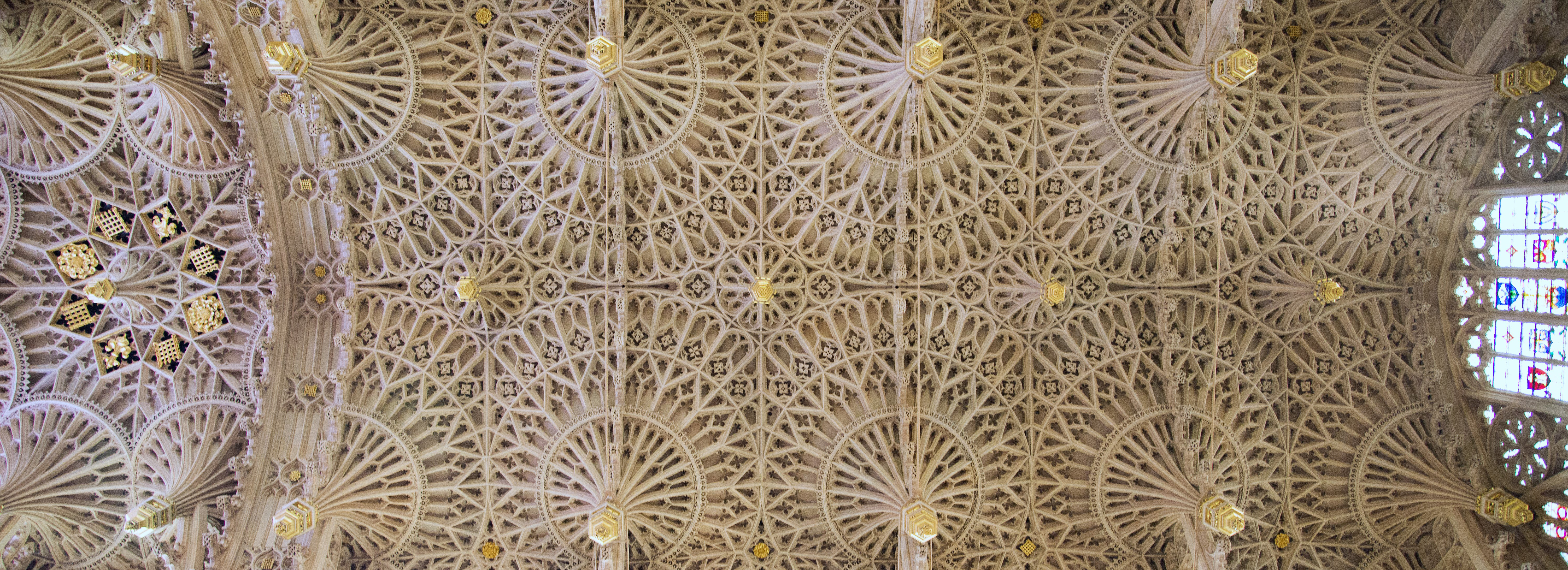
At least eighteen monarchs are buried in the abbey, from Edward the Confessor to George II, the last royal interment here in 1760. The Henry VII Chapel, a masterpiece of late Perpendicular Gothic architecture with a fan-vaulted ceiling that Washington Irving compared to a cobweb, holds a remarkable concentration of royal dead. In one sub-chapel, the coffins of Elizabeth I and her Catholic half-sister Mary I share a single monument. In another, Mary Queen of Scots, executed on Elizabeth's orders, rests in a tomb commissioned by her son James I, who reunited the English and Scottish crowns. The proximity is deliberate and disquieting: rivals in life, inseparable in death, their fates literally sealed beneath the same roof.
The Corner Where Words Echo
Poets' Corner began by accident. Geoffrey Chaucer was buried in the south transept around 1400 not because of his literary fame but because he worked at the abbey as Clerk of the King's Works. When Edmund Spenser was buried nearby in 1599, a tradition crystallized. Today the transept contains burials of or memorials to Dryden, Tennyson, Dickens, Kipling, and Hardy, among dozens of others. Shakespeare and Milton are commemorated here despite being buried elsewhere. Ben Jonson lies upright in the nave, reportedly buried standing to save space. Aphra Behn rests in the cloisters. At the west door, ten statues of twentieth-century Christian martyrs gaze outward, including Martin Luther King Jr. and Dietrich Bonhoeffer. The abbey has become what the artist William Morris called a National Valhalla, though its population is considerably more eclectic than any Norse hall of heroes.
The Floor That Holds the Universe
In front of the high altar lies the Cosmati pavement, a mosaic of almost 30,000 pieces of coloured glass and stone brought from Rome in 1258. The floor's geometric patterns encode medieval ideas about the nature of the universe: the four inner roundels represent the classical elements, while the central disc symbolizes the unformed cosmos at creation. A lost brass inscription predicted the end of the world 19,683 years after the floor's completion. Recent research has proposed that the pavement's geometry represents a two-dimensional slice of a rhombic dodecahedron, a twelve-sided shape used as a secret architectural symbol for universal harmony. Every coronation since Edward II in 1308 has taken place on this floor. In 2011, Prince William and Catherine Middleton were married in the abbey. A UNESCO World Heritage Site since 1987, Westminster Abbey remains a working church where 3,300 people are buried, monks once chanted, and kings still kneel.
From the Air
Located at 51.4993N, 0.1273W in Westminster, London, immediately south of the Palace of Westminster. The abbey's distinctive Gothic buttresses and western towers are visible from the air. Nearest airports: London Heathrow (EGLL) 14 nm west, London City (EGLC) 7 nm east. Best viewed at 1,500-2,500 ft AGL. St Margaret's Church stands adjacent to the north.