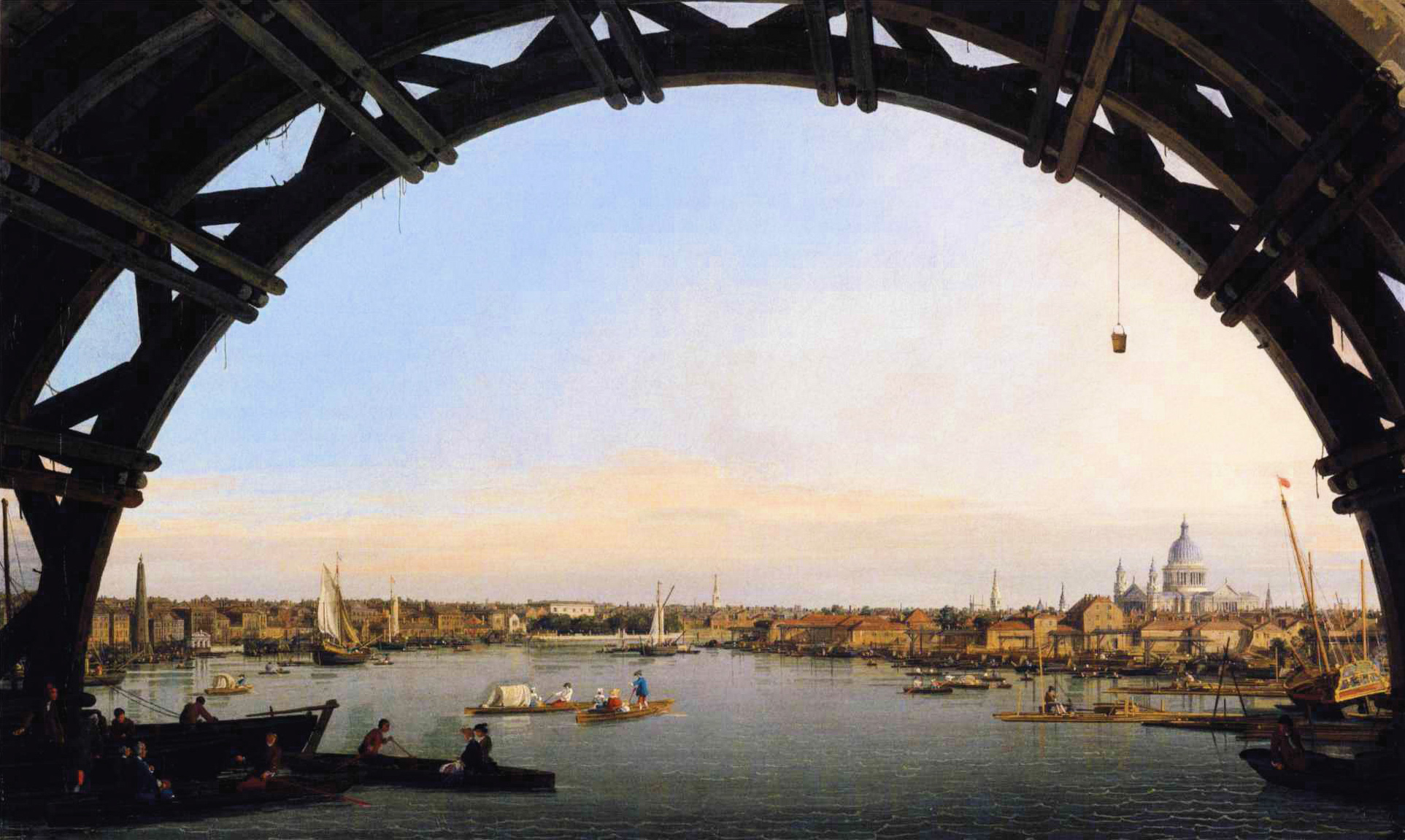
Westminster Bridge
The bridge is painted green, the same shade as the leather benches in the House of Commons, and this is not coincidence. Downstream, Lambeth Bridge is painted red, matching the benches of the House of Lords. These are the colours of British democracy, applied in enamel to cast iron, framing the Parliament they serve on either side. Westminster Bridge sits at the intersection of politics and poetry, power and spectacle, connecting the Palace of Westminster on the west bank to County Hall and the London Eye on the east.
Breaking London Bridge's Monopoly
For more than six hundred years, from at least 1129 until 1729, London Bridge was the only crossing of the Thames anywhere near the city. A bridge at Westminster was first proposed in 1664, but the Corporation of London and the Thames watermen fought it bitterly, fearing the loss of revenue from their ferries and tolls. It took seventy years of political wrangling and the precedent of a timber bridge at Putney in 1729 before Westminster Bridge received parliamentary approval in 1736. The Swiss engineer Charles Labelye oversaw construction, and the bridge opened on 18 November 1750. It immediately transformed London's geography, unlocking the development of the West End and South London, and triggering a cascade of new river crossings: Blackfriars in 1769, Kew in 1759, Battersea in 1773, and Richmond in 1777.
Wordsworth's Dawn
On 31 July 1802, William Wordsworth crossed Westminster Bridge at dawn, probably in a coach bound for Dover and then France. The experience moved him to compose one of the most celebrated sonnets in the English language, published in 1807: Earth has not anything to show more fair. Wordsworth described a sleeping city draped in the beauty of the morning, its ships, towers, domes, theatres, and temples lying open unto the fields and to the sky. The poem has become inseparable from the bridge itself. Two centuries later, tourists still pause at the parapet to photograph the view Wordsworth described, though the city no longer sleeps and the air is rarely smokeless.
Iron and Gothic Stone
By the mid-nineteenth century, the original bridge was subsiding badly. The current structure, designed by Thomas Page and opened on 24 May 1862, replaced it with seven cast-iron arches stretching 250 metres across the river. Charles Barry, architect of the Palace of Westminster, contributed the Gothic detailing, ensuring the bridge harmonized with the Parliament building it served. At 26 metres wide, it was built to accommodate not just carriages but the tram line that ran across it from 1906 until 1952, when the last tram made a ceremonial final journey. The bridge carries the coats of arms of Queen Victoria and Prince Albert, as well as that of Lord Palmerston, who was prime minister when the bridge opened. Since the removal of Rennie's London Bridge in 1967, Westminster Bridge has been the oldest road bridge crossing the Thames in central London.
A Bridge in the Headlines
Westminster Bridge has witnessed both celebration and tragedy. It was the finishing point for the early years of the London Marathon. During the 2012 Olympics, marathon runners and triathletes raced past its green ironwork toward the Victoria Memorial. On 22 March 2017, the bridge became the scene of a terrorist attack when a vehicle was driven into pedestrians, killing four people on the bridge before the attacker fatally stabbed a police officer in the Palace of Westminster grounds. More than fifty people were injured. The attack lasted 82 seconds from start to finish. In the aftermath, flowers and tributes were left along the parapets. The bridge endures as it always has, carrying its daily freight of commuters, tourists, and protesters between the seat of power and the people it governs, the Thames flowing indifferently beneath.
From the Air
Located at 51.5008N, 0.1219W, crossing the Thames between the Palace of Westminster and County Hall/London Eye. The bridge's green colour and seven arches are visible from low altitude. Nearest airports: London Heathrow (EGLL) 14 nm west, London City (EGLC) 6 nm east. Best viewed at 1,000-2,000 ft AGL. The bridge is immediately adjacent to the Elizabeth Tower (Big Ben).