Westminster Cathedral
Walk inside Westminster Cathedral and look up. The upper walls and domes are bare brick, undecorated, rough as a warehouse. Look down, and the lower walls blaze with over one hundred varieties of marble from quarries across the world. This split personality is deliberate. When John Francis Bentley designed the cathedral in the 1890s, he envisioned the entire interior sheathed in marble and mosaic, but the work has never been completed. The result, more than 120 years later, is one of the most striking church interiors in Europe: a building caught permanently between ambition and restraint, its raw brickwork a kind of architectural silence waiting to be filled.
Why Byzantine in Victorian London?
Cardinal Herbert Vaughan, the third Archbishop of Westminster, purchased the site in 1885 and wanted a church that could be built quickly and would not compete visually with the Gothic Westminster Abbey just down the road. Bentley's solution was brilliant: a neo-Byzantine design inspired by ninth-century Christian churches, constructed almost entirely of brick without steel reinforcements. Byzantine architecture allowed for wide open interiors supported by massive piers rather than the slender columns and flying buttresses of Gothic. It could be built faster because the structural brick did not require the elaborate stone carving of a Gothic cathedral. The foundation stone was laid in 1895, and the structural shell was complete by 1903, an astonishing pace for so large a building. Sir John Betjeman called it a masterpiece in striped brick and stone that shows the good craftsman has no need of steel or concrete.
A Hundred Marbles from Twelve Countries
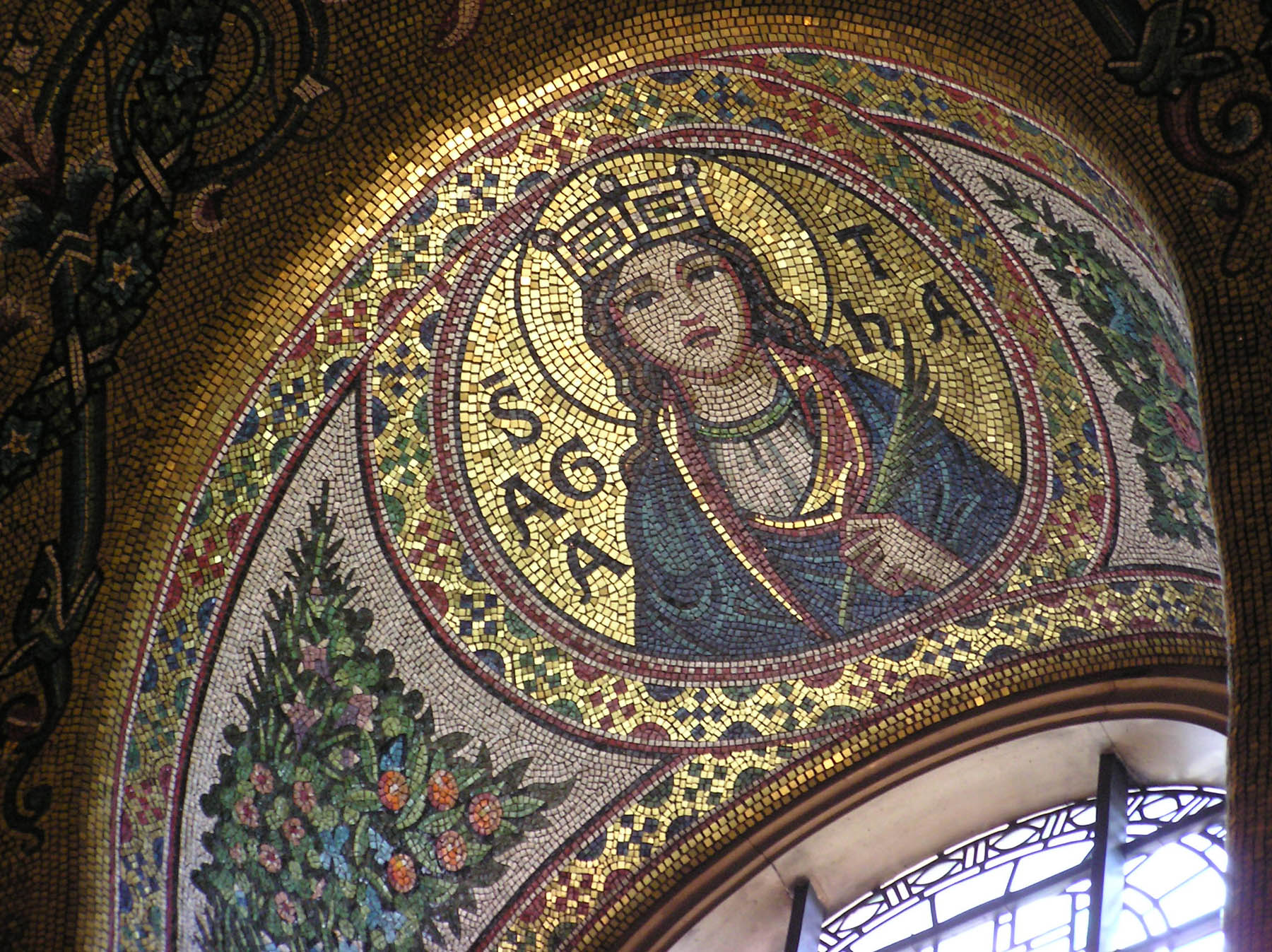
The cathedral's interior decoration has proceeded piecemeal over more than a century, funded by individual donors rather than any coordinated programme. The Chapel of the Holy Souls, completed in 1904, was the first to receive its full mosaic treatment. The Lady Chapel followed, then the Chapel of the Blessed Sacrament, each decorated by different artists in styles ranging from Arts and Crafts to modernist. The marble lining the lower walls represents over a hundred varieties sourced from quarries in Italy, Greece, Norway, Ireland, and beyond. The verde antico columns flanking the nave came from the same quarries in Thessaly that supplied ancient Roman builders. Eric Gill carved the fourteen Stations of the Cross between 1914 and 1918, a commission that launched his career as one of Britain's most important sculptors.
A Bell Tower Over Victoria
The campanile, rising 284 feet above the streets of Victoria, is the tallest church tower in London and offers views as far as the North Downs on clear days. An elevator takes visitors to a viewing gallery near the summit. The tower's exterior is banded in alternating courses of red brick and Portland stone, giving the cathedral its distinctive striped appearance. Below, the cathedral houses relics including a reputed portion of the True Cross and the body of St John Southworth, a Catholic priest executed during the English Civil War whose remains were rediscovered in Douai, France, in 1927. The cathedral has received two papal visits: Pope John Paul II in 1982 and Pope Benedict XVI in 2010.
Unfinished by Design
The bare brick of the upper walls is sometimes described as a failing, but many regard it as the cathedral's most powerful feature. The darkness of the undecorated domes creates a sense of immensity, a void that the mosaics below cannot quite fill. The nave, at 60 feet wide, is the widest in England. The hanging crucifix above the sanctuary, suspended from the gallery arch, dominates the space with a Christ figure by Christian Symons. Because the building was designed to receive its decoration over generations, Westminster Cathedral is a living project, still evolving, still being made. The contrast between the richly decorated lower levels and the austere brick above turns every visit into an encounter with incompleteness, a reminder that even the most ambitious human undertakings are works in progress.
From the Air
Located at 51.4960N, 0.1395W in Victoria, London. The cathedral's distinctive striped brick campanile is the tallest church tower in London, visible from considerable distance. Nearest airports: London Heathrow (EGLL) 13 nm west, London City (EGLC) 7 nm east. Best viewed at 1,500-2,500 ft AGL. The cathedral sits one block south of Victoria Station.