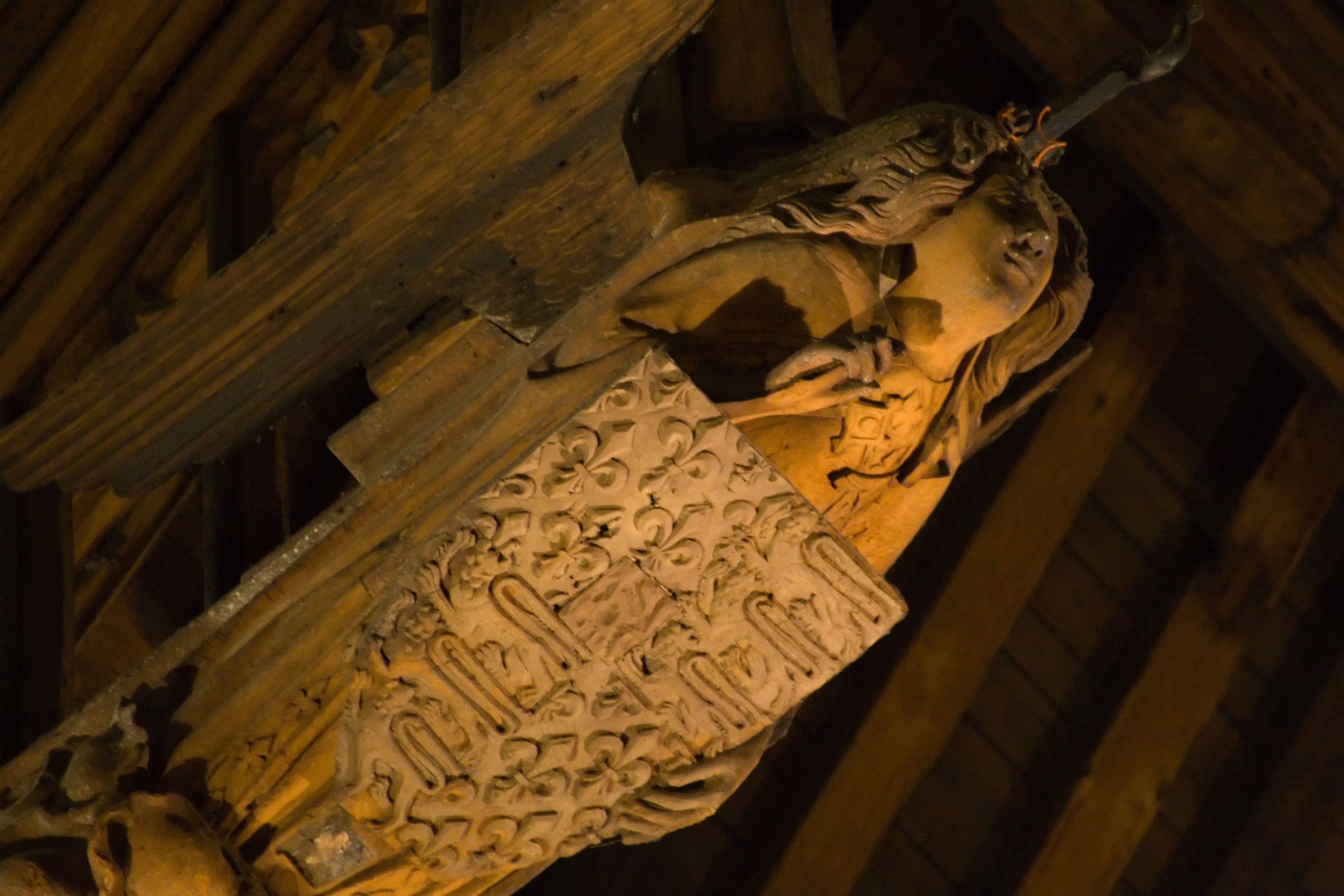
Westminster Hall
Architectural historian John Harvey called the roof of Westminster Hall the single greatest work of art of the whole of the European Middle Ages. It is not difficult to see why. The hammerbeam roof spans 68 feet without a single supporting column, arching over a floor area of 1,547 square metres in a feat of medieval engineering that has defied gravity and deathwatch beetle for more than six centuries. Beneath it, Thomas More heard his death sentence. Charles I stood trial for treason. Guy Fawkes was condemned for trying to blow up the building next door. The hall has witnessed more concentrated history than almost any other room on Earth.
A Hall Fit for a Conqueror's Son
William Rufus, son of William the Conqueror, laid the foundations in 1097 and completed the building by 1099. At the time, it was the largest hall in England and possibly in Europe. Rufus held his Whitsun feast here on its completion, and the hall quickly became the setting for coronation banquets, royal councils, and displays of monarchical power. Henry III provided feasts for the poor here, the only English king to have done so. By the thirteenth century, Magna Carta had designated Westminster Hall as the fixed location for the hearing of common pleas, and the Courts of King's Bench, Chancery, and Common Pleas sat in different corners of the same vast room. Merchants set up booths and stalls alongside the judges, selling books and clothing. Samuel Pepys described shopping here in his diary of the 1660s.
Richard's Roof and the White Hart
In 1393, Richard II commissioned a new roof and a comprehensive remodelling. The royal carpenter Hugh Herland and master mason Henry Yevele carried out the work. Oak timbers were cut from royal forests in Hampshire, Surrey, and Hertfordshire and transported to Westminster by teams of horses, the final leg of the journey by water. Herland's hammerbeam design eliminated the need for supporting pillars, creating a single unobstructed interior space of breathtaking scale. The hammer beams are decorated with twenty-six carved angels. Richard's favourite heraldic badge, the white hart chained and at rest, is repeated eighty-three times throughout the hall, no two carvings exactly alike. The work was incomplete when Richard was deposed in the very hall he had beautified; Henry IV, crowned in the same space, finished what his predecessor had started.
Trials, Fire, and the Blitz
The roll call of those tried in Westminster Hall reads like a syllabus of English history. William Wallace in 1305. Thomas More and John Fisher in 1535. Guy Fawkes in 1606. The Earl of Strafford in 1641. King Charles I in 1649, tried for treason against his own people in a proceeding that had no legal precedent. The impeachment of Warren Hastings dragged on from 1788 to 1795. On 16 October 1834, when the great fire destroyed most of the Palace of Westminster, firefighter James Braidwood concentrated his efforts on saving the hall. Its thick stone walls and massive roof survived. During the Blitz, on the night of 10 May 1941, incendiary bombs hit both the hall and the House of Commons. Scottish politician Walter Elliot directed firefighters to prioritize the medieval hall and smashed through a door with an axe to get hoses inside. The Commons chamber burned. The hall survived.
Ceremonies and the Living Hall
Since the twentieth century, Westminster Hall has served as the setting for lyings in state, the most solemn of British public rituals. When Queen Elizabeth II lay in state in September 2022, the queue of mourners stretched for miles along the Thames, and the foot traffic wore visible grooves into the ancient stone floor. The hall has also hosted joint addresses to both Houses of Parliament by foreign leaders, a privilege extended since the Second World War to only a handful of figures: Charles de Gaulle, Nelson Mandela, Pope Benedict XVI, Barack Obama, Aung San Suu Kyi, and Volodymyr Zelenskyy. In 2016, the glass artwork New Dawn by Mary Branson was installed in the hall, its illumination calibrated to change with the tidal level of the Thames. The work celebrates women's suffrage, adding one more layer to a room that has accumulated nearly a millennium of ceremony, justice, and crisis beneath Hugh Herland's extraordinary roof.
From the Air
Located at 51.4999N, 0.1254W within the Palace of Westminster complex, London. The hall's distinctive medieval roof is partially visible from the air between the Gothic additions of Barry's palace. Nearest airports: London Heathrow (EGLL) 14 nm west, London City (EGLC) 6 nm east. Best viewed at 1,500-2,500 ft AGL. The hall forms the northern portion of the palace complex.