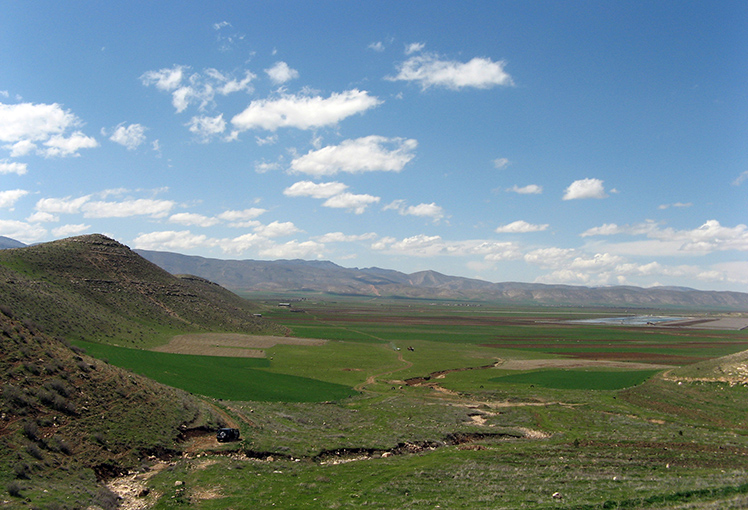
Wezmeh Cave
One tooth changed what we know about Neanderthals in Iran. Discovered in a cave near Islamabad Gharb in western Iran, the tiny premolar belonged to a child between six and ten years old. Analysis of its internal structure -- the enamel thickness, the shape of the enamel-dentine junction -- aligned it not with modern humans but with Neanderthals. Dated to at least 25,000 years ago and likely much older, the tooth known as Wezmeh 1 became the first direct physical evidence that Neanderthals inhabited the Iranian Zagros Mountains. The child who lost it never knew it would rewrite a chapter of human prehistory.
A Carnivore's Larder
Wezmeh Cave was not a home. It was a death trap. The fossil record spanning 70,000 to 11,000 years ago reveals a cave dominated by predators: cave hyenas, brown bears, wolves, lions, and leopards. Foxes, wildcats, badgers, and mongooses prowled the smaller recesses. The herbivores found in the deposits -- wild horses, rhinoceroses, aurochs, red deer, wild goats, and gazelles -- were dragged there as prey. The cave functioned as a carnivore den, a place where predators brought their kills to eat in safety. The Neanderthal child whose tooth survived in these deposits was almost certainly a victim as well -- killed by a predator or scavenged after death and carried into the darkness.
The Zagros Neanderthal
Before Wezmeh, Neanderthal presence in the Zagros was inferred from stone tools, not bones. Mousterian artifacts -- the distinctive flaked tools associated with Neanderthal technology -- turned up across western Iran, but the toolmakers themselves remained invisible. Paleoanthropologist Clément Zanolli and an international team — including Erik Trinkaus — studied the Wezmeh 1 premolar using non-destructive imaging techniques. Initial gamma spectrometry dating placed the tooth at around 25,000 years ago, but further analysis showed this was a minimum age; the tooth is substantially older. Its crown tissue proportions and geometric morphometric features placed it firmly within Neanderthal variation, distinct from both ancient and modern Homo sapiens. The Iranian Zagros joined the map of confirmed Neanderthal territory.
A Neolithic Stranger
The cave yielded a second human surprise from a much later period. A metatarsal bone fragment dated to roughly 9,000 years ago -- the Neolithic -- contained extractable DNA. The genetic analysis revealed something unexpected: this individual belonged to a distinct genetic lineage previously unknown to science. He carried Y-DNA haplogroup G2b, specifically the branch G-Y37100, and mitochondrial haplogroup J1d6. His physical characteristics, reconstructed from his genome, included brown eyes, dark skin, and black hair. Isotopic analysis of his bones showed that his diet included cereals, evidence that he had adopted agriculture. In one bone fragment, scientists found both a new branch of the human family tree and proof of the Neolithic revolution reaching the Zagros.
Seventy Thousand Years of Visitors
The cave tells a story measured in tens of thousands of years. During the late Pleistocene, it served as a den for a bestiary that reads like an inventory of the Ice Age Zagros: narrow-nosed rhinoceroses, now extinct, alongside spur-thighed tortoises and blunt-nosed vipers. Neanderthals and predators competed for the same landscape. By the Neolithic, the large predators were gone and humans used the cave differently. Later still, Chalcolithic herders penned their livestock inside it. The cave's function shifted with each era -- predator refuge, human grave, animal pen -- but its position at the edge of the Islamabad Gharb plain, where the Zagros foothills begin their climb, made it a recurring landmark across deep time.
Discovery and Recognition
The site was unknown to archaeology until 1999. Iranian archaeologist Kamyar Abdi led the first excavations in 2001, uncovering the extraordinary density of animal fossils and the human remains that would prove so significant. Marjan Mashkour and colleagues at the Natural History Museum in Paris studied the faunal collections, establishing the cave's role as a carnivore den. Fereidoun Biglari returned to re-excavate the site in 2019, adding new data to the record. In 2006, the Iranian government listed Wezmeh on its National Register of Historic Sites. The cave has gone from unknown to indispensable in barely two decades, a keystone site for understanding both Neanderthal range and early human genetics in the Near East.
From the Air
Located at 34.06N, 46.65E near Islamabad Gharb (Eslamabad-e Gharb), western Iran. The cave sits in the Qaziwand Mountains at the edge of the Islamabad Gharb plain, in the foothills of the Zagros range. Nearest airport is Kermanshah (OICC), approximately 80 km to the northwest. Terrain is rolling foothills transitioning to rugged mountains. Best viewed at 4,000-7,000 feet AGL. The plain below is agricultural and easily identifiable from the air.