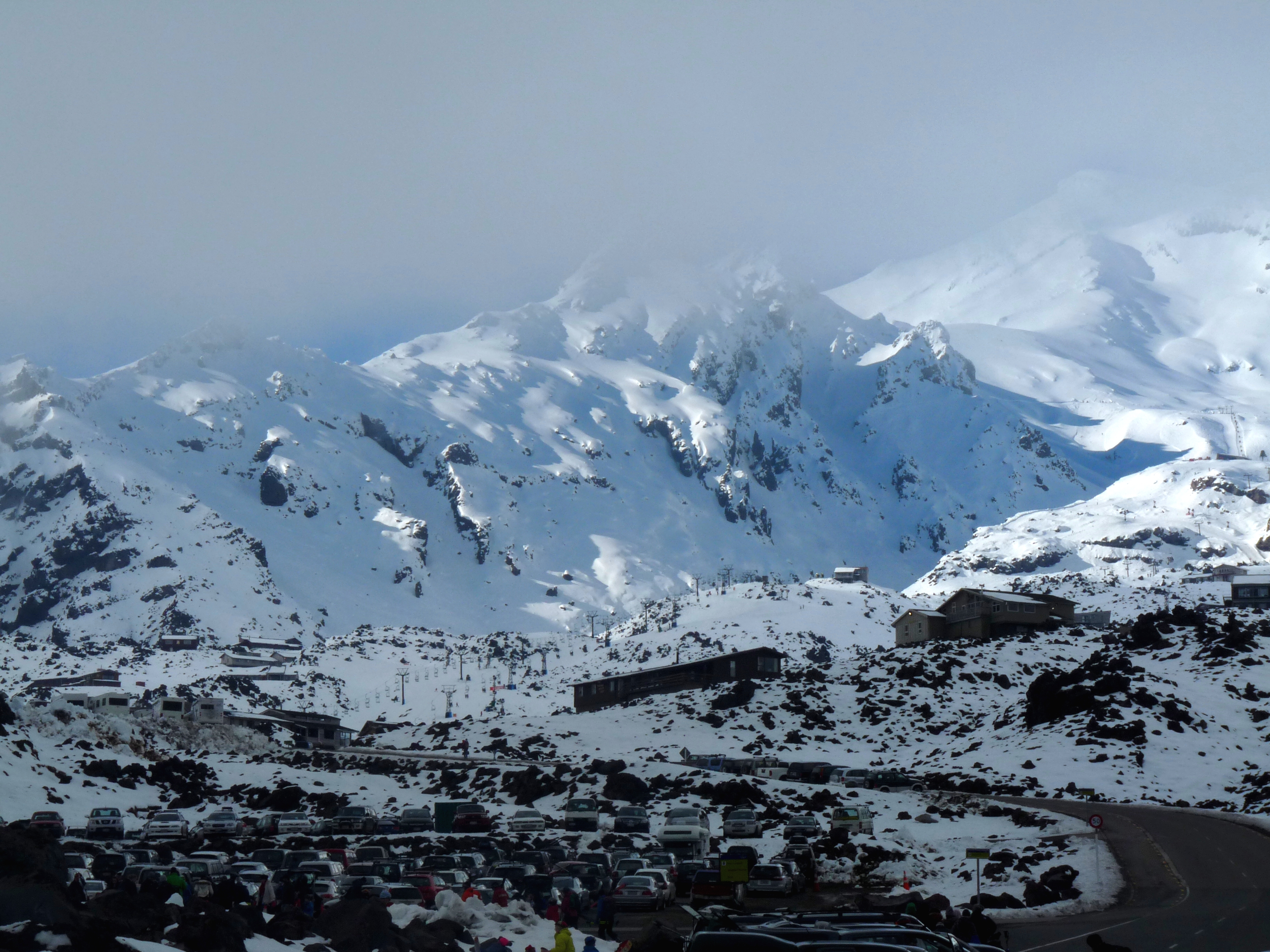
Whakapapa Skifield
On August 1, 1954, Sir Edmund Hillary stood at the base of a single-seat chairlift on Mount Ruapehu and officially declared it open. It was the first chairlift in New Zealand, built by the Swiss firm GMD Muller, powered by a diesel-electric drive, and capable of hauling 350 skiers an hour up to Hut Flat. Hillary had summited Everest just fifteen months earlier. That he chose to lend his name to this moment says something about what Whakapapa meant to New Zealanders: it was where the country learned to ski. Seven decades later, the skifield is still operating on the northern slopes of an active volcano inside Tongariro National Park, still at the mercy of weather that can change in minutes, and still the place where New Zealand's alpine identity was forged.
Pioneers on a Volcano
Skiing on Ruapehu began in 1913 when Bill Mead and Bernard Drake bought a pair of skis from Europe and started making turns on the mountain's slopes. They formed the Ruapehu Ski Club, and by 1923 a small corrugated iron shack served as the first hut on the skifield. It still stands. Between 1924 and 1928, prisoners from the Waikune prison built the access roads, completing State Highway 48 and Bruce Road. Progress was slow through the Depression and World War II, but small rope tows appeared in the late 1930s, the first installed at Scoria Flat in 1938. By 1951, skiing had become popular enough for Walter Haensli to secure a licence to operate a lift. In 1953, Ruapehu Alpine Lifts was formed and purchased his licence, setting the stage for Hillary's chairlift and everything that followed.
The Mountain Fights Back
Whakapapa's defining characteristic is that its mountain is alive. In 1995, the crater lake at Ruapehu's summit erupted, hurling rocks, ash, and steam into the sky and forcing a full evacuation of the skifield. The eruption was small by geological standards, but it served as a reminder that skiers share Ruapehu with forces far older and more powerful than any chairlift. Weather, too, is a constant adversary. In July 2003, a sudden snowstorm trapped 350 skiers and 70 staff overnight at Top o' the Bruce when conditions deteriorated so quickly that the access road became impassable within minutes. Everyone descended safely the next morning. A similar incident in July 2008 stranded over 100 cars. The maritime climate generates extreme rime ice buildup; the No.2 Chairlift, opened in May 1956, was destroyed by an ice storm just one week later.
From Rope Tows to the Sky Waka
The infrastructure on Whakapapa tells the story of New Zealand skiing's evolution. Rope tows gave way to T-bars and poma lifts in the 1970s. Double chairlifts arrived in the early 1980s, and in 1987 the Waterfall Express became the country's first high-speed detachable quad, installed by Doppelmayr. Snowmaking came to Happy Valley in 1990 and expanded to the Rockgarden by 2002. The most dramatic addition arrived in 2019: the Sky Waka, a NZ$15 million gondola funded by the Provincial Growth Fund, carrying over 3,000 people per hour from the base area at 1,630 metres to the Knoll Ridge Cafe at 2,020 metres. The Waterfall Express, which had logged more than 100,000 hours of operation over its 32-year lifespan, was removed to make way. Each upgrade has been a gamble on the mountain's future, a bet that snow and visitors will keep coming.
A Community's Fight to Survive
That bet nearly failed. In 2022, following a dismal snow season widely attributed to climate change, Ruapehu Alpine Lifts entered voluntary administration. The not-for-profit company, founded by ski club members in 1953, had accumulated over NZ$30 million in debt, worsened by the COVID-19 pandemic. Efforts to secure investment or government bailout initially stalled. In March 2024, the government provided a final NZ$7 million to keep the 2024 ski season running at Whakapapa, along with NZ$3.05 million for the sale of the adjacent Turoa skifield. By April 2025, a Department of Conservation concession was finalized allowing new owners Whakapapa Holdings to operate for ten years. The 47 ski clubs that line the road between Top of the Bruce and Hut Flat, some over 50 years old, had watched anxiously. Their lodges are the social backbone of the skifield, a community of bunkrooms, custodians, and shared meals that gives Whakapapa a character no corporate resort can replicate.
Beyond the Snow Line
Whakapapa is not only a winter destination. In summer, guided walks lead visitors to the volcanic crater lake at Ruapehu's summit, a six-hour trek from the chairlift station at 2,020 metres. The Chateau Tongariro, a grand hotel that has appeared on several New Zealand stamps, anchors Whakapapa Village below. Happy Valley, considered one of the country's best beginner areas, offers a dedicated snow tubing zone and access via two glass-enclosed 26-person elevators that descend 22 metres into a canyon. The terrain splits evenly: 25 percent beginner, 50 percent intermediate, 25 percent advanced. Iwikau, the base area at 1,630 metres, averages 3,733 millimetres of precipitation annually and holds a sub-polar oceanic climate classification. It is a place where the weather, the mountain, and the volcanic substrate beneath it are always making their presence felt.
From the Air
Whakapapa skifield sits at 39.24S, 175.56E on the northern slopes of Mount Ruapehu (2,797 m), inside Tongariro National Park. From the air, the skifield is visible as cleared slopes and lift infrastructure on Ruapehu's northern face, with the iconic cone of Mount Ngauruhoe nearby. Chateau Tongariro is visible at the base. Nearest airports: Taupo Airport (NZAP, ~50 km northeast) and Whanganui Airport (NZWU, ~90 km southwest). Recommended viewing altitude: 8,000-12,000 ft AGL for the full Tongariro volcanic massif context; 4,000-6,000 ft for skifield detail.