Wheeler Army Airfield
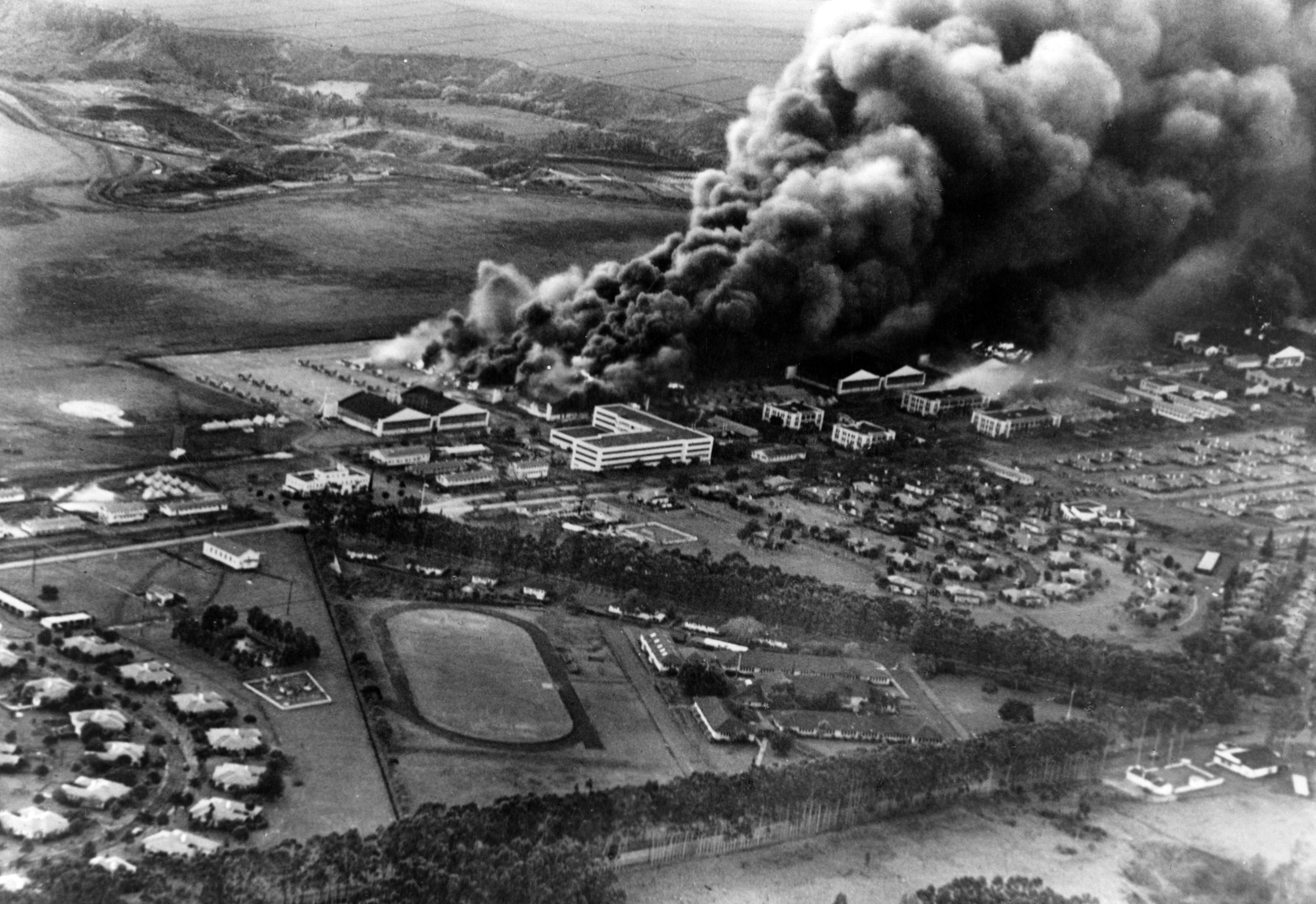
Amelia Earhart landed here twice -- once in 1935 in her Lockheed Vega, again in 1937 in the Electra that would carry her into the Pacific and out of history. Wheeler Field hosted the first transpacific flight from California in 1927, the Dole Air Race, and Charles Kingsford Smith's Southern Cross on its way to Australia. Then, on the morning of December 7, 1941, Japanese aircraft hit Wheeler before they hit Pearl Harbor, destroying or damaging most of the fighter planes that might have mounted a defense. The airfield that had been a stage for aviation's golden age became, in a single morning, a symbol of the cost of being caught unprepared.
Canvas Hangars and Guava Trees
Wheeler Field began on February 6, 1922, when twenty enlisted men from Luke Field on Ford Island arrived at Schofield Barracks to clear a patch of ground that had served as the 17th Cavalry Regiment's drill field. They pulled out weeds, guava, and algaroba trees, and erected two canvas hangars. The field was named on November 11, 1922, for Major Sheldon H. Wheeler, the former commander of Luke Field, who had been killed in a DH-4B crash on July 13, 1921. Permanent construction did not begin until 1930, though by then pursuit squadrons were already operating from the site. The 18th Pursuit Group, the 15th Pursuit Group, and the 14th Pursuit Wing all called Wheeler home. Bellows Field opened as a gunnery camp for tactical units based here. By 1940, the base had evolved into the Army Air Corps' primary fighter station in Hawaii, responsible for air defense of the entire island chain with P-40 Warhawks.
Seven Minutes Before Pearl Harbor
Wheeler was the first target on December 7, 1941. Japanese aircraft attacked the fighter base to neutralize the planes that could have opposed the main strike on Pearl Harbor. The results were devastating: 33 killed, 75 wounded, 76 aircraft destroyed outright, and many more damaged. Of the 146 planes in commission before the attack, only 83 remained operational afterward, including just 27 P-40s. The Hawaiian Air Force -- later redesignated the Seventh Air Force -- spent the rest of the war rebuilding from the wreckage. Wheeler served as a staging base throughout the Pacific campaign, cycling through fighter groups, bombardment squadrons, and troop carrier units in a rotation that reflected the shifting demands of the war. The base's designation changed with the military itself: Army Air Base, then Air Force Base after 1947, then a period of caretaker status before the Korean War brought it back to full operations in 1952.
Garden City in Uniform
What makes Wheeler physically distinctive has nothing to do with runways. The residential areas were designed according to the Garden City principles of Sir Ebenezer Howard, the English planner who conceived neighborhoods as antidotes to the industrial company towns that had blighted Victorian Britain. Streets curve in loops around generous green spaces meant to be shared by residents. The houses themselves are built in the Spanish Colonial Revival style popular in the 1920s and 1930s -- stucco walls, tile roofs, arched windows. In August 1987, the Secretary of the Interior designated Wheeler Air Force Base a National Historic Landmark, recognizing both its World War II significance and the architectural integrity of its Garden City plan. Walking through these neighborhoods today, you could almost forget you are on a military installation, until a Black Hawk helicopter passes overhead from the adjacent aviation brigade.
An Airfield That Changed Hands
On November 1, 1991, the Army held a quiet ceremony and changed the sign at the main gate from Wheeler Air Force Base to Wheeler Army Airfield. The transfer from Air Force to Army control ended decades of split identity, though the paperwork took until 1993 to finalize when the Air Force exchanged Wheeler's real property records for Fort Kamehameha Military Reservation. Today, Wheeler's 1,389 acres host the 25th Infantry Division's Combat Aviation Brigade, flying UH-60 Black Hawks, CH-47 Chinooks, and AH-64 Apaches. The Hawaii Air National Guard's 169th Aircraft Control and Warning Squadron and the Hawaii Army National Guard's 193rd Aviation Regiment also operate from the field. Schools on the base -- Major Sheldon Wheeler Elementary and Major Sheldon Wheeler Middle -- carry the name of the pilot whose 1921 crash gave this place its identity, a reminder that the history here started with loss.
From the Air
Located at 21.48N, 158.04W on central Oahu's plateau, directly adjacent to Schofield Barracks. Wheeler Army Airfield (PHHI) is an active military airfield with helicopter and fixed-wing operations. The distinctive Garden City layout of curved residential streets and green spaces is visible from altitude. Nearest major airport is Daniel K. Inouye International Airport (PHNL), approximately 15 nautical miles to the southeast. Caution: active military airspace. Best viewed at 3,000-5,000 feet AGL from a safe distance.