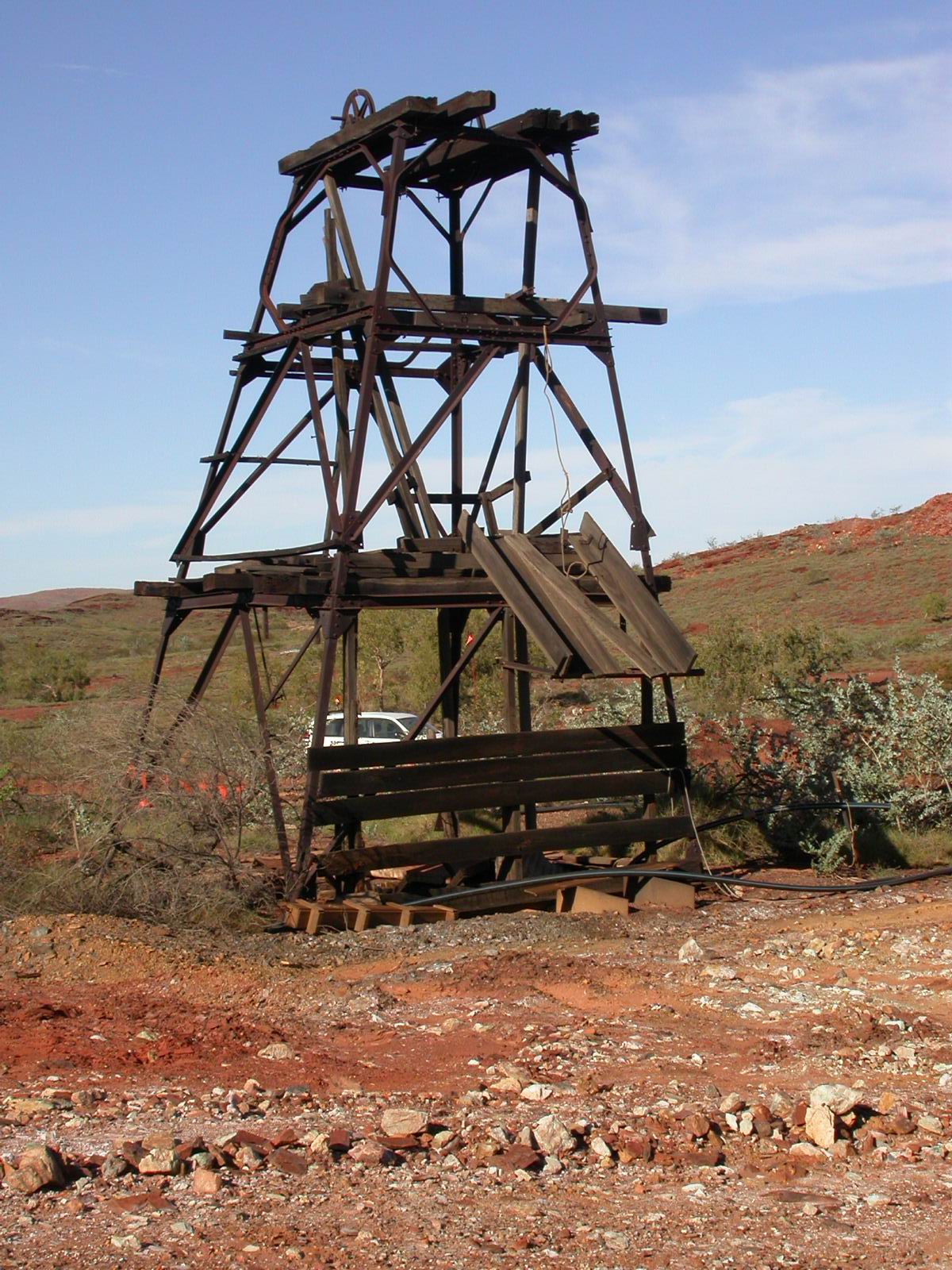
Whim Creek Copper Mine
Two large diesel engines from World War One submarines sit at the Whim Creek copper mine site. They were brought here in the 1960s by Japanese interests conducting a resource drilling programme — not the strangest journey an object has taken in the Pilbara, but memorable. The engine blocks are still visible on site. They powered the ore processing equipment for a decade before the operation shut down in the early 1970s. They were left behind, which is fitting for a mine that has been opened, worked, closed, and handed to new owners roughly every generation since copper was first discovered here in 1872.
A Hundred and Twenty Years of Copper
Copper was found near the town of Whim Creek in 1872, gold twenty kilometres north in 1887. By 1882, artisanal miners were already extracting small quantities of malachite, azurite, and chrysocolla — the blue-green copper carbonate minerals that are characteristic of the oxidised ore bodies here. A narrow-gauge railway once ran from Whim Creek to the port town of Balla Balla on the coast. At its peak, the town had two hotels, a blacksmith, a police station, and a horse track. The port served the early operations; the railway served the port. In the early 1900s, a second period of mining produced around 60,000 tonnes of copper concentrate. Then the industry moved on. Then it returned. The pattern repeated.
What Lies Underground
The Whim Creek Group — the geological formation hosting the ore bodies — is approximately 2.9 to 2.8 billion years old, part of the ancient Pilbara Craton. Two volcanogenic massive sulfide deposits are extracted here: Mons Cupri (Latin for 'copper mountain') and Whim Creek itself. The ores were laid down when sulphur-rich mineral fluids exhaled onto the ancient sea floor, depositing sheets of sulfide minerals up to seven metres thick. Over billions of years, weathering transformed those primary sulfides into the copper carbonate minerals — the greens and blues of malachite, azurite, chrysocolla — that characterise the upper oxide zone. Straits Resources Limited surveyed the deposits in the 1990s and upgraded the resource estimate to around 10 million tonnes of ore grading one percent copper. Operations at industrial scale began in 2003.
The Modern Operation
The Straits-era mine was an open-cut heap leach operation — ore blasted and trucked from two pits to a central processing facility, crushed to less than 20 millimetres, stacked six metres high on plastic-lined pads, then irrigated with dilute sulphuric acid. The copper dissolved out, was purified by solvent extraction, and deposited as copper cathode sheets in an electrowinning plant. The product — 99 percent pure copper — went directly to market. Nameplate capacity was 15,000 tonnes of A-grade copper cathode per year; actual production averaged around 12,000 tonnes annually from 2006 to 2007. The ore bodies were projected to be exhausted by 2009, and they were. Straits sold the depleted mine to Venturex Resources in 2010.
The River Problem
In 2019, while the mine sat idle in care and maintenance, small-scale reprocessing of existing stockpiles was underway. Monitoring detected copper levels of 3.5 milligrams per litre in the local drinking water drawn from the Balla Balla River — well above the permitted level of 0.002 milligrams per litre. The Department of Water and Environmental Regulation issued an Environmental Protection Notice. The reprocessing operation ceased in October 2019. The Balla Balla River, which once served the small port town of the same name and carried the ore from the mine to ships, was being contaminated by the legacy of the mine it had originally served. Anglo American provided A$20 million in project funding to Anax Metals in 2021 for renewed development. The mine's future, as ever, is unsettled.
From the Air
The Whim Creek copper mine lies at approximately 20.86°S, 117.84°E in the Pilbara region of Western Australia, inland from the coast between Karratha and Port Hedland. From altitude the open-cut pits are visible as reddish-brown excavations with characteristic heap leach pads nearby. The Balla Balla River winds toward the coast to the north. Nearest airport: Karratha (YPKA), approximately 80 km to the west. The surrounding terrain is flat semi-arid scrubland typical of the Pilbara plateau.