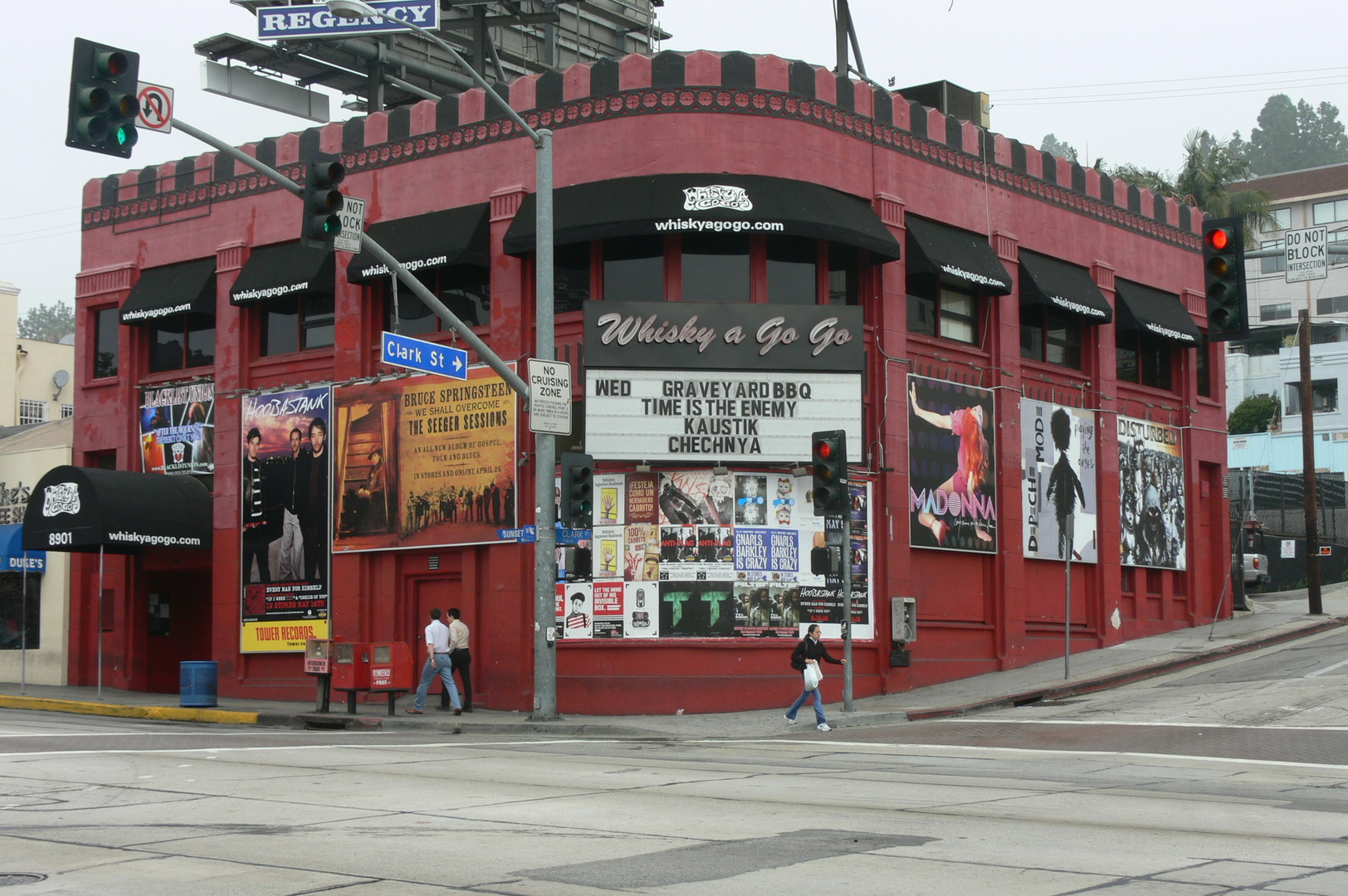
Whisky a Go Go
On January 16, 1964, Elmer Valentine opened a club at 8901 Sunset Boulevard and named it after a Paris venue he had admired. Nobody present that night could have predicted that the Whisky a Go Go would become one of the most consequential rooms in rock and roll history — not because of any single night, but because of what it set in motion across the next half century.
The Invention of Go-Go Dancing
The story of how go-go dancing was born is specific enough to be verifiable. A cigarette girl named Patty Brockhurst was working a shift at the Whisky when the DJ failed to show up. She climbed into the suspended cage above the dance floor to spin records, and she danced while she worked. The crowd responded. The DJ booth-as-performance-space, with a dancer visible to everyone in the room, was something new. It spread from the Whisky across the country, then across the world.
The name itself traveled further than the dancing. Scientists working on a cardiac potassium channel in the 1990s found that flies with mutations in the relevant gene moved erratically, as if dancing. They named it hERG — human ether-a-go-go-related gene — as a quiet tribute to the Whisky and the dancers who inspired it. Rock and roll named a gene.
The Doors, Van Morrison, and Frank Zappa
The Doors became the house band at the Whisky, playing residencies that shaped their sound before they were famous. Jim Morrison's stage presence — the dangerous stillness interrupted by sudden movement — developed in that room, in front of audiences close enough to feel his breath. When the band was finally fired for performing their extended version of 'The End,' complete with its Oedipal narrative, it only added to the legend.
Van Morrison's band Them held a residency in June 1966, and a rotating cast of Los Angeles musicians backed them on various nights — including a young bassist named Jim Morrison, who happened to be in the building. Frank Zappa was signed to a record deal after being discovered at the Whisky, launching the trajectory that would produce some of the most eccentric and brilliant music of the following decade. These were not coincidences. The Whisky created a specific kind of pressure that forced musicians to become themselves.
From Metallica to the Rock and Roll Hall of Fame
In 1982, Metallica was auditioning a new bassist. Cliff Burton came onstage at the Whisky and played a solo that lasted several minutes, during which the rest of the band stood in silence at the side of the stage. Burton was offered the job immediately; he accepted on the condition that Metallica relocate to the San Francisco Bay Area. They agreed. His influence on the band's sound — complex melodic bass lines that functioned almost like a lead instrument — reshaped heavy metal.
By 2006, the club itself had received formal recognition, inducted into the Rock and Roll Hall of Fame. But the honor felt somewhat beside the point. The Whisky had spent four decades being recognized by musicians in the only way that actually matters: they wanted to play there. The stage has hosted the Who, Led Zeppelin, Janis Joplin, Alice Cooper, and enough others to fill a library.
A Room That Keeps Its Character
The Sunset Strip has changed enormously since 1964. Clubs have opened and closed, been demolished for condominiums, or survived as hollow versions of their former selves. The Whisky has remained. It still occupies its original location. It still runs on live music. The capacity is still intimate enough that a band on the stage can make eye contact with almost everyone in the room.
The experience it offers has not fundamentally changed since the night Patty Brockhurst climbed into that cage: loud music, close proximity, the possibility that something extraordinary might happen because the right people are in the same small space. Most nights nothing extraordinary happens. But the structure remains in place for it to happen, and that is what decades of history have actually built.
From the Air
The Whisky a Go Go sits on the Sunset Strip in West Hollywood, just east of the city's western neighborhoods. From the air, the Strip traces a distinctive curve through the foothills below the Santa Monica Mountains. Los Angeles International Airport (KLAX) lies about 12 miles to the southwest. The Pacific Ocean is visible on clear days from moderate altitude, roughly 5 miles due west.