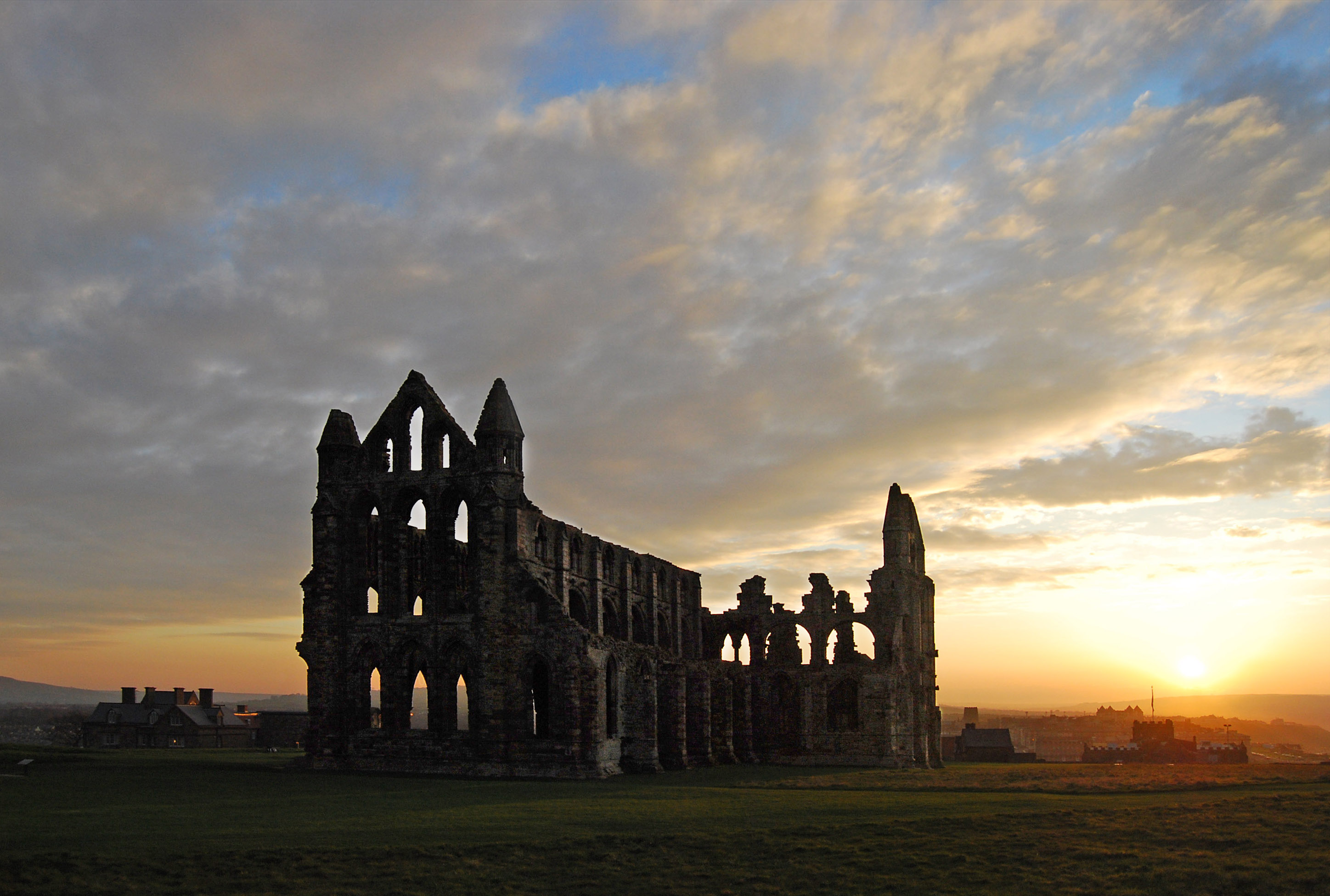
Whitby Abbey
Bram Stoker was walking through the graveyard of St Mary's Church in the summer of 1890 when he looked up and saw it: the skeleton of Whitby Abbey, its Gothic arches open to the sky, silhouetted against the North Sea. In his novel, this is where Dracula arrives in England, bounding up the famous 199 steps in the shape of a great dog. But the abbey's real history is stranger and richer than any vampire tale. For more than thirteen centuries, this headland has drawn monks, kings, poets, and pilgrims to its wind-scoured cliffs.
Hild's House on the Headland
The monastery was founded in AD 657 by King Oswy of Northumbria, who named it Streoneshalh. He appointed Lady Hilda, grand-niece of the first Christian king of Northumbria, as founding abbess. This was no ordinary religious house. Hilda ran a double monastery of both monks and nuns, and under her leadership it became one of the great centres of learning in early England. It was here that Caedmon, an illiterate cowherd, received the miraculous gift of song and composed the earliest known poem in Old English. In 664, the abbey hosted the Synod of Whitby, a gathering that would shape the future of the English church. The question was deceptively simple: when should Easter be celebrated? The debate pitted the traditions of the Celtic church against the newer Roman calculation. King Oswy sided with Rome, and the decision rippled outward, binding England's church more closely to the continent.
Destruction and Rebirth
The first monastery did not survive the Viking Age. Between 867 and 870, Danish raiders under Ingwar and Ubba laid Streoneshalh waste, and for more than two hundred years the headland stood empty. When William de Percy refounded the monastery after the Norman Conquest, his monks found the ruins of roughly forty small chapels and cells scattered across the clifftop, remnants of the earlier community. The greater part of Percy's building was itself pulled down and rebuilt on a grander scale in the 1220s. This Benedictine abbey thrived for centuries as a centre of learning until Henry VIII dissolved it in 1539. Sir Richard Cholmley bought the property, and it passed through his family and their descendants, the Stricklands, until the UK government took custody in 1920.
Shelled by Kaiser's Cruisers
Even in ruin, the abbey found new ways to make history. In December 1914, the German battlecruisers Von der Tann and Derfflinger appeared off the coast and opened fire. Their crews were aiming for the Coastguard Station at the end of the headland, but the abbey took considerable damage during the ten-minute bombardment. Scarborough and Hartlepool were struck in the same raid. The attack shocked a British public that had assumed the war would stay on the continent, and the damaged abbey became an unexpected symbol of a conflict that respected no boundaries, not even those of ancient stone.
Dracula's Doorstep
Stoker stayed at a house on the West Cliff during his visits to Whitby, and the town saturated his imagination. The ruined abbey, the graveyard with its weathered headstones, the 199 steps climbing steeply from the harbour to the church above -- all of it entered the novel almost unchanged. In Mina Harker's diary, the abbey is described as seen from across the harbour, its broken arches framing the sky. Today Whitby embraces its Dracula connection with a twice-yearly Goth Weekend that draws thousands of visitors in black Victorian dress. But the abbey itself predates the count by well over a millennium. Its jagged walls have served as a landmark for sailors approaching the harbour for centuries, a purpose far older and more practical than any gothic fiction.
Bones Beneath the Headland
The abbey's graveyard holds the remains of Northumbrian royalty: King Oswiu himself, his wife Eanflaed, and their daughter Aelfflaed, who followed Hilda as abbess. Edwin of Deira, the first Christian king of Northumbria, is also buried here. Among the later burials, William de Percy, the Norman baron who refounded the monastery, lies beneath the headland he helped rebuild, alongside Richard de Percy, a signatory to Magna Carta. Today the ruins are a Grade I listed building in the care of English Heritage. The wind still drives off the North Sea, and the abbey's empty windows still frame the same grey sky that Hilda knew. What remains is not just architecture but a layered record of faith, learning, violence, and reinvention stretching across nearly fourteen hundred years.
From the Air
Whitby Abbey sits at 54.488N, 0.608W on the East Cliff headland overlooking Whitby Harbour and the North Sea. Dramatically visible from the air as a skeletal Gothic ruin atop coastal cliffs. Best viewed at 1,500-3,000 ft AGL. Nearest airfield is Scarborough/Sherburn-in-Elmet. The 199 steps and St Mary's Church are visible just south of the ruins. ICAO: EGCJ (Sherburn-in-Elmet) approximately 50nm southwest.