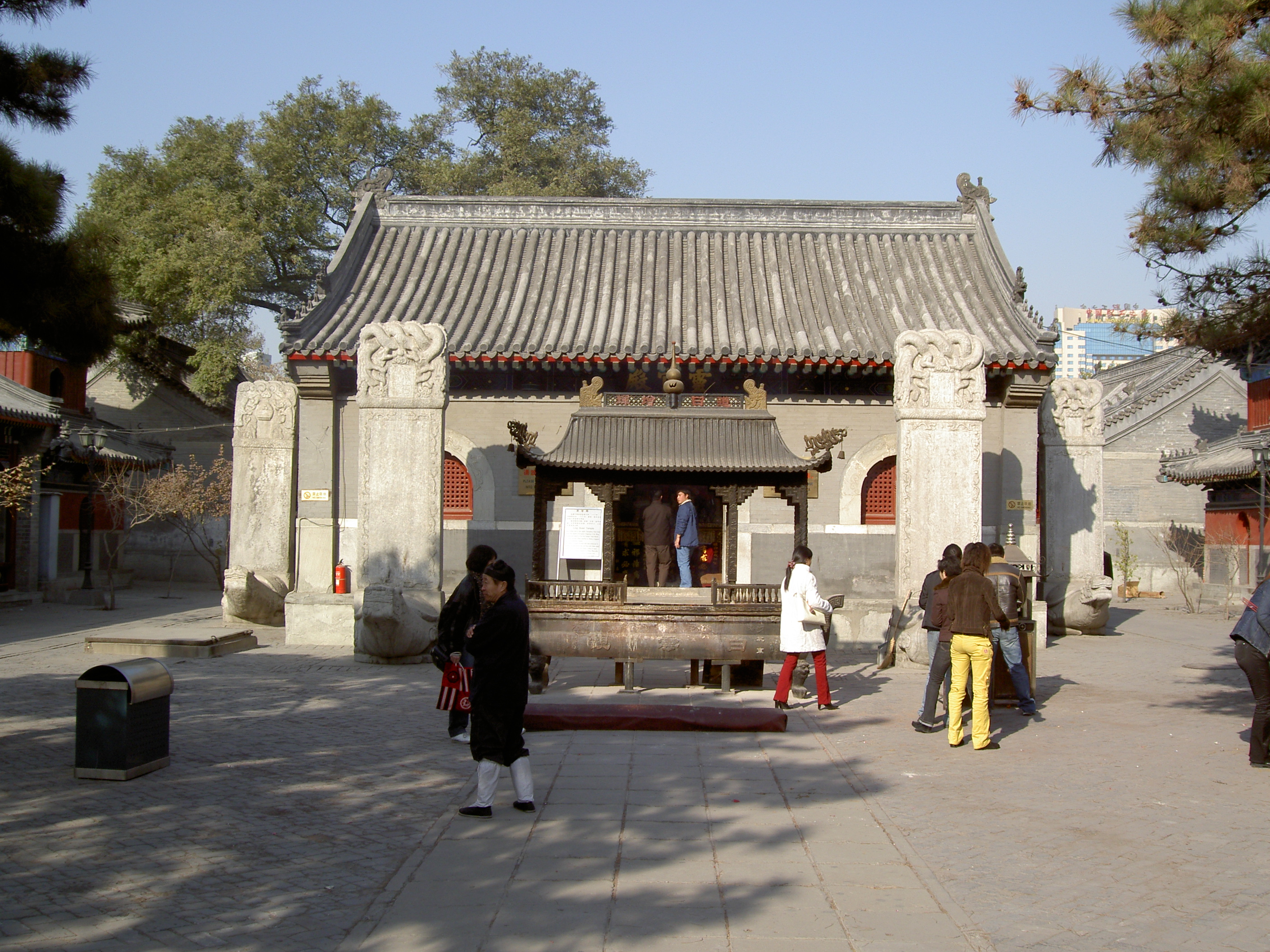
White Cloud Temple
Genghis Khan summoned a Taoist master, and the master walked for three years to answer. In the early 13th century, the Quanzhen patriarch Qiu Chuji trekked from Shandong province to Central Asia to give the great khan an exposition on Taoism, completing his journey in October 1222. When Qiu returned to Beijing, he took over a temple that had been standing since the Tang dynasty and renamed it the Palace of Eternal Spring. His grave, and the shrine built over it, became the White Cloud Temple -- the spiritual headquarters of Quanzhen Taoism and one of Beijing's most continuously sacred sites.
A Temple Older Than Its Name
The site dates to the mid-8th century, when it was founded during the Tang dynasty as the Temple of Heavenly Perpetuity. For its first few centuries it was a state-sponsored institution staffed by elite clergy. When the Jin dynasty controlled Beijing from 1125 to 1215, the temple served as the administrative headquarters for all Taoist affairs in the capital and played a central role in state ceremonies. Then the Mongols arrived. After taking Beijing in 1215, they handed the temple to Qiu Chuji, and it became the nerve center of the Quanzhen movement -- a school of Taoism emphasizing internal alchemy, meditation, and monastic discipline. Qiu's successor, Yin Zhiping, built a memorial shrine over his master's grave, and that shrine gradually absorbed the identity of its parent institution.
Surviving by Adapting
The temple's history reads like a masterclass in institutional survival. When the Mongols damaged it in the late 13th century, the White Cloud Temple outlasted its own parent institution, the Palace of Eternal Spring, which was eventually destroyed during the Ming dynasty. Under the Ming, clergy from the rival Zhengyi school took over operations but kept Quanzhen traditions and ordination ceremonies intact -- a pragmatic compromise that preserved continuity. The Zhengyi held control until the 17th century, when the Quanzhen master Wang Changyue reclaimed the temple. The abbey went without an abbot through the turbulent 1940s and was closed when the communists came to power in 1949. During the Cultural Revolution, while temples across China were being demolished, the White Cloud Temple survived -- damaged but not destroyed.
Five Halls on a Sacred Axis
Like most Chinese temples, the White Cloud Temple is oriented on a north-south axis, with the entrance at the south. Five main halls march along this central line: the Main Gate, Yuhuang Hall dedicated to the Jade Emperor, Laolü Hall built in 1456, Qiuzu Hall honoring the venerable Qiu Chuji, and Sanqing Hall consecrated to the Three Pure Ones -- the highest deities in the Taoist pantheon. The progression from gate to innermost sanctum mirrors the Taoist journey from the mundane world toward spiritual refinement, each hall a step deeper into contemplation.
The Immortal's Birthday
Every year on the 19th day of the first lunar month, the temple holds a festival celebrating Qiu Chuji's birthday. Tradition holds that the master will return to earth as an immortal on this day. The festival draws crowds that fill the courtyards and spill into the surrounding streets, a living demonstration that the temple's spiritual authority has not diminished with the centuries. Today, the White Cloud Temple is again a fully functioning monastery and serves as the seat of the Chinese Taoist Association. It holds the title 'The First Temple under Heaven' -- not because it is the oldest Taoist temple in China, but because of the unbroken chain of spiritual authority that connects its present monks to the patriarch who walked three years to educate an emperor.
From the Air
Located at 39.899N, 116.338E in western Beijing, south of the Second Ring Road. The temple complex is set among dense urban development but its traditional roofline and courtyard layout are distinguishable from altitude. Look for it southwest of the Forbidden City, near the Tianning Temple pagoda. Nearest airports: Beijing Daxing International (ZBAD) to the south, Beijing Capital International (ZBAA) to the northeast. Best viewed at 2,000-4,000 ft AGL.