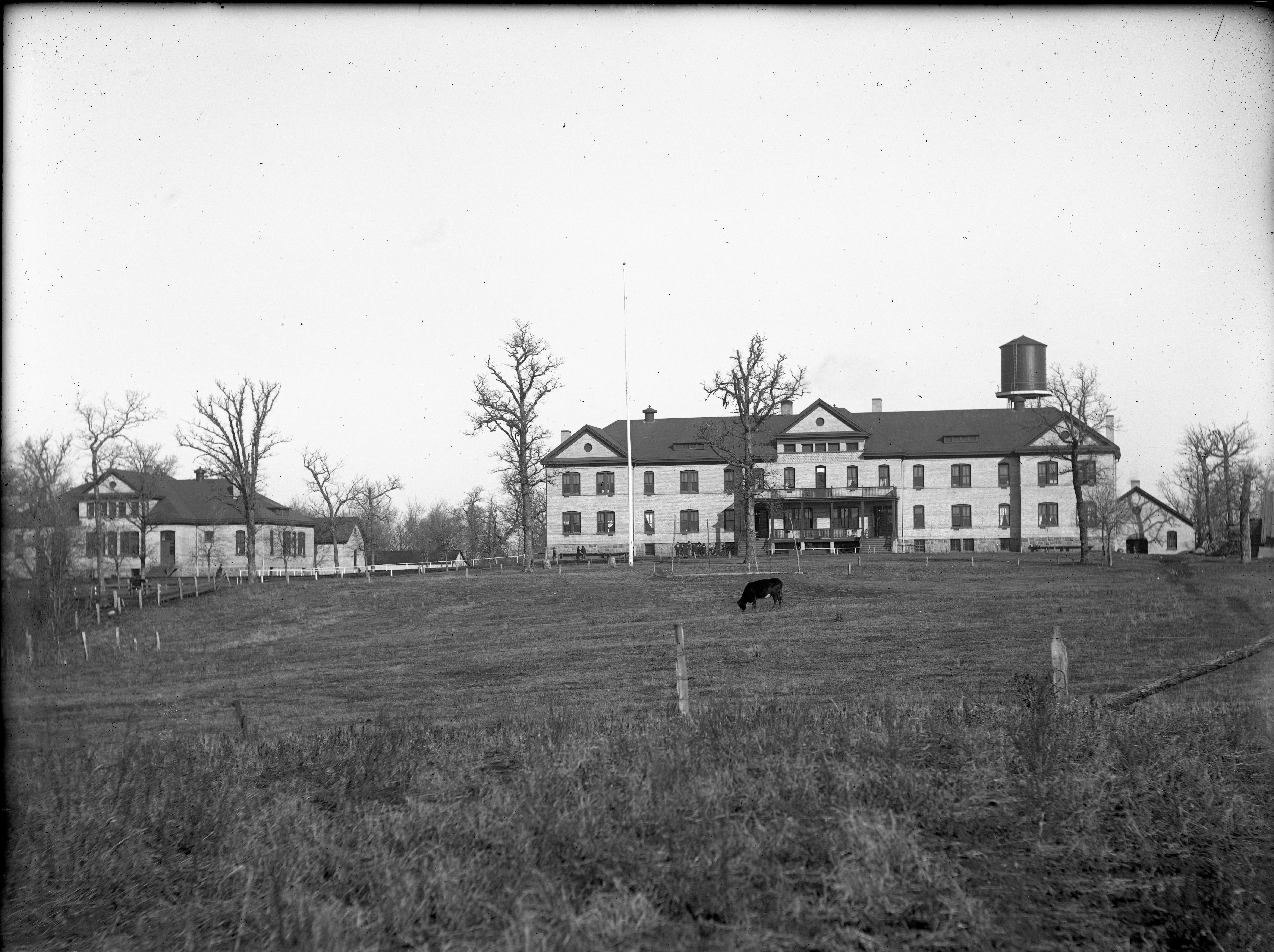
White Earth Indian Reservation
The hymns come in Ojibwe. At White Earth, as at the nearby Leech Lake and Red Lake reservations, the tradition of singing Christian hymns in the Ojibwe language has persisted for generations -- an act of cultural synthesis that captures something essential about this place. White Earth Indian Reservation sprawls across northwestern Minnesota, encompassing all of Mahnomen County and parts of Becker and Clearwater counties, threaded by the Wild Rice and White Earth rivers. At 1,093 square miles, it is Minnesota's largest reservation by land area. The 2020 census counted 9,726 people living here, on land the federal government once tried to use as a dumping ground for every Anishinaabe person in three states. That plan failed. White Earth endured. The hymns continue.
Tricked into Uniform
The Civil War reached White Earth through deceit. In the early 1860s, white citizens of Crow Wing, Minnesota, discovered a loophole in the Enrollment Act: they could avoid the draft by enrolling substitutes to fight in their place. They chose bi-racial Chippewa men from White Earth, deliberately arranging for the substitutes to sign enlistment papers while under the influence of alcohol. Chief Hole in the Day II was furious when he learned what had happened. One of the conscripted men was killed and buried with military honors before G Company of the 9th Minnesota Infantry Regiment even left St. Cloud, where they had been mustered in. The company was posted to Fort Abercrombie in Dakota Territory, arriving on September 3 to find the fort under Sioux attack. They went into action immediately and helped break the assault, then survived the siege that followed. Later sent south, the Chippewa soldiers fought at the Battle of Brice's Crossroads, the Battle of Tupelo, the Battle of Nashville, and the Battle of Fort Blakeley, returning to St. Paul in August 1865 having taken remarkably few casualties.
A Reservation Built for Removal
The United States government had an extraordinary ambition for White Earth: it wanted to relocate every Anishinaabe person from Michigan, Wisconsin, and Minnesota onto this single reservation, opening the vacated lands to white settlement. Officials even proposed moving the Dakota people here, despite the fact that the Anishinaabe and Dakota had been traditional enemies for generations. The relocation policy persisted until 1898. On July 8, 1889, the U.S. broke its treaty agreements, informing the Minnesota Chippewa that only White Earth and Red Lake reservations would remain while the others would be eliminated. The Bureau of Indian Affairs bypassed tribal governance entirely, putting the decision about land allotments under the Dawes Act to a vote of individual adult Chippewa males rather than allowing traditional council deliberation. Chippewa leaders were outraged, especially when they discovered that Dakota men -- not members of their tribe -- were included in the voting.
The Rigged Vote and the Rebellion That Saved Them
The vote was administered by whites with a financial interest in allotment, not by the Chippewa themselves. White Earth and Mille Lacs reservations voted to accept land allotments and allow surplus land to be sold. Leech Lake supposedly voted the same way. But in October 1898, the Battle of Sugar Point on Leech Lake told a different story -- an armed rebellion that made Washington reconsider its approach. The consequences of allotment were devastating. In 1889, the White Earth Reservation had covered its original vast expanse. After the votes were counted, only a small northeast portion remained in tribal hands, a fraction of the original size. Most other Minnesota Chippewa reservations were closed and emptied. But the Leech Lake rebellion saved what remained -- White Earth, Red Lake, and the Chippewa reservations of Wisconsin survived. The Nelson Act of 1889 drew waves of Anishinaabe and Dakota peoples from closed reservations to White Earth. By the 1920 census, the reservation held 4,856 members of the Mississippi Band, 1,218 Pillagers, 472 from the Pembina Band, and 113 Fond du Lac and Lake Superior Chippewa.
The Sons of Hole in the Day
In 1885, Joseph Hole-in-the-Day, youngest son of Chief Hole in the Day II, was sponsored by former Minnesota Governor Alexander Ramsey to become a cadet at West Point. They traveled to Washington, D.C., to meet President Grover Cleveland, making national news. Joseph was considered a strong candidate, but his path took a different turn. He had been working for the U.S. Postal Service -- where no one knew his heritage -- and gave notice that he was leaving to serve as a chief on the White Earth Reservation. The USPS was astonished. Joseph later enlisted in Company I of the 14th Minnesota Infantry Regiment for the Spanish-American War. His older brother Ignatius graduated from St. John's College and traveled Minnesota giving paid lectures on Ojibwa history. Joseph attended the Haskell Institute and the University of Minnesota, and was later employed by the Bureau of Ethnology recording indigenous oral traditions. Two brothers, two paths, both insisting that education and leadership were not contradictions of their Ojibwe identity but extensions of it.
The Land Recovers
Today, White Earth's communities reflect the complexity of its history. Naytahwaush is the largest predominantly Native settlement on the reservation. Mahnomen, the county seat, is predominantly non-Native -- a legacy of the Nelson Act's land sales. The 2020 census recorded a population that is 44.7 percent Native American and 43.2 percent white, with 11.5 percent identifying as two or more races. The reservation sells its own brand of wild rice, a crop with deep cultural significance to the Ojibwe, and operates NIJII Radio. The land itself is still recovering from the damage lumber companies inflicted over a century ago. The reservation is especially scenic in the warmer months, when the rivers run full and the forests that loggers once stripped have grown back thick and green. White Earth's total enrolled membership stands at more than 19,000, most living off-reservation in the Twin Cities and beyond -- but the reservation remains the cultural and spiritual center, the place where the hymns are still sung in Ojibwe.
From the Air
Located at 47.23N, 95.72W in northwestern Minnesota. The White Earth Indian Reservation covers 1,093 square miles encompassing all of Mahnomen County and parts of Becker and Clearwater counties. The Wild Rice and White Earth rivers are visible corridor landmarks. Mahnomen County Airport (3N8) is the nearest local airfield. Bemidji Regional Airport (KBJI) lies approximately 57 miles to the northeast; Hector International Airport (KFAR) in Fargo is roughly 80 miles west. The terrain is gently rolling with forests, lakes, and river valleys -- quite scenic from 3,000-6,000 feet. The reservation boundary encompasses numerous small settlements visible as clearings in the forested landscape. Detroit Lakes lies to the southwest, and the Red Lake Reservation is to the northeast.