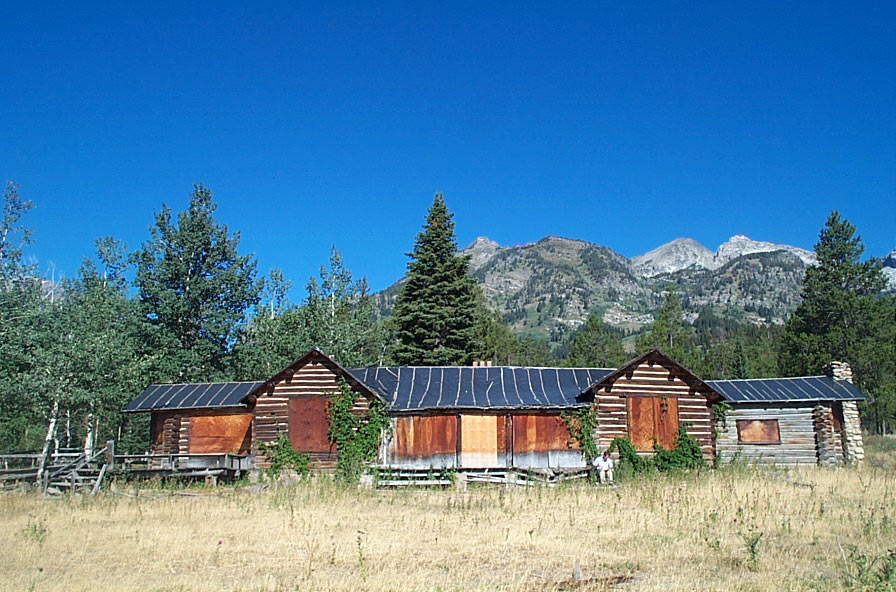
White Grass Dude Ranch
In 1936, when Harold Hammond installed private baths in the cabins at White Grass Dude Ranch, some longtime guests were furious. They had grown accustomed to privies and bath water delivered by roustabouts - that was the authentic Western experience they paid for. This small rebellion captures everything about White Grass: a place where Eastern city dwellers came to play cowboy, where the line between roughing it and comfort shifted constantly, and where one family's determination kept the tradition alive for 72 years beneath the shadow of the Tetons.
Two Homesteads Become One
Harold Hammond arrived in Jackson Hole in 1901, a ten-year-old boy from Blackfoot, Idaho, sent to live with his sister. By 1910 he was working at Jackson Lake Dam for the Bureau of Reclamation, then wrangling horses at the Bar B C - Jackson Hole's pioneering dude ranch. In 1913, Hammond and George Tucker Bispham, a fellow Bar B C hand, combined two adjacent homesteads in the White Grass Valley to create their own spread. For six years they ran cattle. Then, in 1919, they made the calculation that would define the ranch: wealthy Easterners would pay more to pretend to be cowboys than actual ranching would ever bring in. White Grass became one of Jackson Hole's first dude ranch operations, along with the JY and the Bar B C itself.
Fox Pelts and Fickle Fortunes
Running a dude ranch required creativity. In 1925, Hammond set up a fox farm, selling pelts to the very guests who came to experience the "authentic" West. He incorporated the fox operation in 1927. The business seesawed: Hammond and Bispham sold to the Bar B C in 1924, continued to manage the ranch, bought it back in 1928, then Bispham sold his share to Hammond in December of that year. Through it all, Hammond kept expanding - from the original cabins to 18 by 1930. The rustic log buildings, organized around a central road with the dining hall and lodge at the center, developed the consistent character that would later earn them a place on the National Register of Historic Places. Green or red asphalt roll roofing provided the only variation among structures.
Love and Loss in Jackson Hole
Hammond married Marie Adele Ireland of Crystal Run, New York, in 1922, but she died just a few years later. In 1936, he married Marion Galey, a widow who had first visited Jackson Hole in 1919 - that summer she stayed at the Bar B C, then moved to White Grass, where she remained until Christmas. Her son Francis "Frank" Holt Galey Jr. began working at the ranch the year of the marriage. When Harold's health failed and he died in 1939, Marion and Frank took over. World War II brought shortages and hardship. Frank enlisted, leaving the ranch with caretakers. When he returned in 1946, the place had deteriorated badly. With partner Norman Mellor, he rebuilt and expanded to handle 55 guests. By the 1950s, he had bought out both his mother and Mellor.
The Deal That Saved Everything
In 1956, Frank Galey faced a difficult choice. The National Park Service offered $165,000 for the ranch - but with a life estate that allowed him to continue operating it. He took the deal. For nearly three more decades, White Grass continued welcoming dudes beneath the Tetons. Galey closed the fox farm in 1966. When he died in July 1985, White Grass had operated continuously for 72 years - the longest-active dude ranch in Jackson Hole. The cabin Galey had built in the late 1940s burned to the ground shortly after his death, and the Park Service began removing structures not listed in the National Register, returning portions of the land to its "natural state."
Teaching the Old Ways
The story might have ended there, but in 2002 the Park Service saw a different future for White Grass. What better place to teach historic preservation than a collection of authentic rustic log buildings in need of restoration? The National Trust for Historic Preservation and the Park Service signed an agreement in 2003 to create a training program focused on Western rustic architecture. The Western Center for Historic Preservation, established in 2006 and headquartered in nearby Moose, Wyoming, rehabilitated the 13 original log buildings while training staff and volunteers in traditional preservation methods. Since 2016, the restored cabins house trainees and volunteers, while interpretation programs share the stories of the dudes and wranglers who shaped this valley. White Grass lives on - no longer hosting guests playing cowboy, but training the people who will keep Western heritage standing for generations to come.
From the Air
Located at 43.66N, 110.77W in Grand Teton National Park's White Grass Valley, at the southern end of Jackson Hole. The ranch complex sits just west of the southern Teton Range, with the dramatic peaks rising immediately to the west. Look for the cluster of rustic log buildings organized around a central road. The Jackson Hole valley stretches north toward the main Teton peaks. Nearest airports include Jackson Hole Airport (KJAC, 8nm north - one of only two airports located within a national park) and Driggs-Reed Memorial (KDIJ, 25nm west across the Tetons). Best viewed at 2,000-4,000 feet AGL for detail on the historic buildings, or higher for context of the ranch's spectacular setting beneath the Tetons.