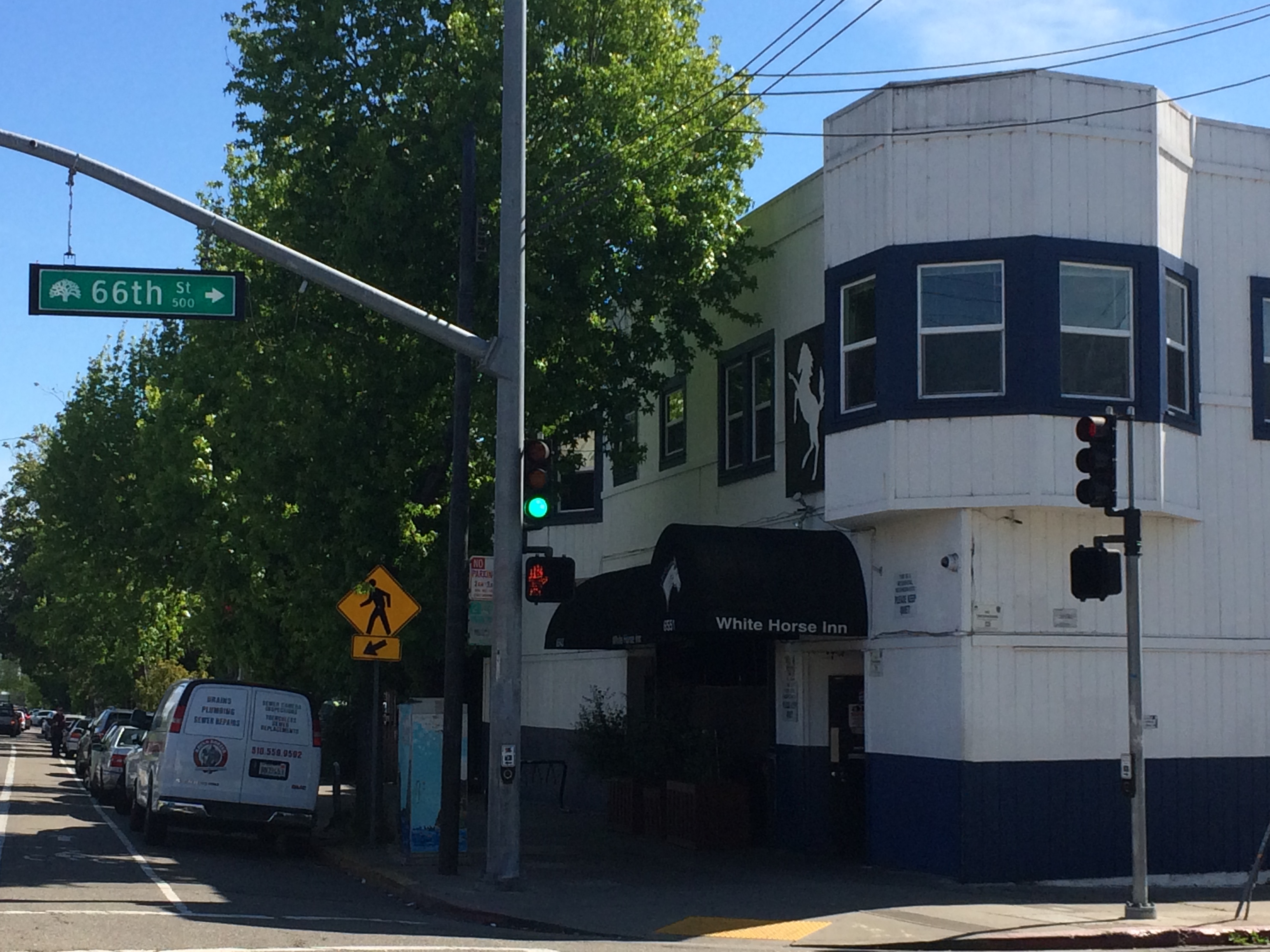
Ninety Years at the White Horse
Abraham C. Karski, the Oakland businessman who built the Grand Lake Theatre, had the building constructed at 6551 Telegraph Avenue in Oakland's Bushrod Park neighborhood. When it opened as a bar in 1933, following the passage of the 21st Amendment, the White Horse Inn was not exactly a gay bar. It was, more precisely, a gay-friendly bar with a no-touching policy and a Chinese restaurant. The distinction mattered. In 1933, there was no such thing as an openly gay bar -- not legally, not safely, not anywhere. What there was, at the White Horse, was a place where people could come as they were, order exotic Chinese dinners and distinctive American cuisine, and exist in relative peace. That cautious beginning has stretched, improbably, across more than nine decades.
Workers, Sailors, Students
The White Horse sat at the convergence of several worlds. Factory workers and longshoremen from Oakland's nearby industrial centers drank alongside soldiers and sailors during the Depression and through World War II. The University of California campus was a short walk away, and students from Berkeley found the bar easily. By 1948, a regular patron recalled, the White Horse had developed a "reputation for being Cal's gay life." The proximity to campus gave the bar a particular character -- younger, more educated, more argumentative than the dockside bars downtown. It also provided a degree of camouflage. A college-town bar that served Chinese food and attracted a mixed crowd could avoid the kind of scrutiny that more explicitly gay establishments drew. This ambiguity was not accidental. It was survival strategy, and it worked. While other bars opened and closed under pressure, the White Horse kept pouring.
The Raids and the Reckoning
Starting in the 1950s, police raids on gay and lesbian bars intensified across the San Francisco Bay Area. Officers wielded a patchwork of "public morals" and sexual perversion ordinances to shut down establishments and arrest their patrons. The political climate was hostile -- postwar anxieties had fused anti-Communist fervor with anti-gay prejudice, and the authorities treated gay bars as threats to public order. In 1961 and 1962, police shut down nearly half of all gay bars in San Francisco. The White Horse, across the Bay in Oakland, was not immune to this pressure but managed to endure. Its low-key atmosphere and mixed clientele may have offered some insulation. Then, in September 1970, the bar faced a different kind of confrontation -- not from the police, but from its own community. Activists staged a sit-in and boycott because the White Horse refused to distribute Gay Sunshine, a gay liberation newspaper, and still enforced its old no-touching policy. For the new generation of activists, the bar's cautious discretion was no longer protective. It was complicit. They called places like the White Horse "symbols of oppression, rather than safe harbors."
Part of the Basic Survival Kit
The bar adapted. Over the decades that followed, the White Horse shed its old reticence and became something its founders might not have imagined: a celebrated institution. Gay and lesbian directories listed it with pride. Betty and Pansy's Severe Queer Review of San Francisco -- a comprehensive and irreverent guide to Bay Area queer life -- declared the White Horse part of the "basic queer East Bay survival kit." In the 1970s, the bar hosted a Women's Night with what was described as a "healthy tradition of cruising and flirting." Its proximity to Mama Bears, a now-defunct lesbian feminist bookstore, made it a gathering place for the East Bay's lesbian community. A sociologist studying the bar in 1975 described the clientele as "diverse," drawing from the surrounding neighborhoods -- though a 1983 account noted the crowd was "mixed" in gender but "primarily white." The jukebox played, the pool tables stayed busy, the disco ball turned above a small dance floor, and the White Horse became the kind of place people described as comfortable, approachable, unpretentious.
Standing Through the Storms
When California passed Proposition 8 in 2008, outlawing same-sex marriage, the White Horse became a gathering point for protests. In 2013, the bar joined a boycott of Russian vodka in response to Russia's anti-gay propaganda law. In October 2014, HBO filmed scenes for the television series Looking at the White Horse, bringing a national audience into a bar that had been quietly making history since the year Prohibition ended. But perhaps the most telling tribute came in June 2016, days after the mass shooting at the Pulse nightclub in Orlando. The podcast The Memory Palace released an episode called "A White Horse," narrating the bar's history and arguing that the White Horse represented something essential -- a thread of continuity and community that stretched back through decades of hostility, police raids, political battles, and cultural transformation. The episode is rebroadcast every year near the anniversary of the Orlando shooting. In 2014, the National Park Service announced an initiative to study and commemorate LGBTQ historic sites. The White Horse Inn was included on the list. For a bar that spent its first decades trying not to be noticed, the recognition carried a certain irony -- and a hard-won satisfaction.
From the Air
Located at 37.852°N, 122.266°W on Telegraph Avenue in Oakland's Bushrod Park neighborhood, near the Oakland-Berkeley border. From the air, Telegraph Avenue runs northwest-to-southeast as a major thoroughfare; the bar is near the intersection with 66th Street, roughly a mile south of the UC Berkeley campus. The area is residential and commercial, making the bar impossible to identify individually from altitude, but the Telegraph Avenue corridor and the nearby university campus provide orientation. Nearest airports: KOAK (Oakland International, 8 nm south), KSFO (San Francisco International, 20 nm southwest). Best viewed at 1,500-2,500 ft in clear conditions.