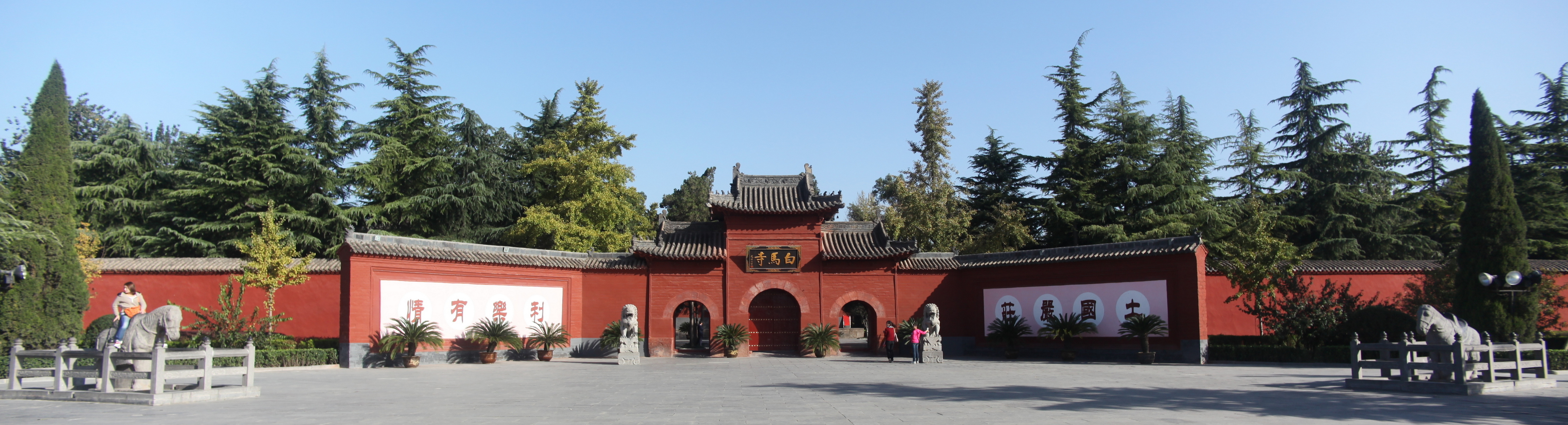
White Horse Temple
The emperor had a dream. In it, a golden figure flew around his palace, radiating light. Emperor Ming of the Eastern Han dynasty sent emissaries west to find the source of this vision, and they returned with two Indian monks, Buddhist scriptures, and -- according to legend -- the white horses that carried them. In 68 AD, the emperor built a temple outside the walls of his capital, Luoyang, to house the monks and their teachings. He named it Baimasi, the White Horse Temple. It was the first Buddhist temple in China, and from this modest compound, a religion that would reshape Chinese civilization began its long march east.
The Cradle of Chinese Buddhism
The temple sits about 12 kilometers east of modern Luoyang in Henan Province, just outside the walls of the ancient Eastern Han capital. Despite being small compared to the grand monasteries that followed, it is considered by most believers as the cradle of Chinese Buddhism. The two Indian monks, Kasyapa Matanga and Dharmaratna, took up residence here and began the work of translation. Matanga produced the Sutra of Forty-two Chapters, the first Buddhist sutra rendered into Chinese -- a landmark in the history of both religion and language. Dharmaratna translated the Dasa Bhumi, the Ten Stages of Perfection, along with five other texts. From this single compound, Buddhism spread to Korea, Japan, and Vietnam, transforming the ethical and philosophical landscape of East Asia.
A Temple Rebuilt Across Dynasties
What visitors see today is not the original structure but a palimpsest of reconstructions. The main temple buildings were rebuilt during the Ming dynasty between 1368 and 1644, then again during the Qing from 1644 to 1912. After the Cultural Revolution caused significant damage, the complex was refurbished in the 1950s and again in March 1973. The compound covers about 13 hectares, organized into halls divided by courtyards and manicured gardens. The Mahavira Hall enshrines three principal Buddhas, flanked by Eighteen Arhats whose statues were made in ramie-cloth during the Yuan dynasty. A jade Buddha, 1.6 meters tall and donated in 1988 by a Chinese man who had settled in Burma, stands in its own hall with a precious stone embedded in its forehead.
Xuanzang's Point of Departure
The temple's most famous resident may have been the Tang dynasty monk Xuanzang, who in 629 AD set out from White Horse Temple on a 16-year pilgrimage to India. His journey -- later immortalized in the novel Journey to the West as the adventures of the Monkey King -- was driven by a desire to obtain original Buddhist texts and resolve contradictions among existing Chinese translations. On his return, Xuanzang served as the temple's abbot until his death, spending his remaining years translating the Sanskrit scriptures he had carried back across Central Asia. His work brought a new precision and depth to Chinese Buddhist scholarship that had been impossible when translations were filtered through intermediary languages.
Where India Meets China
The temple's role as a bridge between civilizations continues into the present. Indian Prime Ministers P.V. Narasimha Rao and Atal Bihari Vajpayee visited in 1993 and 2003 respectively. In 2008, India completed a Buddhist shrine within the temple's International Garden -- a replica of the Sanchi Stupa, complete with Sanchi's east gate and a Buddha statue modeled on the 5th-century Sarnath image. President Pratibha Patil of India inaugurated the shrine in 2010. Built on land donated by the Chinese government, the Sanchi replica stands within the precincts of China's first Buddhist temple as a physical embodiment of the 2,000-year conversation between these two civilizations.
Peonies and Pagodas
Beyond the main complex, past manicured gardens and across a small bridge, stands the Qiyun Pagoda -- a 13-tiered, 25-meter-high brick tower built during the Jin dynasty in the 12th century. The monks' quarters lie within, accessible only with restricted permission. Each April, the temple grounds become part of Luoyang's famous Peony Festival, which draws on a legend of Empress Wu of the Tang dynasty: when peonies refused her command to bloom in winter, she banished them from Xi'an to Luoyang. The festival celebrates that defiance, and during its two-week run, the temple and the city fill with crowds who come for the flowers as much as the faith.
From the Air
Located at 34.72°N, 112.60°E, approximately 12 km east of modern Luoyang, Henan Province. The temple complex covers about 13 hectares and is visible from low altitude as a traditional Chinese compound set amid development along the road from Luoyang. Nearest airport is Luoyang Beijiao Airport (ZHLY/LYA), roughly 15 km west. Zhengzhou Xinzheng International (ZHCC/CGO) is about 140 km east. Altitude recommendation: 2,000-3,000 feet AGL. The Qiyun Pagoda within the complex may be visible as a vertical element. The Luo River and Manghan mountain provide geographic context to the south.