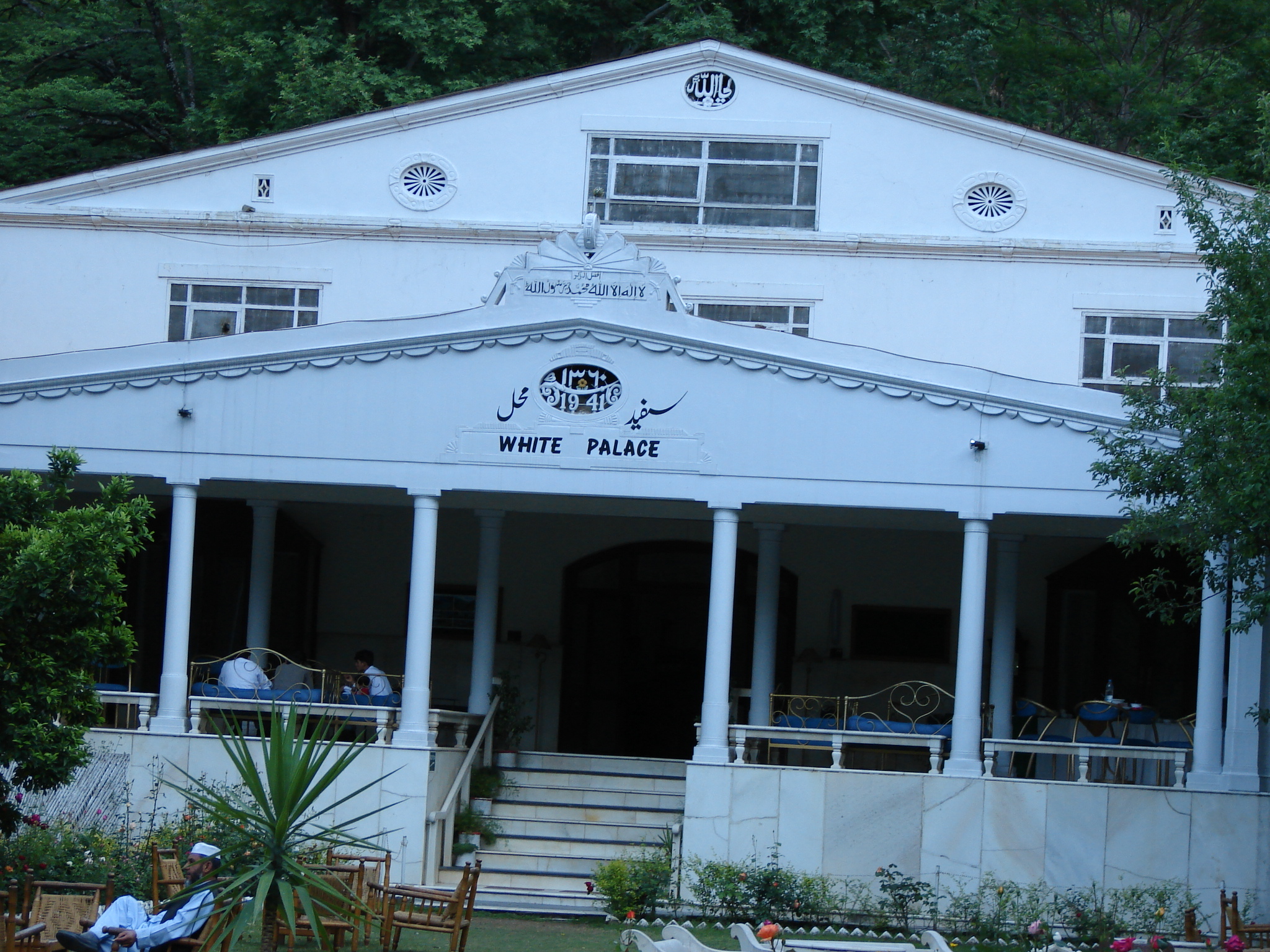
White Palace (Marghazar)
Marble from the same quarries that supplied the Taj Mahal, hauled over mountain roads to a hilltop at 7,136 feet in the Swat Valley. Bronze fittings shipped from Belgium. Artisans brought from Turkey to shape it all into something the King of Swat could call his summer retreat. The White Palace at Marghazar is an improbable building in an improbable place -- a gleaming monument to one ruler's ambition, perched above the green terraces and cedar forests of northern Pakistan's most storied valley.
A King's Vision in White Stone
In 1935, the lush landscape around the small town of Marghazar, thirteen kilometers from Saidu Sharif, caught the eye of Miangul Abdul Wadud, the Badshah Sahib -- the first king of the princely state of Swat. He decided to build a summer palace here, and he intended it to rival anything in the subcontinent. Construction began shortly after, with marble imported from Jaipur, India -- the very quarries that had supplied stone for the Taj Mahal centuries earlier. Turkish artisans designed and built the structure, which was completed in 1941. The palace went through several names: first the Swatti Taj Mahal, then Motti Mahal, and finally Sufed Mahal -- the White Palace. Each renaming reflected the building's evolving identity, but the white marble remained constant, glowing against the dark green hillside like a misplaced jewel.
Rooms Fit for Royalty -- and Royalty Came
The palace contains 24 spacious rooms arranged across several blocks, each designed with a specific purpose. The Royal Suite served as the king's personal quarters. Two large conference halls hosted cabinet meetings. A king's lobby opens onto views of the garden lawn, while a veranda on the right side overlooks a rushing mountain stream. The six-roomed Lord's Block housed ministers and advisors, the eight-roomed Prince Block sits nestled among trees and shrubs, and the Queen's Block -- twelve rooms on the upper level -- was divided symmetrically between Abdul Wadud's two wives, each receiving three personal rooms, three servant rooms, and a private lawn. In 1961, Queen Elizabeth II and Prince Philip stayed in the Royal Suite for three days during their tour of Pakistan. Ceiling fans installed during construction in 1941 were still spinning when they arrived -- and reportedly still work today.
Built Without Cement
What makes the White Palace structurally remarkable is not just its materials but its method. Instead of cement, the builders used chuna -- traditional lime mortar -- as the binding agent. The result is stonework so dense it resists drilling. Ceilings rise thirty to thirty-five feet, a design choice that serves both grandeur and function: the height provides structural strength while channeling heat upward, keeping the lower rooms cool through Swat's warm summers. Outside, the grounds were developed into a miniature botanical garden and zoo, stocked with selected fauna and flora. A colossal chinar tree, estimated at over two hundred years old, still spreads its canopy over the garden, offering shade to visitors who come to see the palace that a mountain king built from materials gathered across three continents.
From Palace to Hotel
After the death of Miangul Abdul Wadud, ownership passed through the royal family -- first to his grandson Miangul Asfandyar Amir Zeb, and now jointly to Miangul Shahriyar Amir Zeb and the three daughters of the late Asfandyar. The palace has been converted into a hotel, and during summer months tourists climb the hill to Marghazar to sleep in rooms where a king once held court and a British queen once rested. The conversion from royal residence to tourist accommodation is a common enough fate for palaces that outlive their dynasties, but at the White Palace the transition carries a particular poignancy. The marble still gleams. The chinar still shades the lawn. The ceiling fans still turn. What has changed is not the building but the world around it -- the princely state of Swat absorbed into Pakistan, the royal family's political authority dissolved, the palace's purpose shifted from governance to hospitality.
From the Air
Located at 34.66N, 72.34E in the Swat Valley of Khyber Pakhtunkhwa, Pakistan, at an elevation of 7,136 feet. The palace sits on Marghazar Hill, approximately 13 km from Saidu Sharif. From the air, the white marble structure is visible against the green hillside. The nearest major airport is Saidu Sharif Airport (OPSS). The Swat Valley runs northwest-southeast, flanked by forested mountain ridges. Expect mountain weather patterns with potential turbulence along valley walls.