White Tower of Thessaloniki
It is not actually white anymore. The current color is closer to buff, the warm pale gold of weathered limestone, but the name has stuck because what happened in 1890 was indelible. A convict serving a long sentence offered to whitewash the entire exterior of the Ottoman tower in exchange for his freedom, and the authorities took the deal. He climbed the scaffolding, painted thirty-four meters of fortified masonry, and walked away free. Within a generation the whitewash had weathered off, but by then everyone had a new name for the building, and the older names — the Lions Tower, the Fortress of Kalamaria, the Janissary Tower, and grimmest of all, the Blood Tower — had begun to fade from common use.
What the Walls Held
For most of its working life the tower was a prison and a place of execution. The Ottomans built it sometime after Sultan Murad II captured Thessaloniki in 1430, replacing an earlier Byzantine tower on the same spot, and they used it to guard the eastern end of the city's sea walls. By the nineteenth century its function had narrowed to detention and killing. People sentenced to long terms went in and frequently did not come out. The most notorious episode came in 1826, during the reign of Sultan Mahmud II, when the Janissary corps — the elite slave-soldiers who had become a powerful and uncontrollable political force in the empire — were suppressed in what historians call the Auspicious Incident. Those Janissaries imprisoned at the tower were executed inside its walls. People in the city began calling it the Blood Tower. They were not being metaphorical.
The People Who Lived Around It
For centuries the tower stood at the boundary between communities. On one side were the cemeteries of the city's Muslims and Jews. On the other lay the Jewish quarter, home to the Sephardic community that had arrived after the expulsions from Spain in 1492 and had grown so large that by the early twentieth century Thessaloniki was a majority-Jewish city. A late-nineteenth-century Bulgarian postcard, sold to tourists, shows the tower with a Macedonian merchant leaping from an upper window to escape what the caption calls Turkish tortures. The image is propaganda, the moment exaggerated, but the place was real and the cruelty was real, and the people held inside were not curiosities or symbols. They were prisoners — Greek revolutionaries, Bulgarian rebels, common criminals, dissident soldiers — locked into a building whose walls, by then, had absorbed enough death to give it a permanent reputation.
Greece, 1912
When Greek troops took Thessaloniki from the Ottomans in October 1912, in the closing weeks of the First Balkan War, they inherited the tower along with the city. The new administration set about claiming the building for the Greek nation. The exterior was substantially remodeled and whitewashed again. The chemise — the lower outer wall that ringed the base of the tower and held heavy guns — was demolished in 1917 to open up the waterfront for traffic and views. Five months after the Greek arrival, in March 1913, King George I of Greece was assassinated by a lone gunman while walking near the tower; he was sixty-eight years old. The tower, slowly, became a symbol rather than a function. The Lions Tower and the Janissary Tower and the Blood Tower were folded into Lefkos Pyrgos, the White Tower of Thessaloniki, the building you see on every postcard from the city.
What's Inside Today
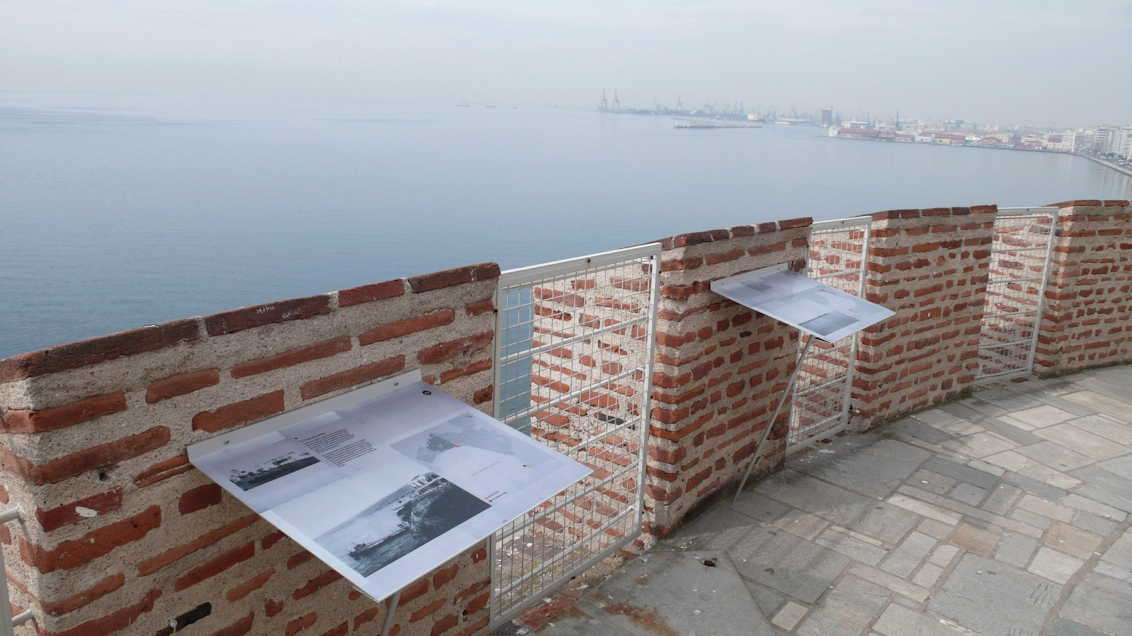
The tower now houses a museum administered by the Ephorate of Byzantine Antiquities of the Greek Ministry of Culture. Six floors arranged around a central spiral ramp, each presenting some chapter of the city's long history — the Roman foundation, the Byzantine flowering, the Ottoman centuries, the Sephardic golden age, the Greek twentieth century, the catastrophic 1917 fire, the destruction of the Jewish community in the Holocaust. From the platform at the top, ten meters across, you can see the long curve of Thermaic Gulf and the cargo ships moving in the bay and the tile roofs of the old upper town climbing toward the Byzantine walls. The whitewash is gone but the name remains, and that combination — the false color, the persistent name — feels strangely fitting for a city that has had to rename itself many times across many centuries while still being recognizably the same place.
From the Air
White Tower of Thessaloniki: 40.6264 N, 22.9483 E, on the waterfront promenade of central Thessaloniki, northern Greece. Best viewed below 2500 feet. Identifiable as a single cylindrical tower, 34 meters tall and 23 meters in diameter, with a smaller turret on top, standing prominently along Nikis (Victory) Street where the city meets the Thermaic Gulf. The tower is the most photographed structure in the city. Thessaloniki Airport (LGTS) is about 13 km southeast on the coast. Class D airspace around LGTS. Expect heavy seasonal traffic; check NOTAMs for waterfront events.