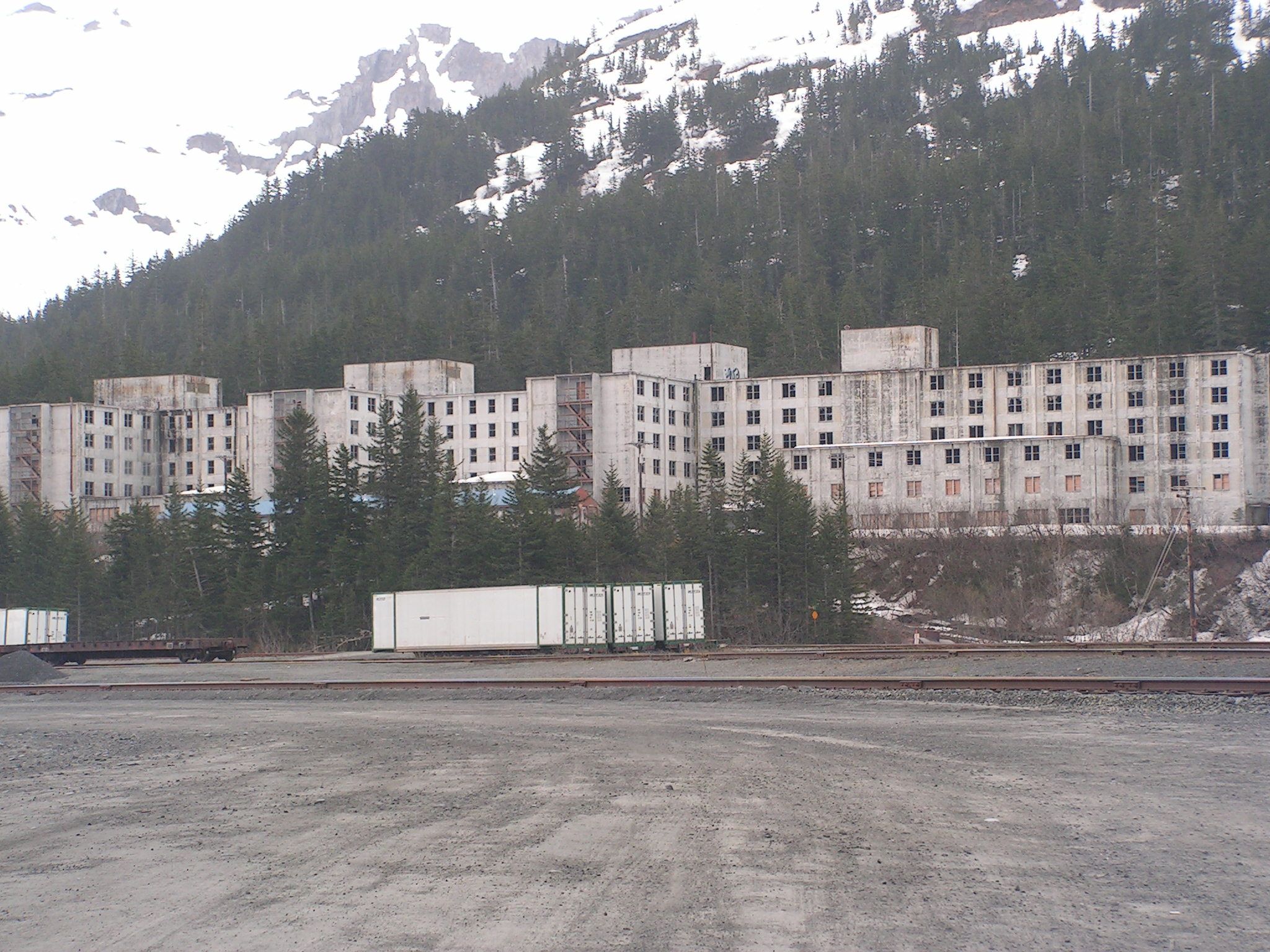
Whittier: The Town That Lives in One Building
Begich Towers has 196 apartments. It also has Whittier's school, police station, post office, church, grocery store, and most of the town's 200 residents. The 14-story concrete building, originally built as barracks for the Cold War military, became Whittier's de facto downtown when the army left in the 1960s. Living elsewhere is possible - a few residents occupy the second former barracks building - but impractical: Whittier receives 22 feet of snow annually, temperatures drop below zero, and winds exceed 60 mph. The tunnel connecting Begich Towers to the Buckner Building (abandoned) and the ferry terminal is how residents reach the outside world. Whittier isn't a town with a building; it's a building that became a town.
The Origins
The U.S. Army built Whittier during World War II as a secret port facility - its location behind the Chugach Mountains, accessible only by tunnel, made it invisible to Japanese reconnaissance. The two massive barracks buildings, Hodge and Buckner, housed troops in what were then the largest buildings in Alaska. After the war, Whittier served as a Cold War logistics hub, then closed in 1960 when the army no longer needed it. The city of Whittier incorporated in 1969, inheriting military infrastructure designed for different purposes. The Hodge Building was renamed Begich Towers and converted to condominiums; most residents moved in and stayed.
The Building
Begich Towers is Whittier. The 14-story concrete structure contains one-bedroom and two-bedroom apartments, a small grocery (Whittier's only store), a bed-and-breakfast, a church, the mayor's office, and a school that serves the dozen or so children in town. The building has a laundry, a meeting room, and views of Prince William Sound from upper floors. A tunnel connects Begich Towers to the ferry terminal and, technically, to the abandoned Buckner Building - though Buckner is sealed off, too contaminated and unstable for occupancy. Life in Begich Towers is communal by necessity: residents share walls, hallways, and the experience of living in a vertical village.
The Access
Reaching Whittier requires commitment. The Anton Anderson Memorial Tunnel, at 2.5 miles the longest combined rail and highway tunnel in North America, provides the only land access. The tunnel is one-lane, alternating traffic direction every 30 minutes; miss your window and wait. The Alaska Railroad passes through the same tunnel on the same schedule. The ferry terminal connects Whittier to Valdez and Cordova, making it a gateway to Prince William Sound. Most visitors are in transit - boarding glacier tour boats, catching ferries, passing through. The town exists to serve the port, and the port exists because of the military infrastructure.
The Life
Living in Begich Towers is like living in a college dorm, a retirement home, and a survivalist compound simultaneously. Everyone knows everyone; privacy is limited; community is mandatory. The school, which sometimes has more teachers than students, occupies a tower floor. The church holds services. The grocery stocks basics. For anything else - medical care, varied shopping, restaurants - residents drive through the tunnel to Anchorage, an hour away. Some residents love the intimacy; others endure it for the scenery and fishing. The 22 feet of annual snowfall and hurricane-force winds make the building's all-in-one design sensible. Whittier is harsh; the building makes it survivable.
Visiting Whittier
Whittier is located on Prince William Sound, roughly 60 miles southeast of Anchorage via the Anton Anderson Memorial Tunnel. The tunnel toll is steep ($13 one-way in 2024); timing is essential, as the alternating-direction system creates 30-minute waits for vehicles traveling the wrong direction. Glacier tour boats depart from the harbor, offering views of College Fjord and surrounding ice. The Alaska Marine Highway ferries connect to Valdez and Cordova. The Buckner Building, abandoned and off-limits, is visible and photogenic. Begich Towers doesn't offer tours, but the ground-floor businesses are accessible. Whittier is a portal - to glaciers, to ferries, to adventure. The town itself is the adventure of collective survival.
From the Air
Located at 60.78°N, 148.69°W on Prince William Sound, Alaska. From altitude, Whittier appears as two large buildings near a small harbor - Begich Towers and the abandoned Buckner Building, dwarfing the small boat harbor and ferry terminal. The tunnel entrance is visible where the road disappears into the mountain. Surrounding terrain is classic Alaska coastal: steep mountains, glaciated valleys, water everywhere. The Sound opens to the south; the Chugach Mountains rise immediately behind town. The setting is spectacular; the town's compression into one building is visible as the absence of typical urban scatter. Whittier looks like what it is: a military installation repurposed for civilian survival.