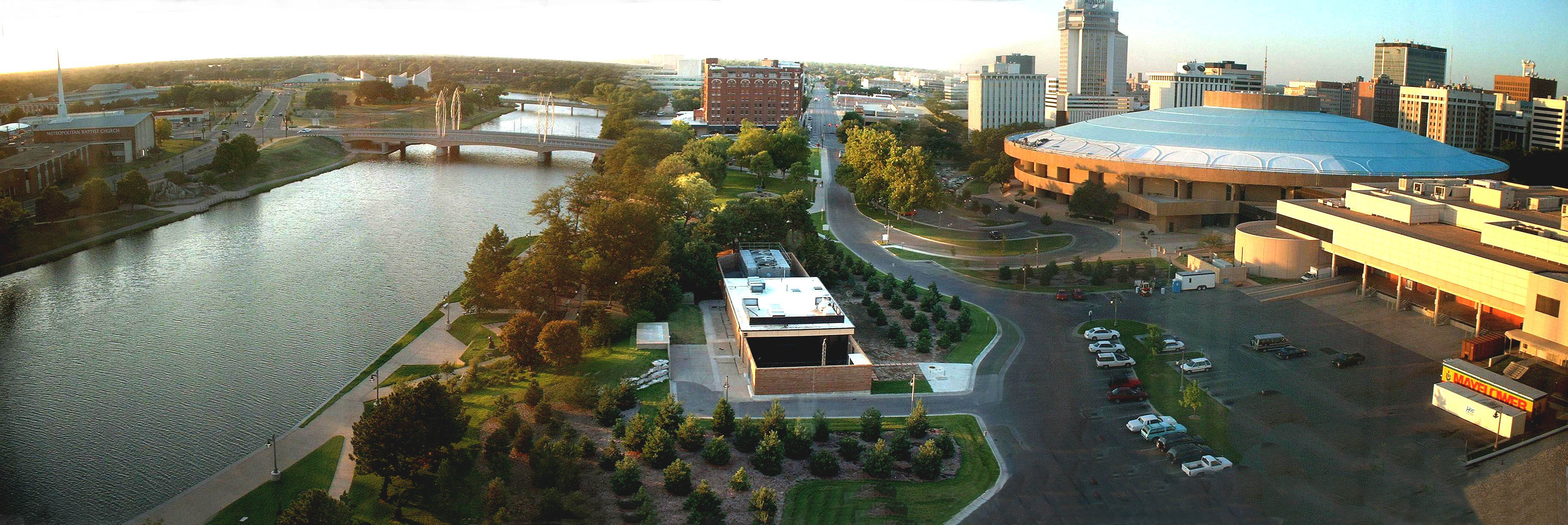
Wichita, Kansas
In 1966, Allen Ginsberg walked into a coffeehouse at 625 East Douglas Avenue called Moody's Skidrow Beanery and read aloud a poem he had been writing on a bus through the Kansas plains. "Wichita Vortex Sutra" cast the city as the geographic and spiritual center of a nation at war with itself. The building is long gone, but Ginsberg was onto something about Wichita's peculiar gravitational pull. Named for the Wichita people who once inhabited the area, the city sits at the confluence of the Arkansas and Little Arkansas rivers in the dead center of the continent. That centrality has shaped everything -- from its origin as a lawless cattle town patrolled by Wyatt Earp to its emergence as the place where more airplanes have been built than anywhere else on Earth.
Cowtown to Air Capital
The first train pulled into Wichita on May 16, 1872, carrying 44 passengers from Newton. The railroad transformed a dusty stop on the Chisholm Trail into a roaring cattle town, and the violence that came with it prompted the hiring of marshals including the young Wyatt Earp. When the cattle drives shifted west, oil filled the void. The early 20th-century boom in neighboring Butler County turned Wichita into a financial hub, attracting Koch Industries, today one of the two largest privately held companies in the United States. But the city's defining industry arrived in 1916 when Clyde Cessna built his first airplane here. Between 1920 and 1932, six aircraft companies were founded in Wichita: E.M. Laird, Travel Air, Stearman, Cessna, Beechcraft, and Mooney. During World War II, Boeing's Wichita plant employed nearly 30,000 workers at peak production. Today, Textron Aviation (encompassing Cessna and Beechcraft), Spirit AeroSystems, and Airbus maintain major operations. In total, Wichita has produced an estimated 250,000 aircraft.
Planeview and the WWII Neighborhoods
The aircraft factories demanded workers, and the workers needed homes. Four neighborhoods built in southeast Wichita near the Boeing, Cessna, and Beech plants represent some of the last surviving examples of U.S. government-funded temporary World War II housing in America. Beechwood, Oaklawn, Hilltop, and massive Planeview -- where over 30 languages are spoken today -- collectively housed about a fifth of the city's population at their peak. Designed as temporary structures, all have remained occupied into the 21st century, evolving into low-income communities with a rich multicultural character. Thousands of Vietnamese immigrants settled in Wichita after the Vietnam War, adding to a cultural tapestry that includes a large African-American community, a growing Hispanic population making up over 18 percent of residents, and diverse Asian communities whose annual festival at Century II fills the convention hall with the cuisines and performances of a dozen nations.
The Keeper and the River
Where the Big and Little Arkansas rivers merge, a 44-foot steel sculpture stands watch. The Keeper of the Plains, created by Kiowa-Comanche artist Blackbear Bosin, was installed in 1974 and has become Wichita's most recognizable landmark. At night, ring-of-fire gas torches illuminate the statue from below. The river corridor around the Keeper anchors a cultural district that includes Exploration Place, the Mid-America All-Indian Center, and the Old Cowtown living history museum. Wichita has suffered devastating Arkansas River floods -- in 1877, 1904, 1916, 1923, 1944, 1951, and 1955. In 1944 alone, the city flooded three times in eleven days. The resulting Wichita-Valley Center Floodway, locally known as the Big Ditch, was completed in 1958 and has protected the city ever since, though the Great Flood of 1993 kept it full for more than a month and caused six million dollars in infrastructure damage.
Pizza Hut, White Castle, and Dennis the Menace
Wichita has seeded American culture in unexpected ways. Pizza Hut was founded here in 1958 by two Wichita State University students; the original building is now a museum on the WSU campus. White Castle, the nation's first fast-food hamburger chain, traces its origins to Wichita in 1921. The city is the fictional hometown of Dennis the Menace, and Glen Campbell immortalized it in the 1968 hit "Wichita Lineman." The Tallgrass Film Festival has drawn independent filmmakers downtown each October since 2003. The Wichita Art Museum holds 7,000 works, making it the largest art museum in Kansas, while the Sedgwick County Zoo -- the state's most popular outdoor attraction -- is home to over 2,500 animals. The annual River Festival has drawn more than 370,000 patrons, featuring everything from concerts and parades to boat races on the Arkansas.
Where the Prairie Meets the Runway
From the air, Wichita sprawls across the Kansas flatland in a grid pattern bisected by the sinuous path of the Arkansas River. Wichita Dwight D. Eisenhower National Airport, the state's largest, serves commercial traffic from the western edge of the city. McConnell Air Force Base anchors the southeast, its runways adjacent to the Kansas Aviation Museum housed in the elegant 1935 terminal of the former Municipal Airport. Colonel James Jabara Airport handles general aviation on the northeast side. Cessna Aircraft Field and Beech Factory Airport -- private strips operated by the manufacturers themselves -- underscore just how deeply aviation is woven into the fabric of daily life. The city sits at roughly 1,300 feet elevation, and the flat surrounding terrain means aircraft are visible for miles on approach, a fitting introduction to a place that has built more planes than any city in history.
From the Air
Located at 37.69°N, 97.34°W at approximately 1,300 feet MSL on the Kansas plains. Wichita Dwight D. Eisenhower National Airport (KICT) is the primary commercial field on the city's west side. McConnell AFB (KIAB) lies southeast with restricted airspace -- check NOTAMs. Colonel James Jabara Airport (KAAO) serves GA traffic northeast. Cessna Aircraft Field (KCEA) and Beech Factory Airport (KBEC) are private manufacturer strips east of downtown. The Arkansas River is the primary visual reference, threading through the urban area from northwest to southeast. The Keeper of the Plains statue and fire ring are visible at the confluence of the Big and Little Arkansas rivers near downtown. Flat terrain provides excellent visibility; watch for strong Kansas crosswinds, particularly spring through fall.
Sources
- Wikipedia - Wichita Vortex Sutra
- Wikipedia - History of Wichita Kansas
- Kansas Historical Society - Clyde Cessna
- NPS - Aviation Production in Wichita WWII Heritage City
- Wikipedia - Koch Inc
- Wichita State University - Pizza Hut Museum
- Wikipedia - The Keeper of the Plains
- Boeing Airbus Spirit AeroSystems Acquisition