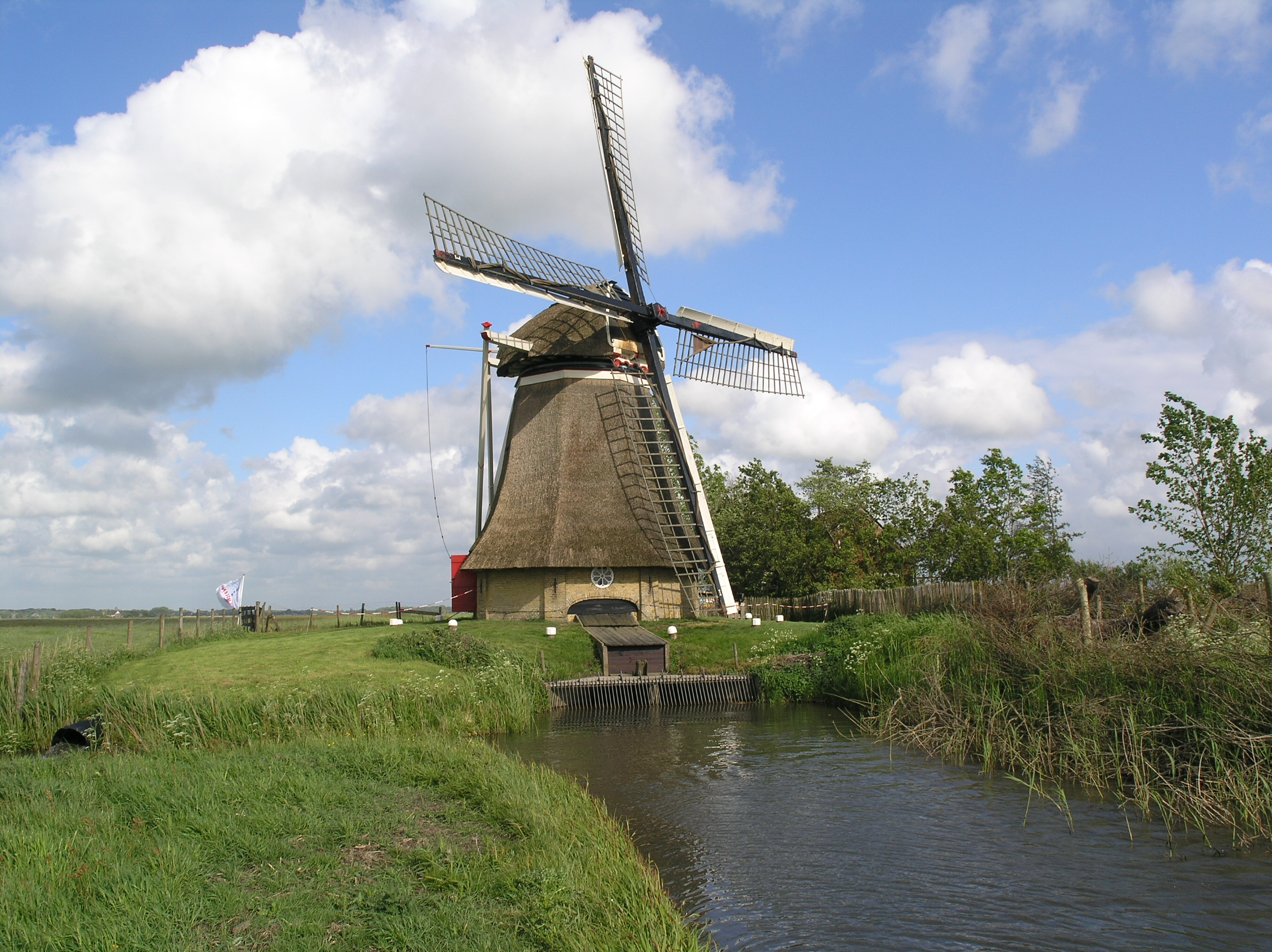
Wijnsermolen, Wyns
When the miller Sierksma stopped working at the Wijnsermolen in 1967 — his health no longer up to the job of climbing the cap and trimming sails in a Frisian gale — the polder board could not find anyone to replace him. The mill came with a miller's house, but a house and a salary were no longer enough to attract a young trained miller in the late 1960s. So two members of the Wijnserpolder water board did the unthinkable: they kept the mill running themselves, by hand, on top of their other jobs, for the next eight years. They were not professionals. They were trustees who refused to let their own polder mill stop.
The Polder That Hired Its Own Miller
The Wijnserpolder was created in 1871, a piece of low Frisian ground organized as a unit so that the surrounding farms could pool the cost of draining it. The new polder needed a single dedicated mill to do the work that several smaller privately-owned mills had been doing badly, and a millwright probably named Gerben van Wieren — based in nearby Janum — built one. The result is the Wijnsermolen: a three-storey thatched smock on a single-storey brick base, what the Dutch call an *achtkante grondzeiler*, an octagonal ground-sailer whose sail tips sweep almost to the grass. In 1924 the polder board added a miller's house next door, an investment that committed the mill to having someone living within walking distance. That house is still standing today, though for most of its later life no miller has lived in it.
Modernizing the Old Machine
By 1926 the mill was tired. The board debated replacing it with an electric pump and decided the electric option cost more than they could justify, so they did the next best thing: they modernized the mill in place. In 1932 the patent sails came off and were replaced with steel airfoil-shaped *dekkerised* sails — a streamlined Dutch innovation of the 1920s that worked like a stubby aircraft wing. The wooden Archimedes' screw was swapped out for a steel one with new Dekker roller bearings. A bronze bearing went on the windshaft. Together the changes squeezed more lift out of every gust. They also made the mill terrifyingly prone to running away in heavy weather; the airfoil sails grabbed the wind too well. When the inner stock had to be replaced in 1957, the board quietly removed the Dekker setup and reverted to a more conservative *Fok* system, which was both safer and cheaper. The second stock got the same treatment a few years later, after its airfoil plates wore through.
A Mill Without a Miller
Then came 1967 and Sierksma's retirement. Modern housing regulations made it hard to formally hire a new miller for the existing miller's house — a small bureaucratic snag that ended a long tradition. Rather than mothball the mill or convert immediately to electricity, two board members of the Wijnserpolder water board took on the work themselves. They ran the windmill, alongside their day jobs, until 1975. In that year the board finally gave up on wind: the drive wheels and upright shaft came out and were set aside, and in their place went a diesel engine — pulled, used, from another Frisian mill, the De Hoop at Roodkerk. As a diesel pumping station the Wijnsermolen kept the polder dry for almost another decade, until 1984, when a new electric station called *De Murk* took over and the old building was finally retired.
Rescued, Restored, On Standby
For about a decade after 1984 the Wijnsermolen sat empty and slowly fell apart. Demolition was actually discussed. Then in 1995 Stichting De Fryske Mole — the Frisian foundation that owns and operates dozens of historic mills around the province — took the building over and put it back into working order. A volunteer miller now turns the sails. The drive wheels and upright shaft that were taken out in 1975 are back where they belong, and the polder authority lists the windmill as a backup pumping station, in case the modern electric pump at De Murk fails during a storm. The most recent restoration, in 2010 and 2011, replaced one of the stocks and the Archimedes' screw itself — a screw 1.05 meters in diameter, set at 16.5 degrees, that lifts 956 liters of water with every revolution. Each turn the screw makes today is the same job it was first asked to do in 1871, by a polder board that hired a millwright in Janum to solve its drainage problem.
From the Air
Located at 53.261°N, 5.845°E in the village of Wyns, about 8 km north of Leeuwarden on the eastern bank of the Dokkumer Ee. The Wijnsermolen is a thatched octagonal smock on a brick base, with a separate miller's house alongside — both visible against the open polder. The sails sweep almost to ground level, giving the silhouette a distinctive low-slung look. Leeuwarden Air Base (EHLW) is the nearest field, about 9 km south; Groningen Airport Eelde (EHGG) is around 55 km east. Best viewed at low altitude in clear conditions, with the rectangular Wijnserpolder grid helping locate it.