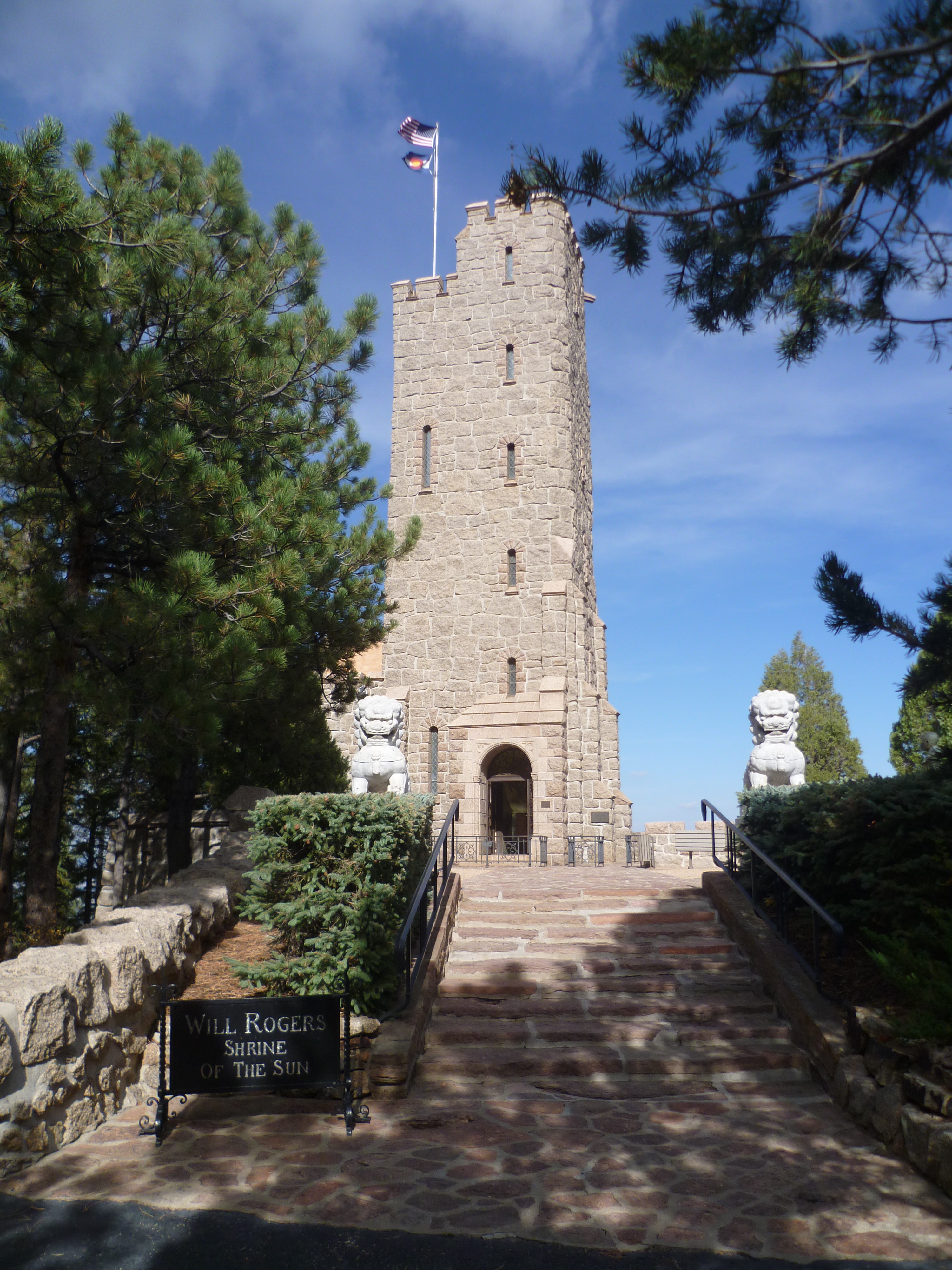
Will Rogers Shrine of the Sun
Every fifteen minutes, Westminster chimes ring out from a five-story tower on the slopes of Cheyenne Mountain, carrying across the valley to Colorado Springs below. The sound comes from a vibraharp inside a building made entirely without wood or nails, constructed from a single block of pink granite quarried from the very mountain it stands on. Spencer Penrose began building this tower in the early 1930s as a monument to the rising and setting sun. Then, in August 1935, his friend Will Rogers died in a plane crash in Alaska, and Penrose gave the shrine a second purpose: a memorial to the man who had made America laugh through the Great Depression. The Will Rogers Shrine of the Sun is part monument, part mausoleum, and part time capsule, blending Romanesque stone with murals of Colorado's frontier history and art spanning five centuries.
The Man Who Built Colorado Springs
Spencer Penrose was not a modest man. He arrived in Colorado Springs at the turn of the twentieth century and proceeded to build or acquire much of what defines the city to this day. The Broadmoor resort, the Cheyenne Mountain Zoo, the Pikes Peak Highway, and the shrine itself all bear his mark. He funded the first Pikes Peak International Hill Climb and established the El Pomar Foundation to support the region long after his death. Penrose wanted a monument that would endure for centuries, so he chose granite, steel, cement, iron, and brass. No wood, no nails, no material that could rot or burn. The ceramic tile roof, terrazzo floors, and marble interior were designed to outlast everything around them. Construction cost approximately $250,000, a substantial sum in Depression-era dollars. The shrine was completed and dedicated on September 6, 1937.
A Humorist Immortalized
Will Rogers was already a national treasure when he boarded Wiley Post's experimental floatplane in August 1935 for a flight through Alaska. Rogers had risen from Cherokee ranch life in Oklahoma to become America's most beloved humorist, filling stages, movie screens, and radio airwaves with his folksy wisdom and sharp political commentary. When the plane crashed near Point Barrow, Alaska, killing both men, the country mourned. Penrose, who had been building his shrine on Cheyenne Mountain during that very summer, rededicated it in Rogers's memory. Three floors of the tower now contain a photographic history of Rogers's life, from his childhood days in Oklahoma through his vaudeville career, his Hollywood films, and his final journey. The last image is of Will and Wiley Post, taken just before the fatal flight.
Stone, Art, and Sacred Ground
The shrine is entered through a stone gateway into grounds encircled by a wall of the same pink granite as the tower. Inside the walls stand Jo Davidson's statue of Will Rogers, Chinese sculptures, and native plantings, along with a bronze bust of Spencer Penrose by sculptor Avard Fairbanks. The building itself is Romanesque Revival architecture, featuring buttresses, ornately decorated iron and brass doors, and narrow leaded windows. Artist Randall Davey of Santa Fe, New Mexico, painted murals across the first floor and the lower stairway levels depicting the Pikes Peak region's history: Native American life, Zebulon Pike's explorations, the Cripple Creek gold mining era, and William Jackson Palmer's founding of Colorado Springs. The murals were restored in 1994 by Eric Bransby. That same year, the shrine was listed on the National Register of Historic Places for its artistic and architectural significance.
The Chapel Below
Beneath the tower lies a chapel that doubles as a crypt and an art gallery spanning centuries and continents. European works from the fifteenth and sixteenth centuries fill the space, including a sixteenth-century Baroque painting of the Madonna, carved monk benches, a Classical Baroque altar, and choir stalls. The crucifix is a German woodcarving. Eastern art shares the room: a standing bronze statue of the Bodhisattva Guanyin wearing rosary beads and three Buddha statues. Spencer and Julie Penrose are interred here, along with two close friends, Spencer's social secretary Horace Devereaux and Harry Leonard. It is a deeply personal space, reflecting Penrose's eclectic tastes and his desire to surround himself in death with beauty drawn from across the world.
Chimes Over the Valley
At night, floodlights illuminate the granite tower while the walkway leading to it glows softly, and Cheyenne Lake at The Broadmoor below reflects the light. During the day, visitors climb the internal staircase through five stories of murals, photographs, and art before emerging at the top to views stretching across Colorado Springs, Garden of the Gods, and the high plains beyond. The Westminster chimes continue their quarter-hour rhythm, and over the decades the tower has broadcast Home on the Range and classical music from what was a state-of-the-art amplification system when installed. The shrine overlooks everything Penrose built and everything he loved about this corner of Colorado, standing as his final and most enduring statement.
From the Air
The Will Rogers Shrine of the Sun sits at approximately 38.77N, 104.86W on the slopes of Cheyenne Mountain, above the Broadmoor resort and Cheyenne Mountain Zoo. The pink granite tower is visible from the air against the forested mountainside, particularly when illuminated at night. Colorado Springs Airport (KCOS) is approximately 8 nautical miles to the southeast. The shrine is at roughly 7,400 feet elevation on the eastern face of Cheyenne Mountain. Nearby landmarks include The Broadmoor resort directly below, Cheyenne Mountain Zoo adjacent to the north, and Garden of the Gods to the northwest. Be aware of mountainous terrain and potential turbulence along the Front Range.