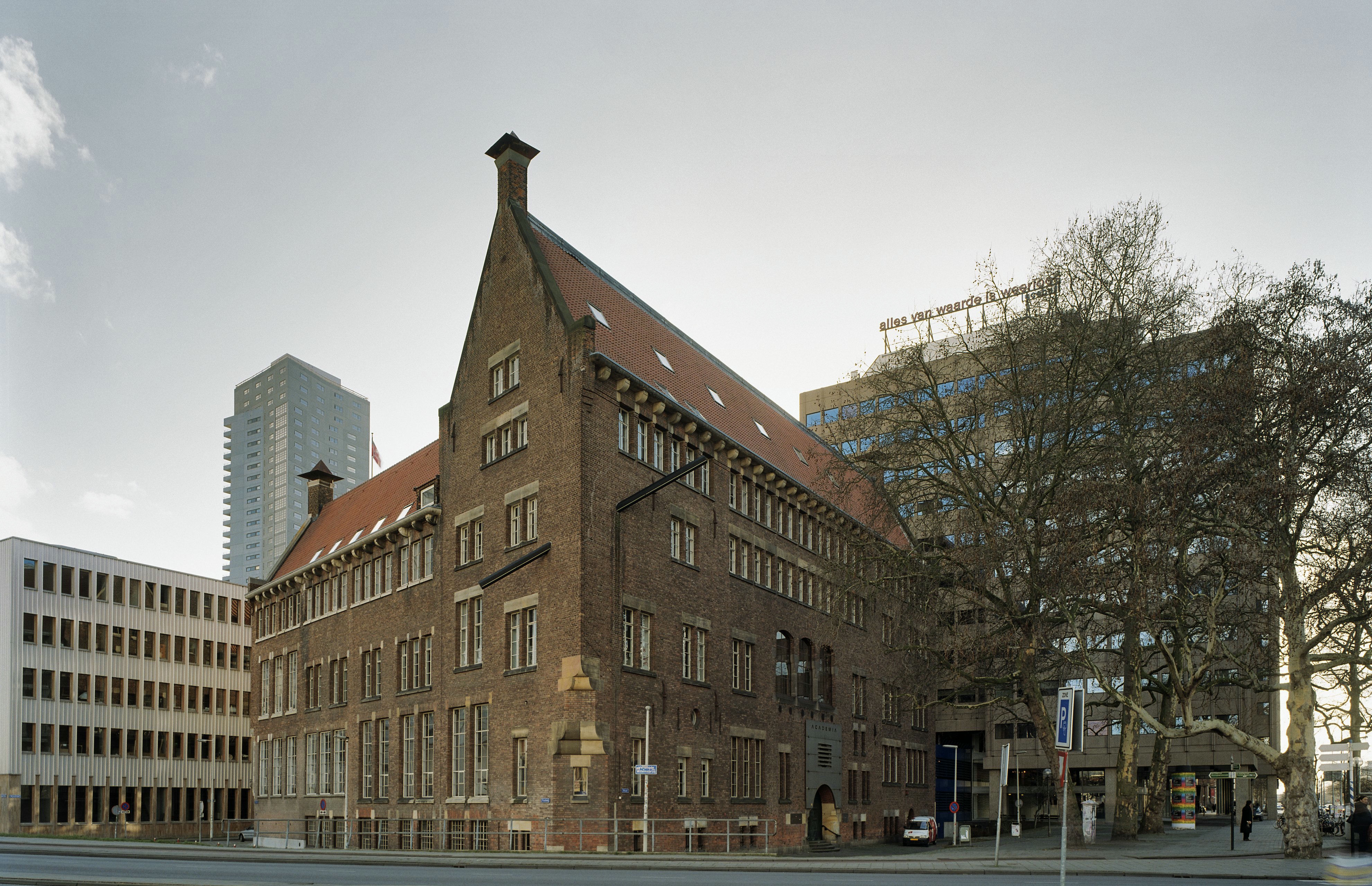
Willem de Kooning Academy
Willem de Kooning was twenty-two when he left Rotterdam for New York in 1926, paying his passage as a stowaway on a British freighter and arriving with no English and a diploma in decorative arts from the school then called the Academie van Beeldende Kunsten. He would become one of the central figures of American Abstract Expressionism, a man whose paintings of Women would set teeth on edge and auction records together. Back home in Rotterdam, the academy that trained him kept its dry institutional name for another seventy-two years. Only in 1998, one year after de Kooning's death, did it finally rename itself the Willem de Kooning Academy. The school had taken some time to decide whether to claim him.
From a Drawing Society to a City Institution
The institution's roots reach back to 1773, when the marine painter Hendrik Kobell gathered a circle of Rotterdam artists into a drawing society called Tekengenootschap Hierdoor tot Hooger. Eighteenth-century Dutch cities were full of these societies, places where newly arrived painters worked from the nude in the evenings, apprentice craftsmen received drawing instruction, and amateurs gathered to argue about taste and collect, preferably Dutch, art. In 1781 the drawing society became a public academy, adding classes in engineering, perspective theory, anatomy, and the philosophy of art. By 1808 it had 303 members and 45 pupils. The name kept changing. Stadstekenschool voor de Bouwkunde in 1822, Volksindustrieschool in 1832. In 1851 a merger with the Rotterdamse Industrieschool produced the Academie van Beeldende Kunsten en Technische Wetenschappen, which divided art and engineering between two formal departments and settled in at Coolvest, the street now called the Coolsingel.
The Boy from North Rotterdam
De Kooning was born in 1904 in north Rotterdam and enrolled at the academy as a teenager, training in what was then called decoration art and is now called styling. He went to evening classes after working days as an apprentice in a commercial art firm. The skills he picked up here, the careful drawing, the patience with surfaces, the technical underpinnings of decorative work, would all reappear later in the muscular ambiguity of the Women paintings. He left for America in 1926, and the academy went on training Rotterdam's artists without quite knowing that one of its graduates was becoming, in the 1940s and 1950s, a frontman for a movement that would relocate the center of Western painting from Paris to New York.
Piet Zwart, the Other Inheritance
The school's postgraduate programs are housed in the Piet Zwart Institute, named after a faculty alumnus born in 1885 and active well into the twentieth century as a designer of stamps, print advertising, books, interiors, and furniture, including the Bruynzeel kitchen system that reshaped Dutch domestic space in the 1930s. He was officially recognized as the Dutch Designer of the 20th Century. Where de Kooning went outward to New York, Zwart stayed home and reshaped everyday Dutch life from the inside. The academy points to both alumni as evidence of what it can produce, two artists far ahead of their time pulling in opposite directions, one toward the heroic gesture and the other toward the well-designed cupboard.
Stations Instead of Studios
The contemporary academy occupies two adjoining buildings at Blaak 10 and Wijnhaven 61, connected by an airbridge across the street. It is part of the Rotterdam University of Applied Sciences and offers thirteen full-time bachelor majors, from Fine Art and Photography to Animation, Audiovisual Design, Lifestyle Transformation Design, and Fine Art & Design Teacher Training. The recent overhaul abolished the idea that each department owned its own studio. Instead the school is organized around stations, shared facilities for interaction design, image and sound, publication, materials, drawing, business, and research, where students from different majors meet at the same equipment. The Piet Zwart Institute itself runs four highly selective postgraduate programs, admitting only ten to twelve students per program per year.
An Alumni List That Reads Like a Century
Beyond de Kooning and Zwart, the school's roll includes Kees van Dongen, the Fauvist painter; Fiep Westendorp, who illustrated the Jip en Janneke books that nearly every Dutch child grew up with; Joep van Lieshout, the sculptor and provocateur behind Atelier Van Lieshout; the marine painter Hendrik Chabot; and the contemporary artist duo Bik Van Der Pol. The list runs from 1837, the birth year of Petrus van der Velden, to working artists born in the 1960s and beyond. Walk into any major Dutch museum and the academy has alumni hanging on the walls. The choice to name the school after de Kooning rather than Zwart or van Dongen reflects how cultural memory works. The international career, the dramatic late paintings, the New York studio, all of it cast a long shadow back across the Atlantic to a Rotterdam street where the same teenager had walked in the door to study decoration.
From the Air
The Willem de Kooning Academy sits at 51.919N, 4.489E, in central Rotterdam near the Blaak metro station and the famous cube houses. From altitude central Rotterdam is identifiable by the Erasmusbrug to the south and the Markthal a short walk from the academy. Rotterdam The Hague Airport (EHRD) is about 5 km north. Amsterdam Schiphol (EHAM) is roughly 55 km north.