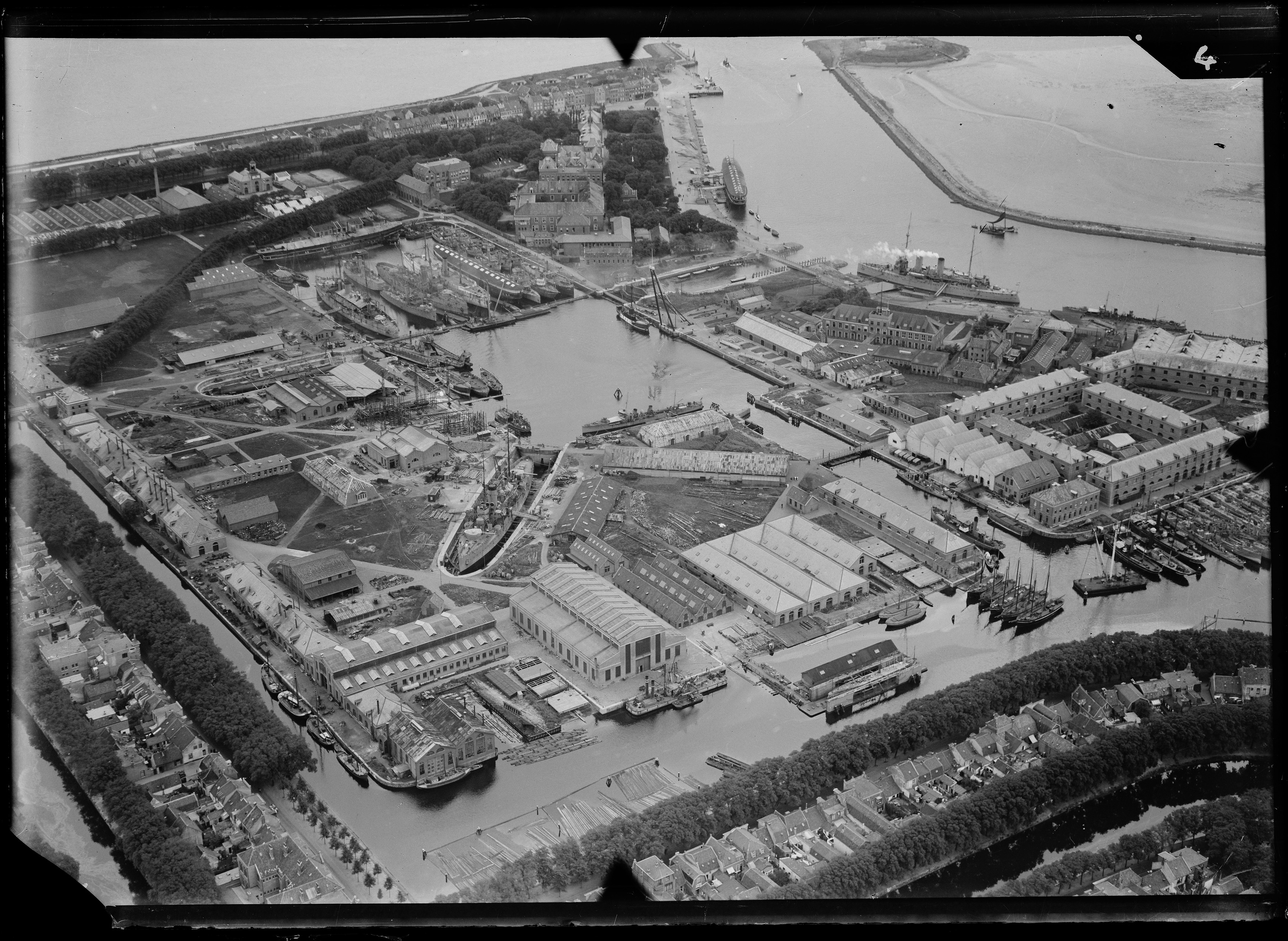
Willemsoord, Den Helder
In 1811 Napoleon Bonaparte stood on the windswept tip of North Holland and decided that this, of all places, would house the largest naval base in the Netherlands. He budgeted six million francs for the fortifications and another six million for the yard itself, then handed the drawings to an engineer named Jan Blanken. Two centuries later the warships are gone, the rigging lofts house tenants, and the wet dock that workers spent eleven years digging by hand is ringed with restaurants, but the bricks are mostly the same bricks. Willemsoord is one of those rare industrial spaces that grew old without being torn down.
What the Nieuwediep Was Before It Was Anything
The Nieuwediep was a sliver of deep water hugging the coast of what would become Den Helder, a natural harbor protected by a shoal and almost wasted on a country that did not yet understand it had one. Through the seventeenth and eighteenth centuries the big ships of the Dutch East India Company anchored in the Roadstead of Texel and let small craft ferry cargo to the inland cities. Then came the Fourth Anglo-Dutch War and the urgent realization that the fleet needed a deep, defensible base. In August 1781 orders went out to deepen the Nieuwediep. By 1785 there were 150 ships wintering safely behind the shoal, including ships of the line laying close to the harbor floor. The bones of a naval base were taking shape.
The First Yard, and Why Amsterdam Hated It
The Nieuwe Werk careening yard opened in 1792 with a clever lock that let ships in at high tide, tipped them on their sides at low tide, and held them there until the work was done. Amsterdam fought every expansion. The Zuiderzee cities knew exactly where this was going: first a careening facility, then a repair shop, then warehouses, then commerce itself bleeding north. They were right. By the height of operations the Nieuwe Werk employed up to 700 men and housed sixty-five families on the upper gun deck of a retired ship of the line called the Zoutman, with single workers stacked on the lower decks. In 1799 a British and Russian invasion force walked into the abandoned yard and found ninety-five guns, mountains of supplies, and most of a Dutch fleet at anchor. The Orange flags flying over captured Nieuwediep contributed to the Vlieter incident the next day, when twelve Dutch warships, cut off from their home base, mutinied and surrendered without firing a shot.
Napoleon's Yard
Napoleon's visit in 1811 brought money and ambition the Dutch had never been able to muster on their own. Jan Blanken's design called for a sea lock, a wet dock, and a dry dock, arranged so that ships could be brought in at constant water level, handled cleanly, and rolled into the dry dock for hull work without the indignity of being tipped on their side. The Netherlands regained independence before the work was done. The new base was named Willemsoord, and the king it was named for would inaugurate it. In 1822 the first buildings were ready: Dry Dock I, the wet dock, the sea sluice, the pump house with its steam engine, and the yard canal. A second wave between 1857 and 1866 added Dry Dock II and a new pump building. The twentieth century filled in the workbench building, the kettle factory, the rigging and sailmakers' workshop. In 1992 the navy moved its last shipyard operations to the Nieuwe Haven and switched the lights off.
The Eleven-Year Hole
The wet dock is the centerpiece of Willemsoord and the most stubbornly impressive thing on the site. Workers dug it out by hand from 1812 to 1823. Every cubic metre of soil they pulled out was used to elevate the surrounding ground, a kind of vertical equilibrium achieved through eleven years of shovels and barrows. The finished basin runs 325 metres long, 135 metres wide, and was originally eight metres deep. The north side was extended thirty metres in 1857 to handle bigger ships, and in 1972 the original sea sluice that connected it to the open sea was replaced by a larger lock. Around the basin stand the workshops, the dry docks, and the masthouse. The whole arrangement still reads as a working diagram of nineteenth-century naval logistics, slightly improbably, on the same brick paving the original workers laid.
The Museum Quarter
Between 1992 and 1995 the municipality drew up plans. The first proposal made Willemsoord a single museum. A 1994 masterplan called The Netherlands Overseas tried to wrap the whole site in a maritime theme park complete with new buildings evoking Dutch trade partners; the national monument service killed it. A 1997 revision focused on museums, recreation, and culture. The architects at Atelier Quadrat insisted that Willemsoord be experienced as a single planned object: no roads, no street names, no sidewalks, every surface paved in the original clinker brick. Willemsoord opened to the public on 29 April 2004. Visitors came in smaller numbers than projected at first, so the strategy shifted toward serving Den Helder itself. The Dutch Navy Museum is still here, with the 1868 ironclad ram Schorpioen, the 1965 submarine Tonijn, and the 1877 gunvessel Bonaire moored in the wet dock. The National Sea Rescue Museum Dorus Rijkers moved in during 2003, bringing five historic lifeboats including the 1927 Insulinde, the first steel self-righting motorized lifeboat in the world. The lightvessel Texel, built here in 1952, now houses a museum of lighthouses and lightships.
What Happens to Buildings That Outlast Their Purpose
The pumphouse for Dry Dock I, designed by Blanken in neo-classical style between 1813 and 1823, became superfluous in 1862 when a new pumphouse took over both docks. The old building was demoted to a warehouse for ironware. By 1889 even the lower floors were given over to wheat storage for the naval bakery, earning it the nickname graanpakhuis, the wheat house. Reinforced concrete went in during World War II. Restoration in 2004 turned it into the local tourist office. The masthouse was always for masts until it became a national monument in 1997. Building 72, the post-war tarpaulin and ropemakers hall, is becoming part of the new town hall along with the masthouse, an arrangement that will see municipal employees working in a structure originally designed for canvas and hemp. Even the replica Dutch East India Company ship Prins Willem, anchored here in 2004 for the Cape Holland theme park, was lost to fire in 2009. Willemsoord keeps adapting. The bricks stay.
From the Air
Located at 52.96 north, 4.77 east, at the seaward end of Den Helder where the Nieuwediep meets the Marsdiep. From the air, look for the rectangular wet dock surrounded by red-brick warehouses and the two dry docks notched into its southwest corner. The whole site forms a tight grid against the long curve of the harbor. De Kooy airfield (EHKD), the former naval air station, sits about 2 km north. Schiphol (EHAM) is roughly 70 km south. Texel airfield (EHTX) is 15 km north across the strait. Best viewed at 2,000 to 4,000 feet in clear coastal weather, when the historic yard and the active Royal Navy base at Nieuwe Haven both come into frame.