Willemstad
The paint is the first thing you notice. Lining the Handelskade waterfront, narrow merchant houses stand shoulder to shoulder in shades of canary yellow, deep terracotta, cerulean blue, and coral pink -- colors so saturated they look retouched, except they are not. Legend holds that an early governor complained of headaches caused by tropical sunlight glaring off white-painted walls, and ordered the buildings repainted in any color but white. Whether the headache story is apocryphal hardly matters. The effect is unmistakable: Willemstad looks like no other city in the Caribbean, or anywhere else. It is a Dutch colonial capital rebuilt in tropical pigment, a UNESCO World Heritage Site since 1997, and the home of roughly 90 percent of Curacao's 136,660 people.
William's Town
The name first appears in records from 1680: Willemstad, William's Town, honoring William of Orange. The Dutch had taken the island from Spain in 1634, and by the late seventeenth century more than 200 houses stood within the city's walls. But the walls also contained a darker enterprise. Curacao became one of the major centers of the Atlantic slave trade, a transit point where enslaved Africans were held before being shipped to plantations across the Americas. The trade drove rapid population growth and generated the wealth that built the merchant houses still standing along the waterfront. In 1674, Sephardic Portuguese Jews from Amsterdam and Recife, Brazil, built the Curacao synagogue -- one of the oldest in the Western Hemisphere. They had come as traders, following Dutch commercial routes to a place where religious tolerance, at least for them, was good for business.
Spilling Beyond the Walls
A walled city can only hold so many people. By the early eighteenth century, Willemstad was overflowing. In 1707, the suburb of Otrobanda was founded across Sint Anna Bay -- its name, from the Papiamentu otro banda, means simply 'the other side.' The suburb of Scharloo followed. On May 13, 1861, the city walls themselves came down, and residential houses filled the gap between Willemstad and the district of Pietermaai. Each new neighborhood added a layer to the city's character. Otrobanda became the cultural center. Scharloo attracted the merchant elite with its ornate mansions. Pietermaai developed its own bohemian energy. By 1818, the population had reached 9,536. What had started as a fortified trading post was becoming something recognizable as a city -- one split across a bay, stitched together by bridges, and speaking a creole language called Papiamentu that blended Portuguese, Spanish, Dutch, and West African tongues.
Oil, Shell, and the Refinery That Defined an Era
Around 1925, oil and phosphate transformed Willemstad again. Sitting close to the Venezuelan oilfields, blessed with political stability and a natural deepwater harbor, the city became the site of a massive refinery built by Royal Dutch Shell, with construction beginning in 1915 and the refinery operational by 1918. At its peak, the refinery was the largest in the world. Between 1945 and 1955, Shell built entire neighborhoods -- Julianadorp and Emmastad -- to house the workers who kept it running. Then the boom ended. In 1985, Shell shut down the refinery, which had employed 12,000 people. The government of Curacao bought the entire operation for the symbolic sum of one guilder per company -- four guilders total -- and assumed responsibility for all future pollution claims. A year later, it was leased to Venezuela's state oil company, PDVSA, and reopened at reduced capacity. The refinery's story is the story of the island's modern economy: a deepwater harbor that attracted global capital, created prosperity, left pollution, and now sits entangled in geopolitical sanctions.
A Small Island's Big League
For a city its size, Willemstad has produced a remarkable number of professional athletes. Andruw Jones, inducted into the Baseball Hall of Fame, grew up here. So did Ozzie Albies, Kenley Jansen, Jurickson Profar, Jonathan Schoop, Ceddanne Rafaela, and Andrelton Simmons -- all Major League Baseball players. The island's little league program, Pabao, has appeared in nine Little League World Series and won the championship in 2004. Enith Brigitha, born in Willemstad, became the first Black athlete to win an Olympic swimming medal when she took bronze representing the Netherlands. Tennis doubles player Jean-Julien Rojer was born here too. On an island of roughly 150,000 people, the per-capita production of elite athletes is extraordinary, and baseball is woven so deeply into daily life that a pickup game is never more than a few blocks away.
Two Halves, One Heritage
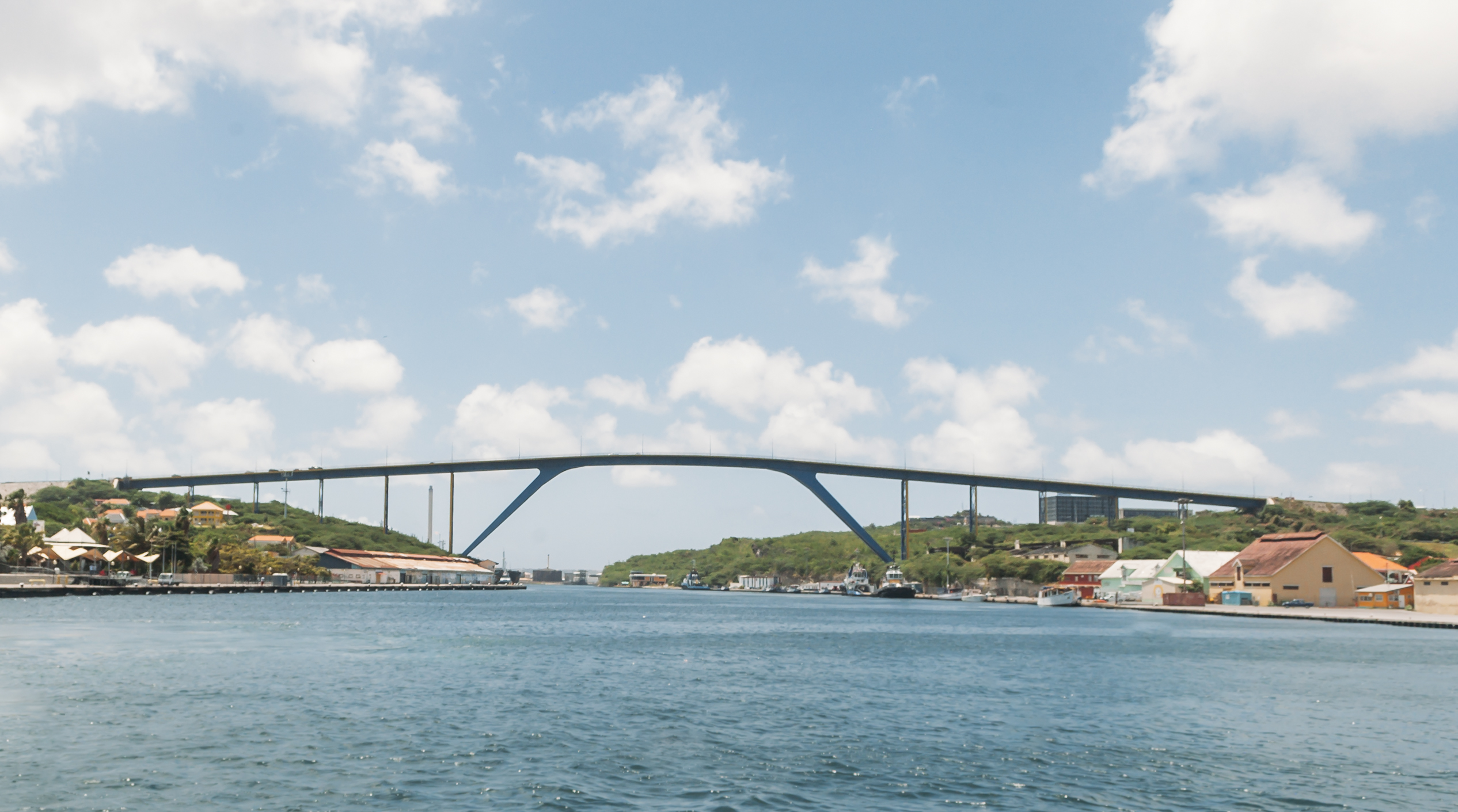
Willemstad is still, fundamentally, a city of two sides. Punda and Otrobanda face each other across Sint Anna Bay, connected by the Queen Emma pontoon bridge -- the Swinging Old Lady -- and the soaring Queen Juliana Bridge further inland. The bay between them serves as both division and lifeline: ships still pass through it, the pontoon bridge still swings open, ferries still shuttle pedestrians when it does. In 1997, UNESCO designated the historic center and its former suburbs as a World Heritage Site, recognizing the blend of Dutch colonial planning and Caribbean adaptation that gives the architecture its character. A large-scale renovation program has been transforming the old quarters building by building. Fort Amsterdam guards the harbor entrance from the Punda side. Rif Fort anchors Otrobanda's western edge. Between them, the painted facades catch the light in ways that no photograph quite captures, because the colors keep changing with the angle of the sun.
From the Air
Located at 12.108°N, 68.935°W on the southern coast of Curacao, roughly 65 km north of Venezuela. Willemstad's distinctive layout is visible from altitude: the narrow Sint Anna Bay splitting the city into Punda (east) and Otrobanda (west), with the Queen Emma pontoon bridge and the high-arching Queen Juliana Bridge connecting them. The oil refinery complex is visible to the west of the harbor. Curacao International Airport (ICAO: TNCC) lies 12 km north, serving approximately two million passengers annually. Best viewed at 3,000-5,000 feet for the full cityscape, or 1,500-2,500 feet for waterfront detail. The semi-arid climate and trade winds provide consistently excellent visibility.