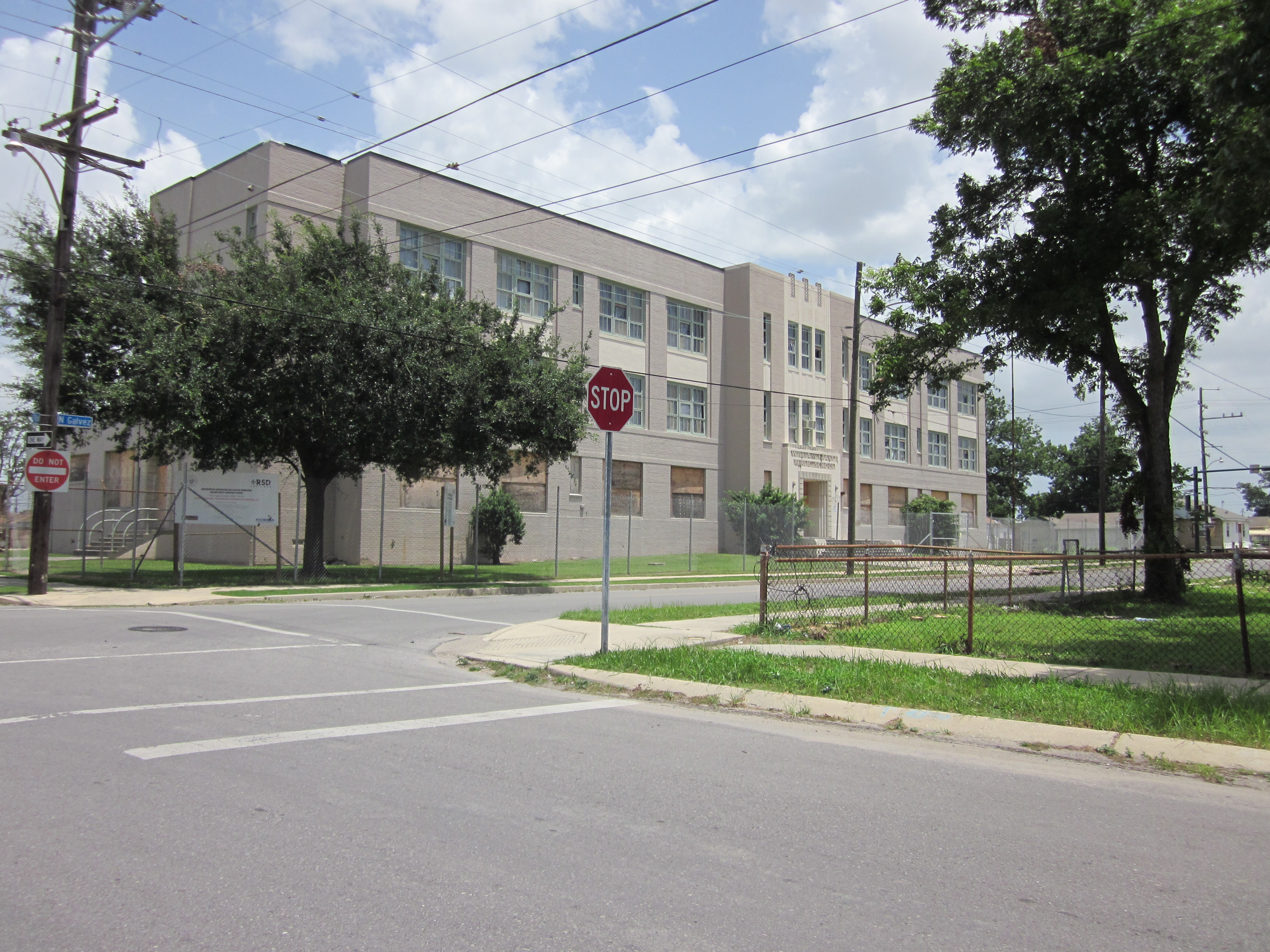
William Frantz Elementary School
She thought it was Mardi Gras. Six-year-old Ruby Bridges, riding in a car flanked by four federal marshals on November 14, 1960, saw the enormous crowd outside William Frantz Elementary School—the shouting, the thrown objects, the raw fury—and her mind reached for the only explanation a child in New Orleans would know. "There was a large crowd of people outside of the school," she later recalled. "They were throwing things and shouting, and that sort of goes on in New Orleans at Mardi Gras." It was not a celebration. It was the first day of school desegregation in the Deep South, and Bridges was about to become the only Black child to walk through those Art Deco doors.
A Building Before Its Reckoning
William Frantz Elementary School was built in 1937, designed in understated Art Deco style by the New Orleans school board's architect E.A. Christy. For more than two decades, it served as a neighborhood school for white families on North Galvez Street in the Upper Ninth Ward. Nothing about its clean geometric lines or orderly classrooms hinted at the role it would play in American history. But in 1960, a federal court ordered the desegregation of New Orleans public schools, and six African-American children passed the entrance examination that would determine whether they could attend previously all-white institutions. Two chose to remain at their old school, three were assigned to McDonogh No. 19 Elementary. Ruby Bridges was the only one assigned to William Frantz.
Four Marshals and a First-Grader
Ruby's father was reluctant, but her mother, Lucille Bridges, believed the family had to act—not just for Ruby's education, but to "take this step forward ... for all African-American children." On that November morning, the marshals escorted Ruby up the steps of William Frantz while a white mob hurled threats and epithets. Norman Rockwell immortalized the scene in his 1964 painting The Problem We All Live With, depicting a small girl in a white dress walking between towering federal agents, a tomato splattered on the wall behind her. Inside the school, the response was nearly as hostile: white parents pulled their children from classes en masse. Ruby spent her entire first-grade year as the sole student in her classroom, taught by Barbara Henry, a teacher from Boston who was the only one willing to instruct her.
Weathering the Storms
In 2005, William Frantz was listed on the National Register of Historic Places as a site of national significance. That same year, the New Orleans Public Schools system was already considering closing the aging building when Hurricane Katrina struck, flooding the ground floor under five feet of water. Instead of demolition, the school received a $23.5 million rehabilitation. Room 2306—the first-grade classroom where Ruby Bridges sat alone for a year—was restored to match its original 1960s appearance to honor her story. In 2014, a statue of Bridges was unveiled in the school's courtyard, placing her likeness permanently at the site of her courage.
A Classroom That Keeps Teaching
After its restoration, the building hosted Akili Academy, a charter school, before that institution merged with another. It then became the high school campus for Morris Jeff Community School, Louisiana's only PK-12 International Baccalaureate World School. The transformation is fitting: a building that once symbolized the most violent resistance to integration now houses one of the city's most intentionally diverse educational communities. Rockwell's painting hung in the White House during President Barack Obama's administration, where Ruby Bridges herself visited and stood beside it. The school on North Galvez Street remains what it became on that November morning in 1960—a place where the distance between injustice and progress can be measured in a single child's walk from the curb to the classroom door.
From the Air
William Frantz Elementary School is located at 29.976°N, 90.034°W in the Upper Ninth Ward of New Orleans, roughly 1.5 miles northeast of the French Quarter. The Art Deco building sits at 3811 North Galvez Street. From the air, look for the rectangular school building set among the residential grid of the Ninth Ward, east of the I-10 corridor. Nearest airports: Louis Armstrong New Orleans International (KMSY, 12 nm west) and New Orleans Lakefront (KNEW, 4 nm north). Best viewed at 1,500–2,500 ft AGL.