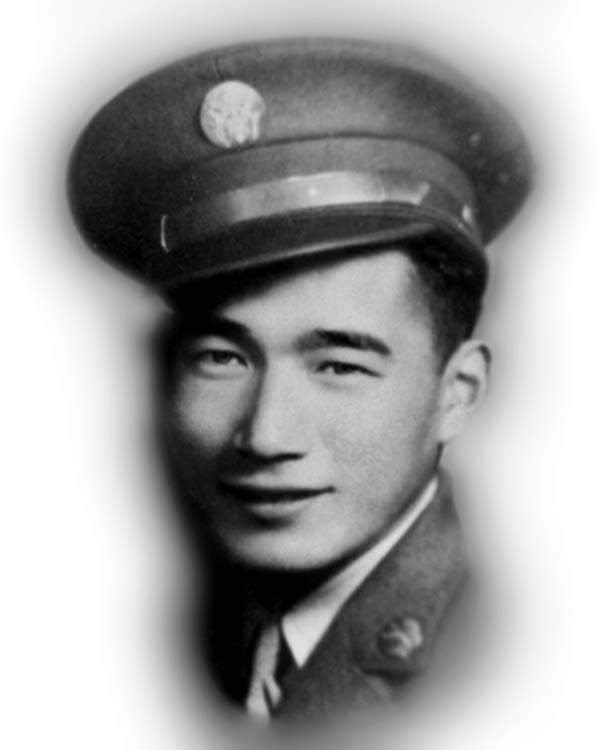
William K. Nakamura
On July 4, 1944, while Americans at home celebrated Independence Day, Private First Class William Kenzo Nakamura was fighting through machine gun fire near Castellina Marittima, Italy. He destroyed one enemy emplacement single-handedly, then volunteered to cover his unit's withdrawal. He was killed attacking a second machine gun nest that had pinned down his platoon. He was 22 years old. Back in Idaho, his family sat behind barbed wire at the Minidoka internment camp, imprisoned by the same government their son was dying to defend. It took 56 years for the United States to fully acknowledge what Nakamura did that day.
Japantown to Minidoka
Nakamura was born on January 21, 1922, in Seattle's Japantown -- the neighborhood now known as the International District. A Nisei, second-generation Japanese American, he grew up in a community that had built a life on the margins of a city that did not always welcome them. He attended Washington Middle School, graduated from Garfield High School, and enrolled at the University of Washington, where he lived in the University Students Club, a fraternal association for Japanese American students. Then came Pearl Harbor. In 1942, following Executive Order 9066, Nakamura's entire family was forced from their Seattle home and transported to the Minidoka War Relocation Center in the Idaho desert. Their crime was ancestry. Their punishment was indefinite incarceration.
The 442nd Goes to War
In July 1943, while his family remained behind barbed wire, Nakamura volunteered for the United States Army. He joined the 442nd Regimental Combat Team, the all-Nisei unit composed mostly of Japanese Americans from Hawaii and the mainland. The 442nd would become the most decorated unit of its size in American military history, its soldiers fighting with a ferocity that was inseparable from what they were fighting to prove. These were young men whose families had been stripped of their homes, businesses, and freedom by their own government. They answered by earning more medals per capita than any other American unit in the war. Nakamura shipped out to Italy, where the 442nd was deployed against entrenched German positions in the hills of Tuscany.
Independence Day, 1944
Near the town of Castellina Marittima on July 4, 1944, Nakamura's unit came under devastating fire from fortified German machine gun positions. Without waiting for orders, Nakamura advanced alone against the first emplacement and destroyed it. When his platoon needed to withdraw, he volunteered to stay behind and provide covering fire. Then he went after a second machine gun nest that was raking his comrades. He was killed in the assault. For this, the Army posthumously awarded him the Distinguished Service Cross, its second-highest combat decoration. It was an honor, but it was not the full truth. A 1990s review of Asian American service records from World War II revealed a pattern: acts of valor by Asian American soldiers had been systematically downgraded. Nakamura's Distinguished Service Cross was upgraded to the Medal of Honor.
Fifty-Six Years Later
On June 21, 2000, at the White House, President Bill Clinton presented the Medal of Honor to Nakamura's surviving family. Twenty-one other Asian Americans received the medal in the same ceremony -- all but seven of them posthumously. It was an acknowledgment, decades overdue, that race had influenced which acts of courage the nation chose to honor and which it chose to overlook. Nakamura is buried at Evergreen-Washelli Memorial Park in Seattle. The federal courthouse in downtown Seattle bears his name: the William Kenzo Nakamura United States Courthouse. At the University of Washington, where he once studied before internment cut his education short, a memorial on Memorial Way honors all eight UW alumni who received the Medal of Honor. The inscription reads: "Ordinary individuals facing extraordinary circumstances with courage and selflessness answer the call and change the course of destiny." Nakamura was 22 when he answered.
From the Air
Located at 47.657N, 122.310W, associated with the International District and University of Washington areas of Seattle. The William Kenzo Nakamura United States Courthouse is in downtown Seattle. The UW Medal of Honor memorial is on the university campus near Red Square. Evergreen-Washelli Memorial Park, where Nakamura is buried, lies in north Seattle near Aurora Avenue. Nearby airports include Boeing Field/King County International (KBFI, 5 nm south) and Seattle-Tacoma International (KSEA, 12 nm south). Best viewed at 2,000-3,000 ft AGL over central Seattle.