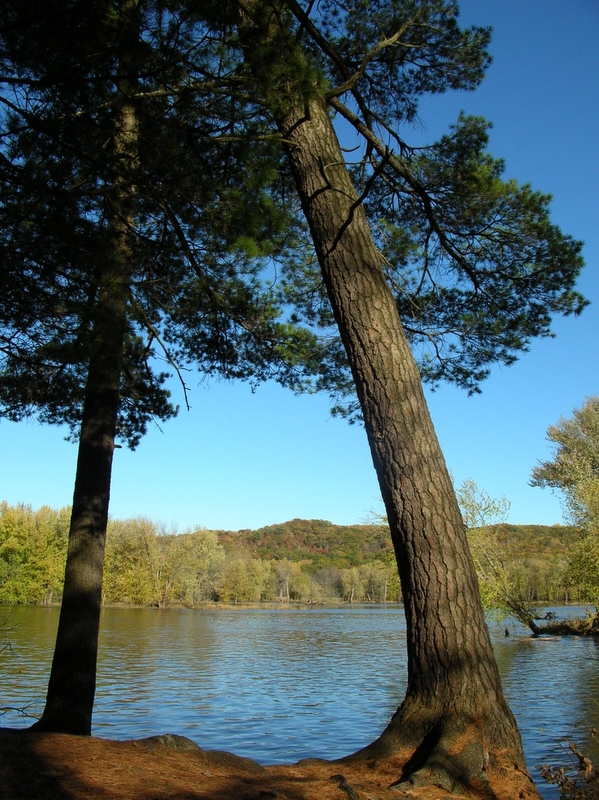
William O'Brien State Park
When the lumber companies finished with the white pines along the St. Croix River, they were happy to sell. They had taken what they wanted -- every tall, straight pine worth cutting -- and left behind a landscape of stumps and secondary growth that held little commercial interest. A lumber baron named William O'Brien saw something else in those spent acres. He bought up the land for his personal estate, and in doing so preserved a stretch of riverfront that would otherwise have been subdivided into farms or house lots. Twenty years after O'Brien died in 1925, his daughter Alice offered the property to the state of Minnesota. The timing was perfect: Minnesota had no state park within easy reach of the Twin Cities, and the legislature ratified the donation in 1947. Today, William O'Brien State Park remains one of the five most visited state parks in Minnesota, a green corridor along the St. Croix where glacial moraines meet restored oak savanna.
Before the Pines Fell
The St. Croix River valley was home to Dakota and Ojibwe tribes long before European contact. European fur trappers commercialized the trade in the 17th century, establishing routes along the waterways that would later carry timber. By the mid-19th century, logging had arrived in force. White pine was the target -- tall, straight, buoyant, and easily floated downriver to mills on the St. Croix and Mississippi. Most other tree species were ignored, left standing while the pines fell around them. The selective harvest reshaped the forest's composition, favoring hardwoods and creating the mixed woodland that characterizes the park today. The landscape visitors walk through is not wilderness but recovery, a forest that has been rebuilding itself for more than a century.
A Gift from Alice
William O'Brien made his fortune in lumber, then used it to acquire a riverside estate along the St. Croix near the small town of Marine on St. Croix. After his death in 1925, the property passed to his family. In 1945 his daughter Alice offered a stretch of riverfront to the state. Minnesota accepted eagerly, and the park was ratified by the legislature in 1947. Proximity to the Twin Cities metropolitan area proved a double-edged gift. The park was immediately popular, but nearby development threatened to encroach on its boundaries. Land was added at every opportunity -- in 1958, S. David Greenberg donated Greenberg Island in memory of his parents, an island accessible only by canoe that became a haven for wildlife and wildflowers. Expansion continued westward into the bluffs above Highway 95, where a second campground was established. A large tract was added in 1973, leapfrogging a rail line, and another parcel came in 1986.
Rolling Moraines and Oak Savanna
The park's terrain tells a glacial story. Rolling moraines -- ridges of gravel and clay pushed into place by retreating ice sheets -- give the hiking trails their undulating character. Between the ridges lie bogs, wetlands, and riparian zones along the St. Croix. Restoration work has brought back stretches of oak savanna, a landscape type that once covered vast swaths of the upper Midwest. Oak savanna depends on periodic fire to keep trees widely spaced and the understory open, a cycle that European settlement disrupted. The park's ecological management now includes prescribed burns to maintain these open, light-filled woodlands. The result is a patchwork of habitats within a compact area: dense forest on north-facing slopes, prairie-like savanna on the ridgetops, and wet bottomlands along the river.
Wings Along the River
Birdwatchers come to William O'Brien for the diversity that its varied habitats support. Raptors soar above the bluffs, riding thermals where the terrain drops to the river. Woodpeckers drum in the hardwood forests. Bluebirds and orioles flash through the oak savanna, while great blue herons stand motionless in the shallows near Lake Alice. Warblers pass through during spring and fall migration, drawn to the insect-rich canopy of the riverside forest. The park's resident mammals -- raccoons, white-tailed deer, foxes, minks, beavers, and woodchucks -- are most visible at dawn and dusk. Greenberg Island, reachable only by canoe, offers an even quieter experience, its shores thick with wildflowers in summer and largely free of the foot traffic that fills the mainland trails.
Slow Water on the St. Croix
The St. Croix through William O'Brien is part of the Saint Croix National Scenic Riverway, and this stretch is designated a slow-speed zone. Jet skis are not permitted. A concessionaire inside the park rents canoes by the hour and provides shuttle service from downstream take-out points, making the river accessible to paddlers of all experience levels. Anglers cast for northern pike, walleye, bass, and trout from the riverbank or from a fishing pier near the outlet of Lake Alice. The lake itself has a sandy beach for swimming -- the river's currents are too strong for safe swimming, so the lake provides a calm alternative. Two group camps along the river accommodate tent camping for up to fifty people each, while drive-in sites near the river and atop the bluffs serve both tent campers and RVs. Rustic cabins on the bluff offer bunk beds and screened porches, a step above canvas but still grounded in the simplicity that Alice O'Brien's gift intended.
From the Air
Located at 45.219°N, 92.766°W along the St. Croix River, approximately two miles north of Marine on St. Croix, Minnesota. The park stretches along the western bank of the St. Croix, which forms the Minnesota-Wisconsin border here. Lake Alice is visible as a small body of water within the park. Greenberg Island sits in the St. Croix just offshore. The park is identifiable by its forested bluffs rising above the river's western bank. Nearest airports: Lake Elmo Airport (21D) approximately 12 nm south-southwest; St. Paul Downtown Airport (KSTP) approximately 20 nm southwest. Highway 95 runs along the park's western edge, a useful visual reference. Best viewed at 2,000-4,000 feet AGL for the river corridor and bluff topography.