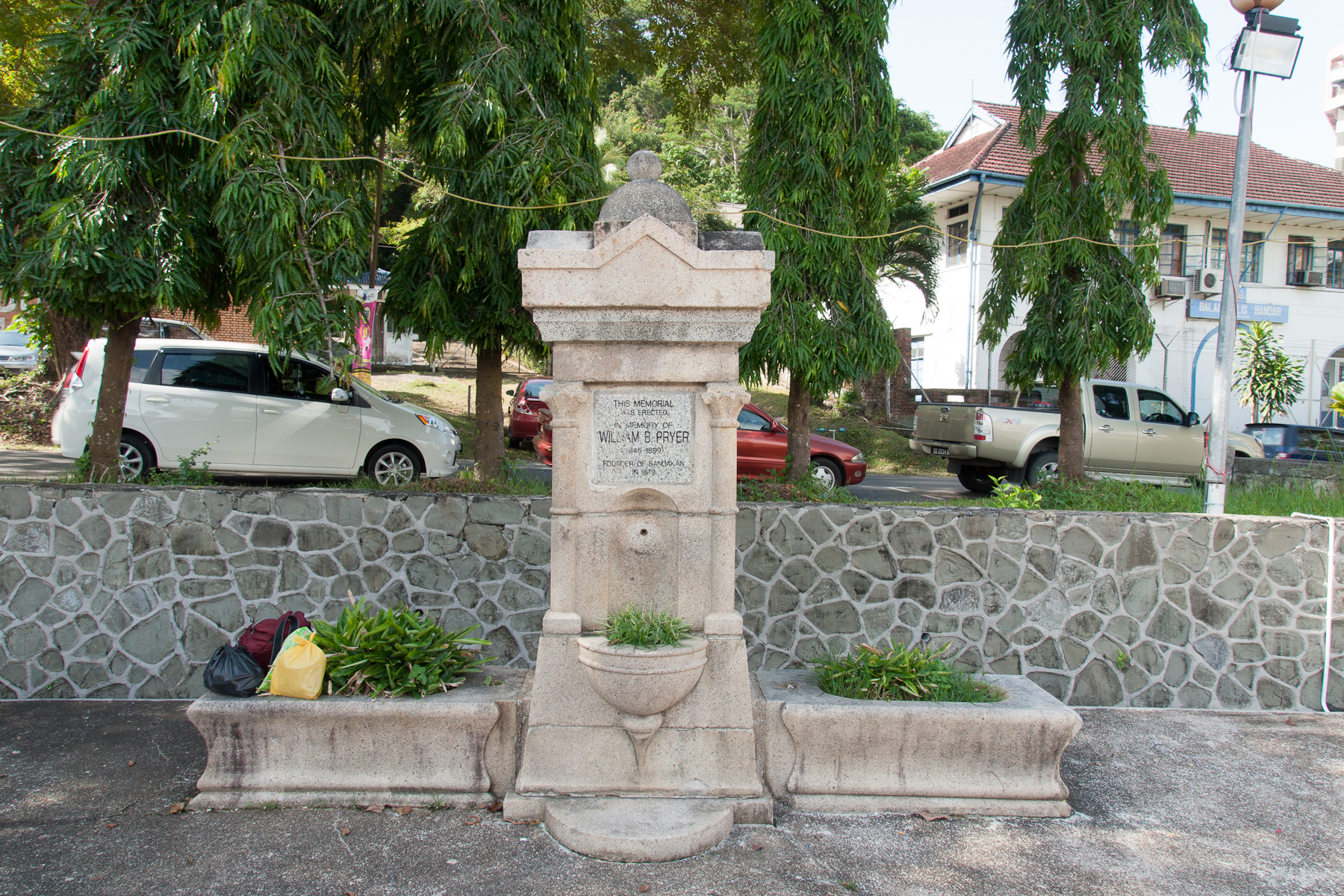
William Pryer Monument
The monument has never been able to sit still. In the 1950s, it stood on a square that would later become the site of the Sandakan Municipal Council building. In the early 1960s, it was relocated near a field. When Sandakan North Road was widened into a four-lane highway, it moved again. Today it rests on MPS Square, fronting the Municipal Council building alongside the Chartered Company Memorial, on what was once a hockey field. This granite fountain, dedicated to William Burgess Pryer -- the man credited with founding Sandakan -- has been shuffled across the town so many times that its wanderings have become a story in themselves, a physical record of how a colonial port town has continuously rebuilt and rearranged itself.
The Man Who Founded Sandakan
William Burgess Pryer arrived on the northeast coast of Borneo in the 1870s as an agent of the British North Borneo Company, tasked with establishing a settlement that could serve as an administrative and trading center. The site he chose -- sheltered by a natural harbor on Sandakan Bay -- would grow into the most important town on the east coast of what is now Sabah. Pryer was the settlement's first Resident, the official title for the senior British administrator in the territory. Under his watch, Sandakan attracted Chinese, Malay, Filipino, and European traders, becoming a cosmopolitan port where timber, birds' nests, and other jungle products were exchanged for manufactured goods from the wider world. The town he founded would serve as the capital of British North Borneo until the Japanese invasion in 1942.
A Fountain in Granite
The monument itself is a granite fountain, an unusual choice for a tropical memorial. It consists of a central section bearing a memorial inscription, flanked by gargoyles and two fountain troughs -- a design that owes more to Victorian municipal decoration than to anything indigenous to Borneo. The inscription commemorates Pryer's role as Sandakan's founder, establishing for the historical record a claim that, like most founding narratives, simplifies a more complicated story of indigenous presence, corporate ambition, and colonial settlement. The gargoyles add a touch of architectural whimsy to what is otherwise a straightforward commemorative object, their carved faces weathered by decades of tropical humidity.
A Monument That Keeps Moving
Most monuments are placed once and left alone. Pryer's fountain has been relocated at least three times since the 1950s, each move triggered by the same force: Sandakan's continuous physical transformation. The town was devastated during World War II and rebuilt from near-total destruction. Roads were widened, government buildings were constructed, and the urban fabric shifted around the monument like a river shifting around a rock. Each relocation was pragmatic rather than disrespectful -- the fountain was moved because the ground it stood on was needed for something else. Its current location on MPS Square, a former hockey field turned civic plaza, places it alongside the Chartered Company Memorial in a cluster of colonial-era monuments that together form part of the Sandakan Heritage Trails, a walking route connecting the town's surviving historical landmarks.
Founder's Legacy on a Changing Shore
Sandakan today bears little physical resemblance to the settlement Pryer founded. The wooden buildings, the timber wharves, the colonial government offices -- all were destroyed in the war. What remains of the town's pre-war identity exists primarily in monuments like this one, in photographs in the Heritage Museum, and in the street names that still echo the colonial era. Pryer's granite fountain is a modest artifact of a vanished world, its gargoyles and inscription more evocative of the British Isles than of equatorial Borneo. But its repeated relocations have given it a second story beyond the one carved into its stone. It is a monument that has survived by adapting, by accepting displacement, by finding a new place each time the old one was taken away -- not unlike the town it commemorates.
From the Air
Located at 5.841N, 118.116E on MPS Square in central Sandakan, Sabah, near the Municipal Council building and waterfront. Nearest airport is Sandakan Airport (WBKS), approximately 10 km to the west. The monument shares the square with the Chartered Company Memorial. From the air at 2,000-3,000 feet, MPS Square is identifiable as an open civic space along Sandakan's waterfront district.