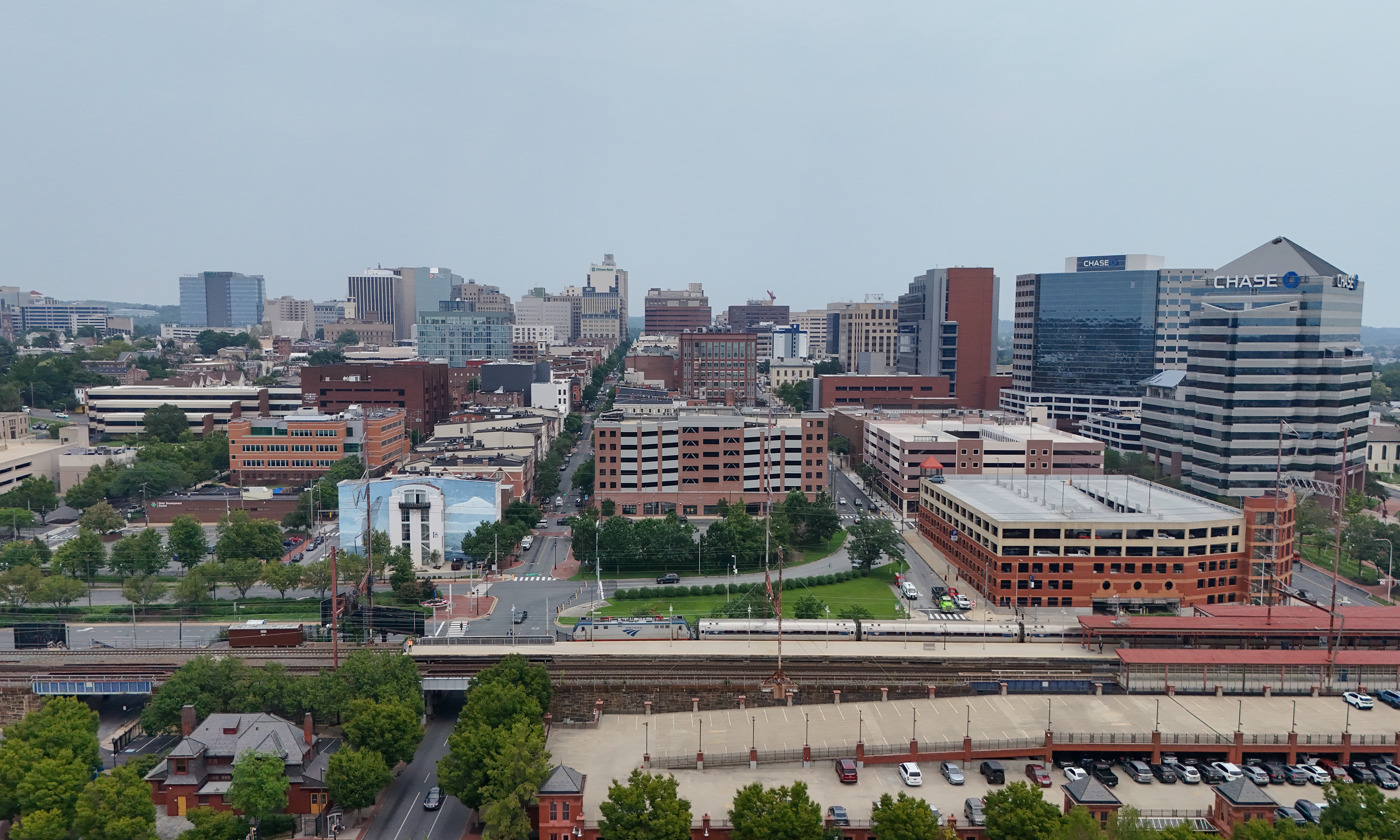
Wilmington: Where Half of Corporate America Is Legally Headquartered
More than half of all publicly traded companies in the United States are legally incorporated in Delaware, most of them listing addresses in Wilmington's office buildings even if their actual operations are thousands of miles away. Delaware's business-friendly laws - its specialized Court of Chancery, its flexible corporate statutes, its legal precedents favorable to management - have made Wilmington the nation's corporate capital on paper. But the city has a physical identity too, shaped largely by one family: the du Ponts, whose chemical fortune built the company town of the early 20th century and whose estates now constitute a museum trail through the Brandywine Valley. Joe Biden commuted daily from Wilmington to Washington during his 36 years in the Senate, a 90-minute Amtrak ride he took so often the train station now bears his name.
Corporate Capital
Walk through downtown Wilmington and you'll pass brass plaques marking the registered addresses of corporations you recognize: banks, tech giants, pharmaceutical companies, retailers. They're not physically here - perhaps a small office, perhaps just a mailbox - but legally, Wilmington is home. The Court of Chancery, Delaware's business court, handles corporate disputes with speed and expertise that general courts can't match; its decisions shape corporate law nationally. The Delaware Division of Corporations processes hundreds of thousands of filings annually. For Wilmington, this means white-collar employment in law firms, banks, and corporate services - and a tax base that funds public services far beyond what the city's 70,000 residents might otherwise support.
Du Pont Country
The du Pont family arrived in Delaware in 1802, refugees from revolutionary France who built a gunpowder mill on the Brandywine Creek. E.I. du Pont de Nemours & Company became the world's largest chemical company; the family became Delaware's wealthiest and most influential. Their legacy sprawls across the Brandywine Valley: Winterthur, a 175-room mansion housing the nation's finest collection of early American decorative arts; Longwood Gardens, Pierre du Pont's 1,000-acre horticultural showcase with its famous fountains; Hagley Museum, preserving the original powder mills and family estates. The Brandywine River Museum displays three generations of Wyeth family paintings in a converted mill. Du Pont wealth built the region; du Pont preservation saved it from suburban sprawl.
Riverfront Revival
Wilmington's Christina River waterfront was industrial wasteland until the 1990s, when redevelopment transformed abandoned shipyards into an entertainment district. The Chase Center hosts concerts and events; outlet shops and restaurants line the river walk; minor league baseball's Wilmington Blue Rocks play at Frawley Stadium. The Frank Furness Railroad District preserves the Victorian station architecture of the Reading Railroad era. Trolley Square, a neighborhood of rowhouses once served by streetcars, has become a dining and nightlife destination. Downtown's Rodney Square honors Caesar Rodney, Delaware's dramatic horseback ride to Philadelphia to cast the deciding vote for independence.
Biden's Hometown
Joe Biden lived in the Wilmington suburbs throughout his political career, commuting daily to Washington on Amtrak. The train ride became central to his biography - the Senator who went home every night, who knew the conductors by name, who kept his family life separate from the capital's social scene. After his 2020 election, Biden gave his victory speech in Wilmington; the city became the transition headquarters. The Amtrak station was renamed the Joseph R. Biden Jr. Railroad Station in 2011. Biden's Wilmington home, in the Greenville suburb, appears regularly in news coverage; local restaurants and businesses have found themselves unexpectedly famous.
Gateway Position
Wilmington sits at the junction of I-95 and I-495, 30 minutes south of Philadelphia, 90 minutes from both New York and Washington. Philadelphia International Airport (PHL) serves most visitors; Amtrak's Northeast Corridor stops frequently at Biden Station. The city anchors Delaware's narrow northern neck, where the state squeezes between Pennsylvania and New Jersey. Tax-free shopping draws visitors from neighboring states. From altitude, Wilmington appears as development along the Christina and Brandywine rivers - smaller than it seems given its corporate importance, the du Pont estates visible as green spaces to the north, Philadelphia's skyline visible on the horizon. What appears from the air as a modest Northeast city is where American corporate law is made and where half the Fortune 500 maintains its legal residence.
From the Air
Located at 39.75°N, 75.55°W where the Brandywine and Christina rivers meet in northern Delaware. From altitude, Wilmington appears as a modest city between Philadelphia and Baltimore - the du Pont estates visible as green spaces in the Brandywine Valley to the north, I-95 running through town. What appears from the air as Delaware's only significant city is the legal home of more than half of all U.S. publicly traded companies, thanks to business laws that have made 'incorporated in Delaware' an American corporate default.