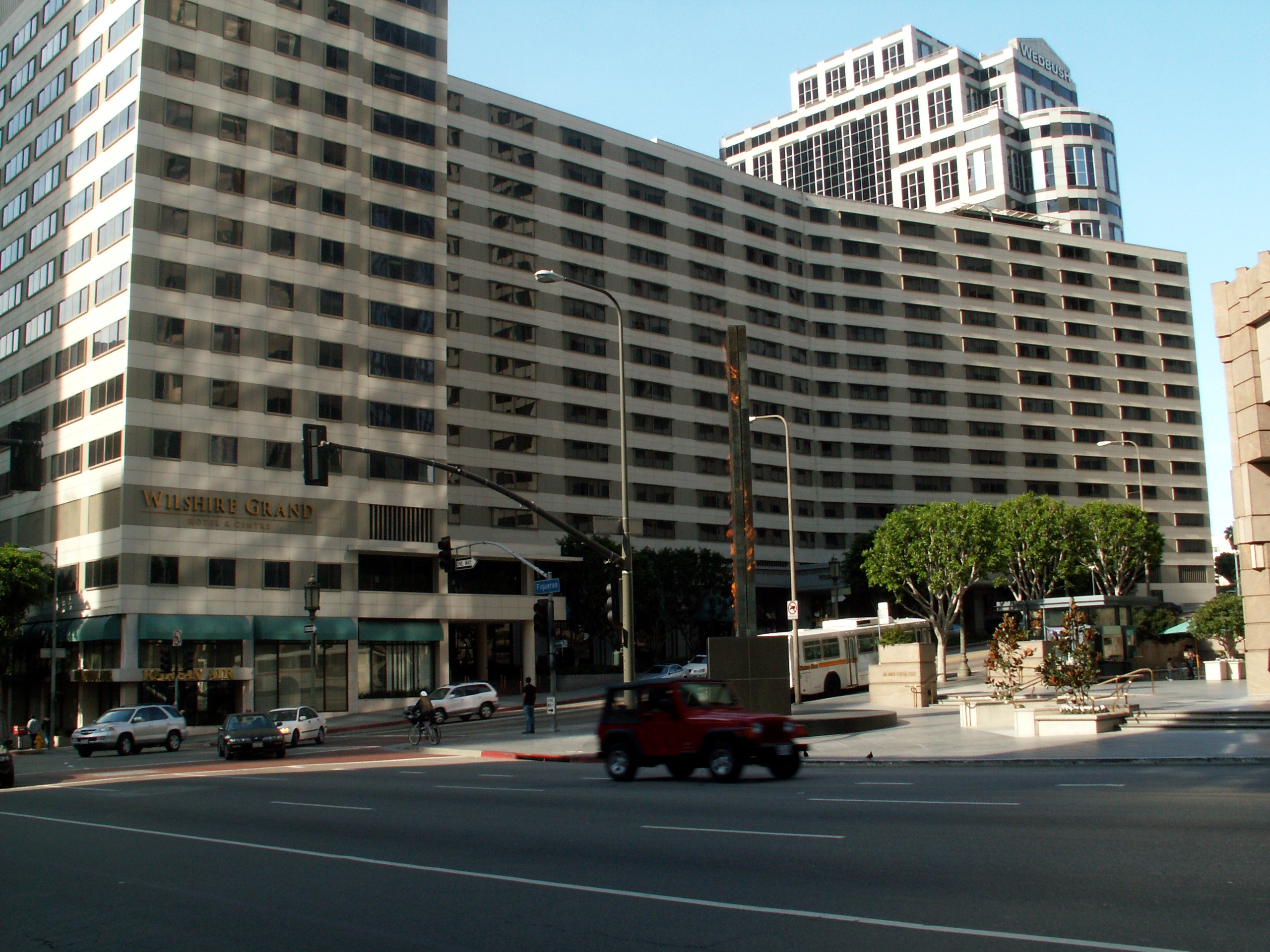
Wilshire Grand Center
On February 15, 2014, in the predawn hours of a Saturday morning, two thousand trucks lined up around a construction site in downtown Los Angeles and began an operation that would run for twenty straight hours. By the time it ended, workers had poured 21,600 cubic yards of concrete into the foundation of what would become the Wilshire Grand Center — a world record for a single continuous concrete pour. The building that grew from that foundation is now the tallest in the United States west of Chicago, a 335-meter tower that changed the silhouette of Los Angeles.
Where the Hotel Statler Stood
The site at Wilshire Boulevard and Figueroa Street had been occupied since 1952 by the Hotel Statler, later known as the Wilshire Grand Hotel. It was the kind of establishment that accumulated history through proximity to power: John F. Kennedy stayed there. Pope John Paul II slept there during his 1987 visit to Los Angeles. The hotel hosted the kind of events that cities use to mark their significance in the national conversation.
By the 2000s, the building was aging and the site was ripe for redevelopment. Hanjin Group, the Korean conglomerate that owns Korean Air, acquired the property and announced plans for a replacement that would be unambiguous about its ambitions. The old hotel came down. The record-setting foundation went in.
Building the Tallest Spire West of Chicago
The Wilshire Grand Center's height is 1,100 feet including its decorative spire — 335 meters to the structural top, enough to claim the title of tallest building in the western United States. The designation matters primarily as a statement of civic aspiration, but the engineering behind it is substantive. The building's 73 stories of mixed-use space — hotel rooms, offices, residences, restaurants — required structural solutions calibrated for both height and seismic risk.
One of the building's deliberate distinctions is its roof. A 1974 Los Angeles ordinance required all buildings taller than 75 feet to have flat roofs, ostensibly to facilitate helicopter landings during emergencies. The Wilshire Grand Center became the first building over 75 feet in the city to be built with a non-flat roof since that ordinance took effect — a curved, pointed form that the designers felt better expressed the building's character. Getting that exemption required negotiations that took years.
Spire 73 and the Record for the Sky
At the top of the Wilshire Grand Center, on the 73rd floor, sits a bar called Spire 73. It claims the title of the highest open-air bar in the Western Hemisphere — a distinction that is narrow in its technical requirements but extravagant in its effect. Sitting outside at that altitude, looking west toward the Pacific Ocean or north toward the San Gabriel Mountains, produces a particular quality of vertigo: the city spread below is recognizably Los Angeles, the freeways and boulevards and the white sprawl extending to the horizon, but the scale of the view renders it unfamiliar.
The bar is part of the InterContinental hotel that occupies the upper floors of the building. The combination of hotel, office space, and public-facing amenities like Spire 73 reflects the building's function as an anchor for downtown Los Angeles's ongoing attempt to create an urban neighborhood — one where people live, work, and choose to spend time in proximity to each other rather than dispersing to their cars and their suburbs.
A Korean Investment in an American City
The Wilshire Grand Center represents a $1.2 billion investment by a Korean corporation in the city of Los Angeles — a fact that reflects both Los Angeles's role as a Pacific Rim gateway and the willingness of international capital to bet on downtown density in a city long defined by sprawl. Hanjin Group built the tallest building in the western United States and put it in a neighborhood that, for much of the twentieth century, emptied out after business hours.
The bet appears to be paying off. The building is a landmark in the straightforward sense — a thing you navigate by, a presence that organizes the visual field from miles away. Whether it accelerated the transformation of downtown Los Angeles or simply participated in a transformation already underway is harder to measure. But the skyline changed when it went up, and the record-setting foundation beneath it ensures it will be part of the city for generations.
From the Air
The Wilshire Grand Center stands at 34.04993 N, 118.259926 W in downtown Los Angeles, rising 335 meters to its structural top. At 1,100 feet including the spire, it is the dominant structure in the downtown skyline and visible from aircraft approaching the LA basin from any direction. Los Angeles International Airport (KLAX) lies approximately 13 miles to the southwest. On approaches from the west, the Wilshire Grand Center and the adjacent US Bank Tower define the western skyline of the downtown core.