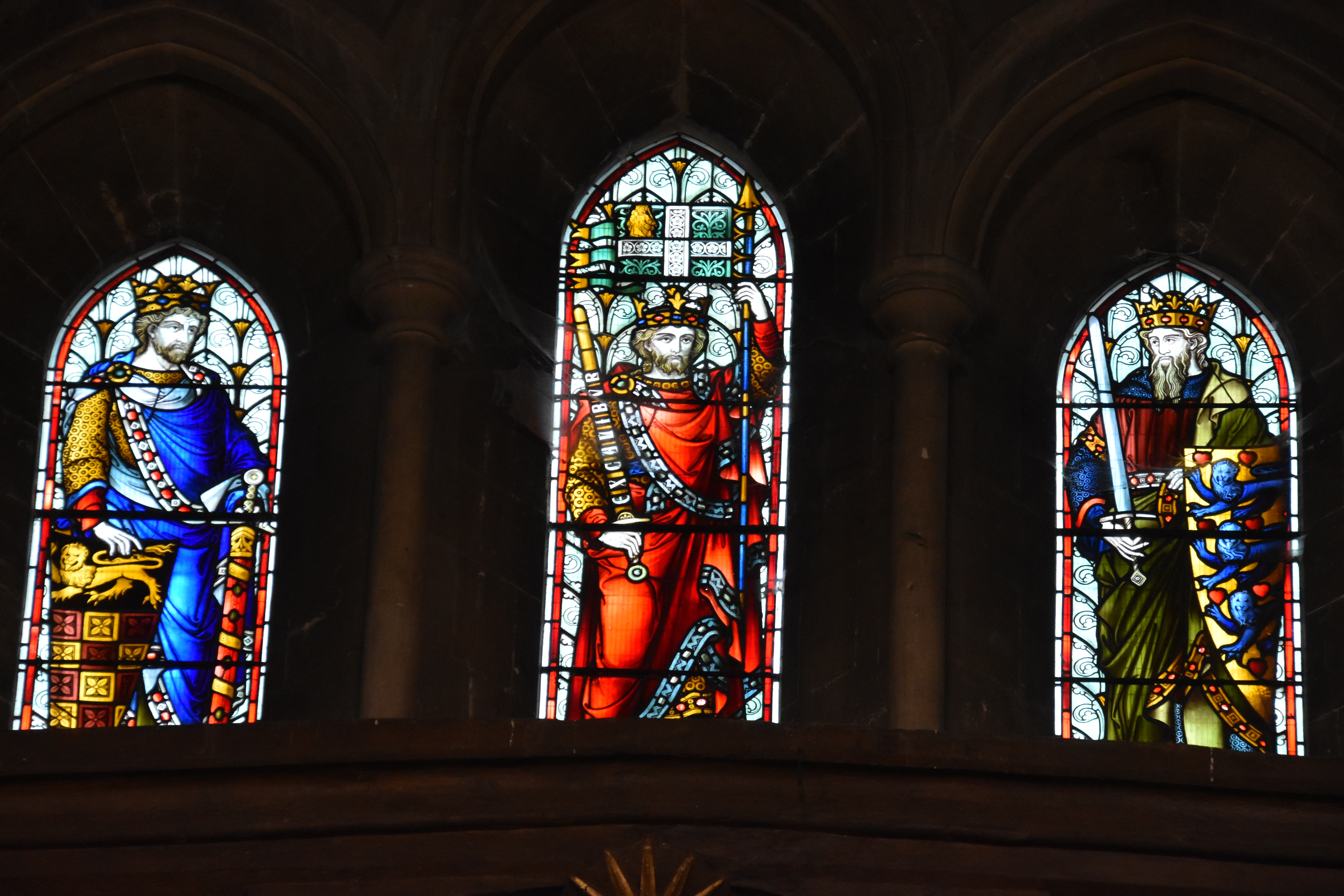
Winchester Castle
Hanging on the west wall of Winchester Castle's Great Hall is a massive round table, eighteen feet across, painted with the names of twenty-four knights and a figure of King Arthur at its head. For centuries, visitors believed it was the original Round Table of Arthurian legend. Dendrochronology dating has placed its construction at 1275 -- during the reign of Edward I, a king who understood the political power of myth. The table is a forgery, but a magnificent one, and the hall that houses it is the real thing: one of the finest surviving medieval halls in England.
The Seat of Norman Power
William the Conqueror founded Winchester Castle in 1067, just a year after the Norman Conquest. For over a century, it served as the seat of government for England's Norman kings, rivaling London in political importance. Henry II built a stone keep to house the royal treasury and the Domesday Book itself -- the great survey that catalogued every acre of conquered England. In 1141, during the civil war known as the Anarchy, forces loyal to the Empress Matilda were besieged by King Stephen's supporters at the castle in the Rout of Winchester. The castle weathered the chaos and remained a center of royal authority, with Edward I spending 1,100 pounds reinforcing it against anticipated French invasion between 1320 and 1326.
Trials and Tribulations
Winchester Castle's Great Hall has served as a courtroom for some of England's most consequential trials. In 1685, in the aftermath of the Monmouth Rebellion, the notorious Judge Jeffreys held the Bloody Assizes there, sentencing rebels to death with a ferocity that earned him lasting infamy. In 1954, the hall hosted a very different kind of trial: Lord Montagu, Michael Pitt-Rivers, and Peter Wildeblood were convicted of homosexual indecency in a case that helped catalyze the movement to decriminalize homosexuality in Britain. And in 1973, six members of the Provisional IRA were tried in the Great Hall for the Old Bailey bombing, one of the last major trials held there before the Winchester Law Courts opened in 1974.
Hidden Stories in the Walls
Not all the castle's history belongs to kings and conquerors. In 1287, a Hebrew inscription was carved into the ruins of the Jews' Tower by Asher, son of Licoricia of Winchester, during his imprisonment. The entire Jewish community had been confined in the castle on 2 May 1287, ahead of a massive tax imposed by Edward I -- a prelude to the expulsion of all Jews from England in 1290. The inscription survives as one of the most poignant physical remnants of medieval Jewish life in England. Elsewhere in the castle's story, the Catholic nun Elizabeth Sander was imprisoned here with other Catholics in 1580; she escaped but voluntarily returned to demonstrate that Catholics were law-abiding subjects.
What Survives
Oliver Cromwell ordered the castle demolished in 1649, after it served as a Royalist stronghold during the English Civil War. The Great Hall survived, along with the Westgate, the castle's principal defensive gateway. Behind the Great Hall, a medieval-style garden called Queen Eleanor's Garden was created in 1986. The Round Table, repainted in the Tudor period with a portrait of Henry VIII as King Arthur, remains the hall's centerpiece and its greatest curiosity -- a 13th-century political statement dressed up as legend. Underground passages and the remains of a 13th-century round tower with sally ports are still visible, traces of the castle that once rivaled the Tower of London as a symbol of royal power. Today the Great Hall is operated by Hampshire Cultural Trust, housing exhibits on Winchester's thousand-year history.
From the Air
Located at 51.06N, 1.32W in the center of Winchester, Hampshire. The Great Hall is near the western edge of the city center. Southampton Airport (EGHI) is approximately 10nm south-southwest. The cathedral nearby is a prominent landmark. Best viewed at 2,000-3,000 ft AGL approaching from the Itchen Valley.