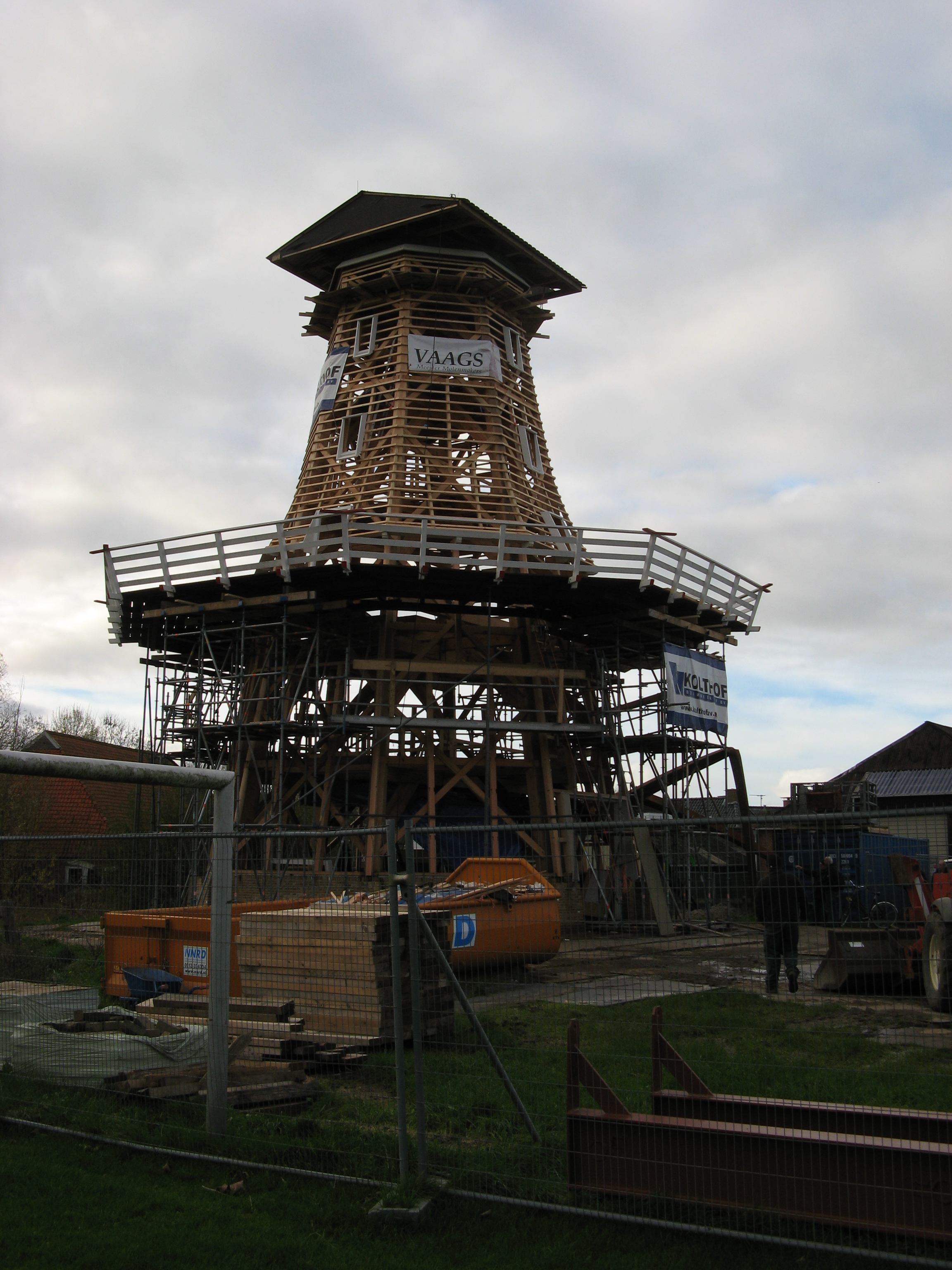
Windlust, Burum
Easter Sunday 2012, late evening. By the time the fire brigade reached the windmill on the edge of Burum, the entire smock was already a column of flame. Thatch and weathered oak burn fast. About thirty minutes after the first call, the mill collapsed in on itself — a 1757 stellingmolen that had ground grain and pearl barley for a quarter of a millennium, gone in under an hour. Six boys, aged twelve to fourteen, were later apprehended for setting it. The mill was insured for €1.45 million. Burum chose to spend it.
A Mill on the Edge of Friesland
Burum sits in the easternmost corner of Friesland, where the province trails off into Groningen, and a windmill has stood somewhere in or near the village since at least 1578 — that's the earliest written record, though there were almost certainly others before. The one called Windlust dated from 1757, a stellingmolen, which is the Dutch word for a smock mill with a stage built around its waist so the miller could reach the sails. Three stories of wooden octagon rose from a low brick foundation, the stage running around the third floor about six meters above the ground. Four Patent sails spanned 21 meters tip to tip. A cast-iron windshaft, forged at the Prins van Oranje foundry in The Hague in 1892, drove a brake wheel with sixty-seven cogs, and from there a chain of gear ratios stepped the power down to two pairs of French Burr millstones grinding flour and a second set producing pearl barley.
The Millers
A working windmill is really a family business with a roof on it. Reinder Durks Hamming had Windlust from 1811 to 1832. Harmannus Habbema took over around 1860 and worked it until he died in 1881. Eelke de Kok of Buitenpost came in 1888 and ran the mill for seventeen years before passing it to his nephew Thijs Berends, who held the trade for nearly four decades. In 1941 — wartime, fuel scarce, every traditional mill in the Netherlands suddenly more useful than it had been in a generation — J. Bremer took over. The mill's last full restoration before the fire was a 2007 rethatching of the smock. Five years later, that fresh thatch became its accelerant.
The Easter Fire
What happened on the night of 8 April 2012 has the dull shape of small-town news: a group of boys, somewhere between bored and stupid, did something that turned out to be much larger than they understood. The fire brigade documented the response. The mill was already lost when the trucks arrived. Half an hour after the flames began, the whole structure folded in on itself. Six teenagers, twelve to fourteen years old, were eventually identified and processed through the juvenile system. The insurance company paid out €1.45 million. The natural ending of this story would have been a memorial plaque on an empty lot. That is not what Burum chose.
Rebuilt, 2014
Construction started in July 2013. By June 2014, a new Windlust stood on the same spot, a working smock mill once again, with a windshaft cast by the Nijmeegsche IJzergieterij rather than the long-vanished Prins van Oranje works. The new shaft runs 4.67 meters, carries a brake wheel with sixty-six cogs, and turns sails spanning 22 meters — a meter wider than the original. The reconstruction is not registered as a Rijksmonument; the Dutch heritage rules reserve that protection for original structures, and a 2014 mill cannot pretend to be a 1757 mill no matter how faithfully it is built. But it is the right shape on the right horizon. The sails turn in the right wind. And the village made a quiet decision that some things are worth restoring even when you cannot get back the original wood.
From the Air
Located at 53.27°N, 6.23°E in the village of Burum, Friesland, near the Groningen provincial border. Recommended viewing altitude FL040-FL080 — low enough to make out the smock mill silhouette against the flat farmland. Nearest airports: Groningen Eelde (EHGG) to the east-southeast, Drachten (EHDR) to the southwest. The KPN/Inmarsat satellite earth station at Burum, with its distinctive parabolic dishes, sits just outside the village and is the most prominent landmark from the air.