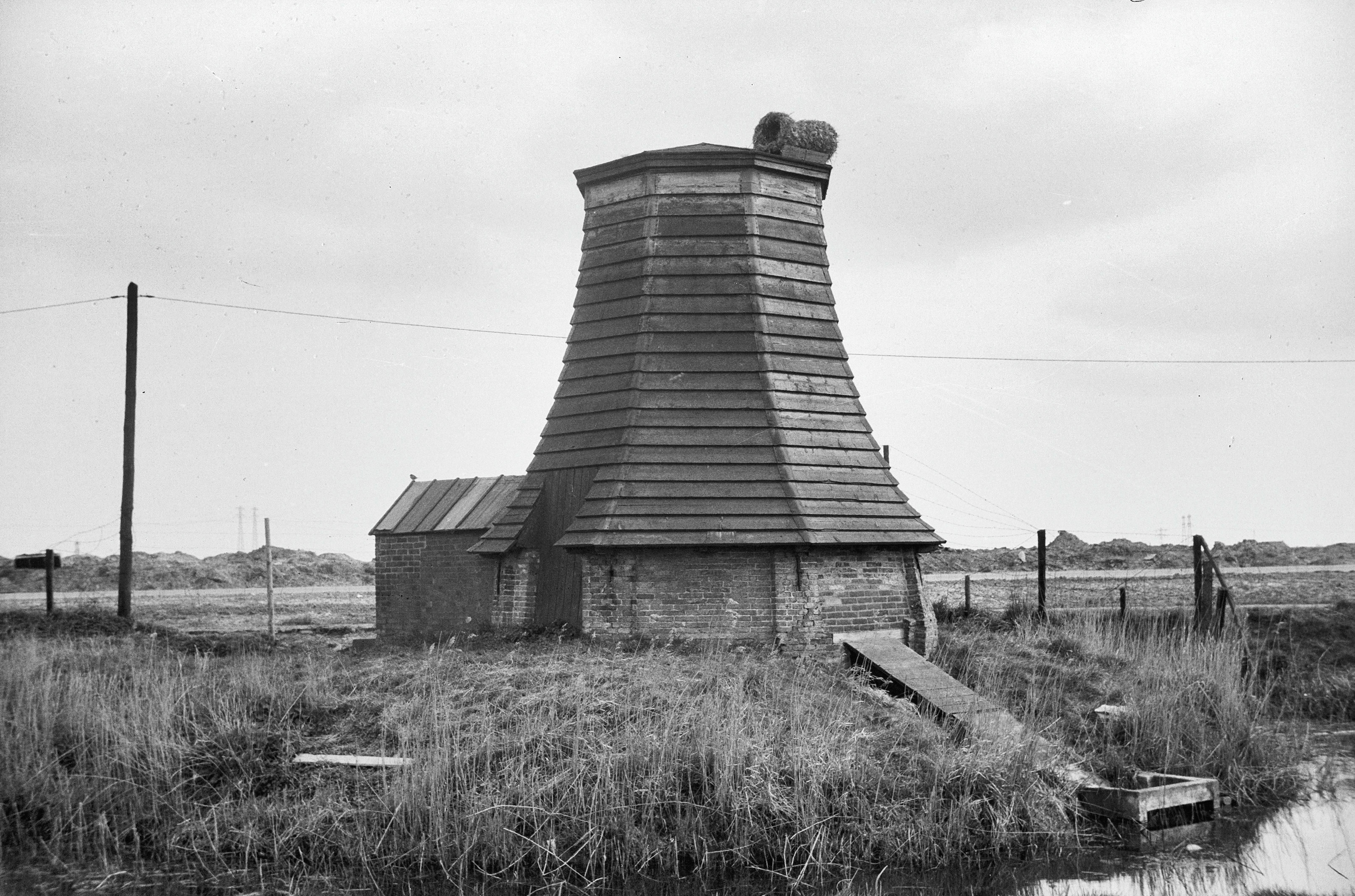
Windmills in Leeuwarden
Of the at least 130 windmills that the city of Leeuwarden has had standing inside its boundaries over the centuries, exactly one still turns there today. The Froskepôlemolen — the Frog's Patch Mill — sits on a small island called Froskepôlle, drains a piece of low ground that has needed pumping since 1850, and is kept in working order. The other 129 are gone: burnt down by arsonists, struck by lightning, moved to other towns, dismantled for their parts, replaced by steam engines, replaced by diesel engines, replaced by electric pumps, demolished for railways, demolished for bypass roads, or simply lost between one survey map and the next. Six of them survive elsewhere in the Netherlands, having been picked up and rebuilt in other places. The rest exist only on paper.
What 130 Mills Were For
The variety is what surprises. Leeuwarden's mills were not all corn mills, or all pumping mills, or all sawmills — they were almost everything a wind-powered industry could be. They sawed timber. They ground rye, wheat, oats, buckwheat, and barley. They hulled barley into pearl barley. They pressed oil from rapeseed for cooking and for paint. They ground gunpowder. They ground tobacco into snuff. They produced dyes. They produced cement. They pounded oak bark to make tannin for leather. They processed chicory root, the great nineteenth-century coffee substitute. They fulled cloth, slamming it with wooden hammers until the fibers tightened. And, all around the city's edges, they pumped water out of the polders and into the canals — the steady, unglamorous job that kept Friesland from going back underwater. One of the Leeuwarden mills, *De Eenhorn*, started life as a dye mill in 1516 and was a corn mill by 1582. Buildings did whatever the local economy needed.
The Polder Numbers
Most of the lost mills were not industrial — they were *poldermolens*, drainage mills, and they were so numerous that the surveyors stopped naming them and started numbering them. *Poldermolen Nr. 15*, *Nr. 21*, *Nr. 36*, *Nr. 50b* — the catalog runs into the high numbers, each entry a small spider-shaped *spinnenkopmolen* or stubby *grondzeiler* set down beside its piece of ditch. They were built before 1832 in most cases. They were still working in the 1850s. Then, mill by mill, they fell to the same handful of fates: an electric motor in the 1930s replacing the sails, the building demolished or left as a roofless base, the polder kept dry now by a black wire and a humming pump. By the time *Friese Molens* — the great Frisian mill survey — was published in 1995, almost all of these numbered mills were gone.
Fires, Storms, and One Foundation Stone
The named mills mostly died spectacularly. *De Eendracht* the first sawmill burnt down in 1878. *Het Fortuin* burnt down on 24 March 1886 after a steam engine had been installed inside it. *De Visser* — also known as *De Fisker* or *Molen van Timmermans* — survived dismantling in 1910, kept the smock standing for half a century as a shell, and finally burnt down on 16 January 1964, when it was already condemned for a bypass road. *De Kroon*, a snuff and paint mill that later ground gunpowder and oil, was demolished in 1914. *De Jong Fenix*, the bark, oil, and cement mill, came down in 1904, but its foundation stone was salvaged and is now on display inside the Fries Museum. Arson took several mills as late as the 1990s: the Cammingha-Buurstermolen burnt in May 1994; the Himriksmolen — by then moved to Tytsjerk — burnt on 30 June 1995, was rebuilt the following year, and now stands as *De Himriksmole*.
The Lone Survivor in Town
The Froskepôlemolen, the one mill that still turns inside the city limits, is itself an immigrant. It was built in 1850 as the *Huizumer en Goutumer Nieuwlandmolen*, drained a 350-acre polder a kilometer southwest of Leeuwarden's railway station, and was moved to its current site on Froskepôlle in 1962. It is a *grondzeiler*, a smock mill whose sails reach almost to the ground, and it is still maintained in working order — wind-powered, pumping its polder when the wind blows. Six other Leeuwarden mills survive in other Dutch towns: *De Eendracht* at Anjum, *De Phenix* at Marrum, *De Vlijt* at Marle in Overijssel, the Heerenveen-Hankate-Veenoord traveler now called *Nooitdgedacht*, *De Welkomst* at Minnertsga, *De Rosenboom* at Hantum. The mill economy that built and rebuilt and recycled these structures across two hundred kilometers of countryside is gone. The buildings, where they still exist, are quiet now, except when a volunteer miller decides to set the sails.
From the Air
The Froskepôlemolen — the single surviving in-city mill — stands at approximately 53.20°N, 5.79°E, on a small island called Froskepôlle on the southeast edge of Leeuwarden, in flat polder country woven with canals. The article covers a wide scatter of former mill sites across the city centre, the Harlinger Trekvaart corridor, the Dokkumer Ee, and the polders surrounding the urban area — most of which now show no above-ground trace. Leeuwarden Air Base (EHLW) is about 5 km west of the city. Best viewed at medium altitude in clear conditions, looking for the surviving mill against the green of the polder and the geometry of the Frisian drainage grid.