Windsor Castle: A Thousand Years on the Thames
William the Conqueror chose this hilltop for a reason. Standing fifty feet above the Thames on a chalk mound he ordered his men to dig, the new king of England could watch for threats from every direction. That was 1070. Nearly a thousand years later, the castle William planted still serves as home to the British monarch, making Windsor the longest continuously occupied palace in Europe. What began as a wooden motte-and-bailey fortification has grown into a 13-acre complex of stone wards, Gothic chapels, and lavish state apartments that collectively embody almost every phase of English architectural history.
From Timber to Stone
The early Norman kings actually preferred the old palace at nearby Old Windsor. It was Henry I who first treated the castle as a royal residence, celebrating Whitsuntide there in 1110 and marrying Adela of Louvain within its walls in 1121. During those years, the southern side of the motte subsided by over six feet, forcing builders to drive timber piles into the chalk and replace the wooden keep with a stone shell. King John used Windsor as his base during the negotiations that led to Magna Carta at nearby Runnymede in 1215, and the castle withstood a prolonged siege during the First Barons' War. By the mid-thirteenth century, Henry III had commissioned a luxurious palace inside the walls. Edward III went further still, launching what historians call 'the most expensive secular building project of the entire Middle Ages in England.'
A Theatrical Performance in Stone
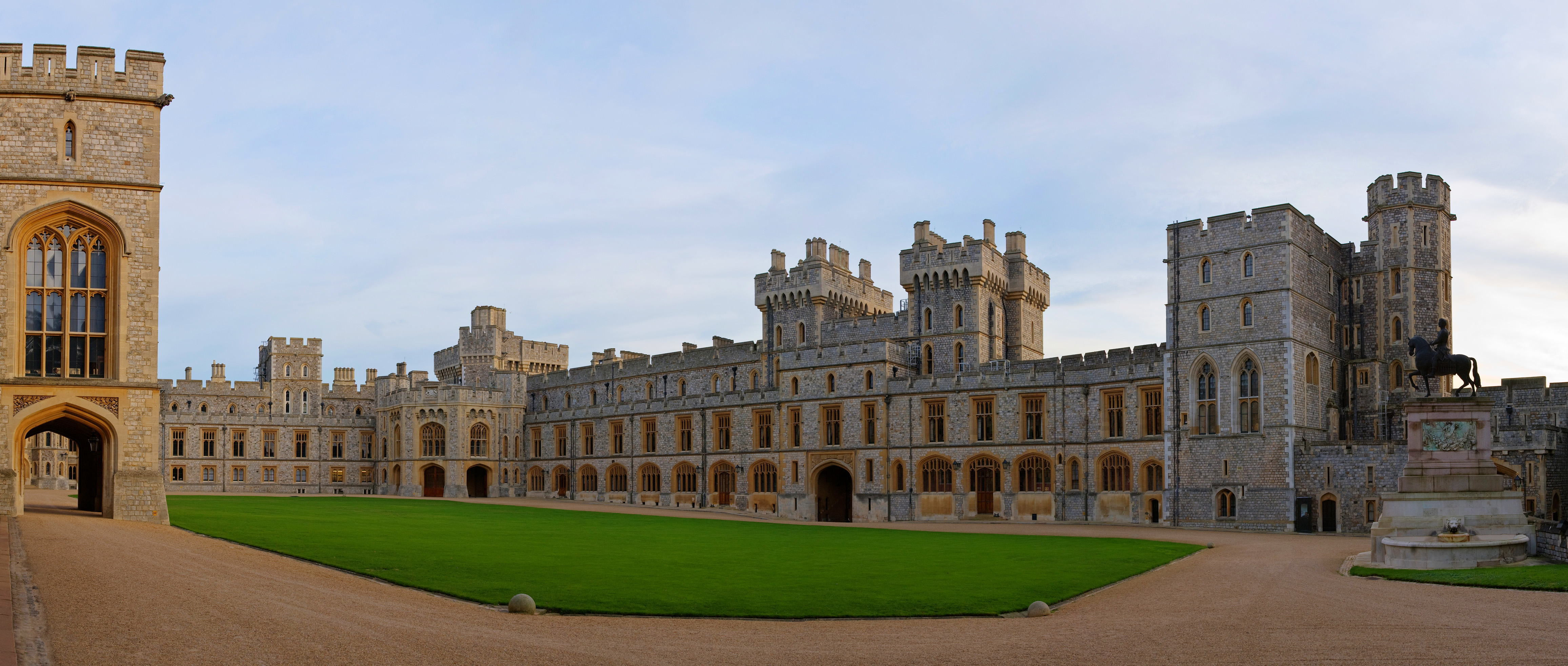
Windsor Castle is, architecturally, a magnificent fiction. Since the fourteenth century, each generation of builders has tried to reinterpret older fashions, repeatedly imitating outmoded styles until the whole complex became, as architect Sir William Whitfield put it, a place with 'a certain fictive quality' where 'a theatrical performance is being put on.' The Round Tower, which dominates the castle's silhouette, looks ancient but was extended upward by thirty feet in the early nineteenth century under Jeffry Wyatville to create a more imposing profile. The Upper Ward's skyline of tall towers and battlements was designed to be dramatic when silhouetted against the horizon, influenced by the Picturesque movement. Even the stonework is artful deception: small pieces of flint set into the mortar give walls from different centuries a matching appearance.
The Chapel and the State Rooms
Within the castle walls, the fifteenth-century St George's Chapel stands as what historian John Martin Robinson called 'one of the supreme achievements of English Perpendicular Gothic design.' Ten monarchs are buried here, including Henry VIII and Charles I. Above the chapel, the State Apartments run along the north side of the Upper Ward, following medieval foundations laid by Edward III. Wyatville designed each room to illustrate a particular architectural style -- Classical, Gothic, Rococo, with touches of Jacobethan -- and to display furnishings and fine arts from the matching period. The art historian Hugh Roberts described them as 'a superb and unrivalled sequence of rooms widely regarded as the finest and most complete expression of later Georgian taste.' These rooms survived largely intact until 1992, when a fire devastated the eastern end of the castle.
Fire and Restoration
On 20 November 1992, a fire broke out in the Private Chapel when a spotlight ignited a curtain. It burned for fifteen hours, destroying or damaging 115 rooms. The restoration that followed became one of the most ambitious architectural projects in modern British history. Conservators used 'equivalent restoration' methods, rebuilding rooms to look like their original appearance while concealing modern structural improvements beneath the period surfaces. The East Terrace garden, first laid out by George IV in the 1820s and tended during World War II by the young Princesses Elizabeth and Margaret as a victory garden, was also refreshed. In 2020, for the first time in forty years, the garden was opened to the public.
Living History
Windsor Castle remains a working royal residence. State visits are hosted in its grand rooms, investitures are conducted, and the Changing of the Guard takes place in its precincts. The Long Walk, a tree-lined avenue stretching nearly three miles through the Great Park, leads the eye south from the castle gates into the Berkshire countryside. From the air, the castle's three wards -- Lower, Middle, and Upper -- are clearly visible, clustered around the central mound where William's original timber keep once stood. The chalk motte, the Round Tower, and the Gothic chapel all endure. What William the Conqueror built to project Norman power has become something more enduring: a living chronicle of English history, each century adding its own layer to the story.
From the Air
Windsor Castle (51.48N, 0.60W) sits on the south bank of the Thames, 25 miles west of central London. The castle's three wards and Round Tower are clearly visible from altitude. The Long Walk extends south through Windsor Great Park. Nearby airports: London Heathrow (EGLL) 10nm east, White Waltham (EGLM) 4nm west. RAF Northolt (EGWU) 15nm northeast. Best viewed from 2,000-3,000ft approaching from the south along the Long Walk.