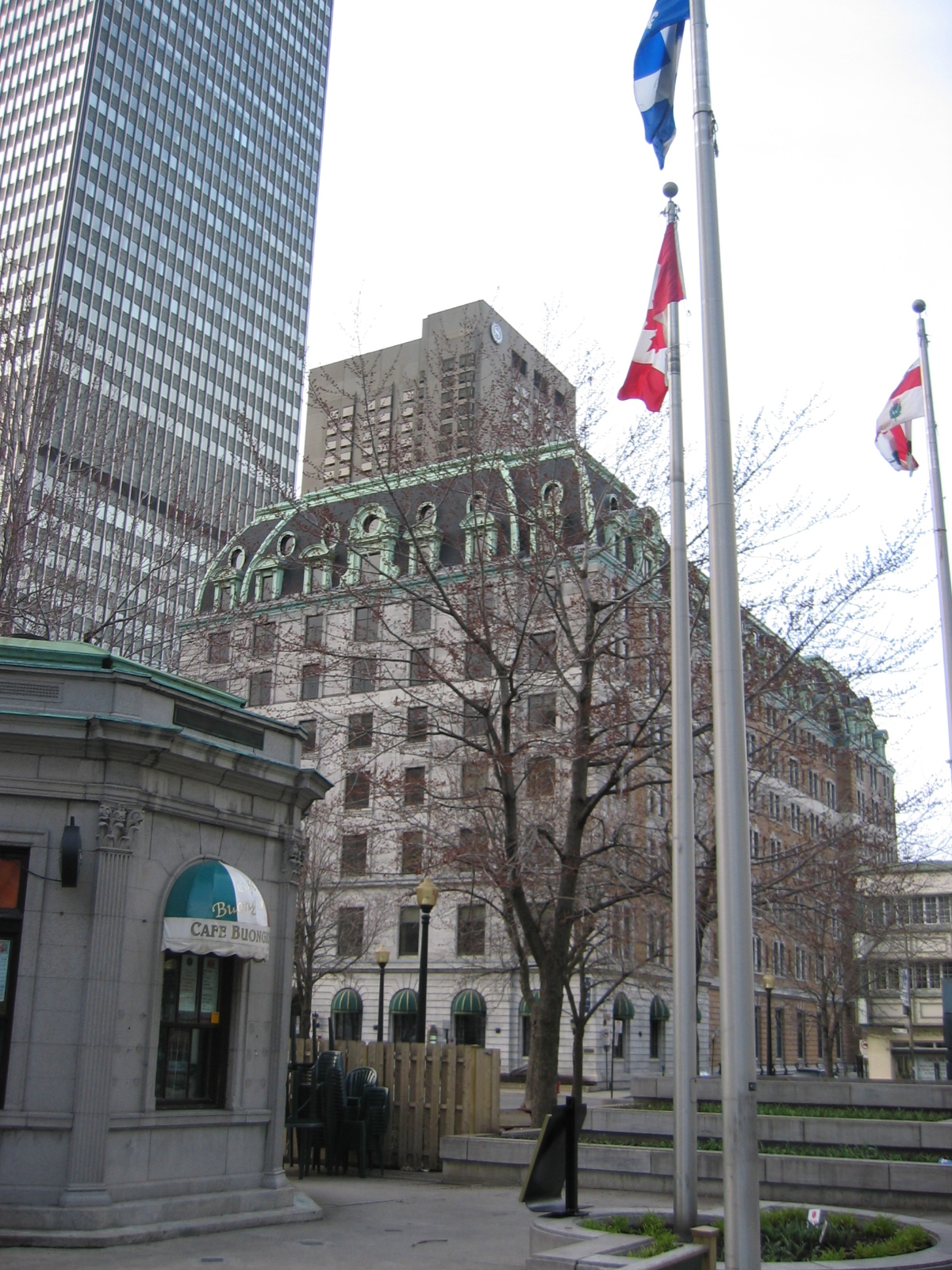
The Windsor Hotel: Where Canada Learned to Be Grand
On May 18, 1939, King George VI and Queen Elizabeth arrived at the Windsor Hotel in Montreal, and the city nearly tore itself apart trying to see them. The crowds surging toward the entrance on Peel Street were so enormous that one man died of a heart attack, dozens collapsed from heat and exhaustion, and police recovered 64 children who had been separated from their parents. At the state banquet that followed, Montreal's francophone mayor, Camillien Houde, addressed the monarchs in English and delivered a line that would outlive them all: "I thank you from the bottom of my heart for coming. And my wife thanks you from her bottom, too." The Windsor had been producing moments like this for six decades -- grand, chaotic, slightly absurd, and entirely Montreal.
A Consortium's Gamble on Grandeur
The Windsor Hotel was born from ambition and insecurity in equal measure. In the mid-1870s, Montreal was Canada's largest city and commercial capital, but it lacked a hotel that matched its self-image. A consortium of six Montreal businessmen -- including the photographer William Notman -- formed the Windsor Hotel Company, capitalized at half a million dollars, and hired architect G. H. Worthing to design something that would announce Montreal's arrival on the world stage. The hotel opened without fanfare on January 28, 1878. Then came the gala. It was the largest social gathering Montreal had ever seen, attended by Prime Minister Sir John A. Macdonald, Princess Louise, and the Marquess of Lorne. The hotel itself was not an immediate financial success -- early losses forced the consortium to take operations back from its leaseholder -- but the Montreal Winter Carnivals of the 1880s, held in the square outside, filled the rooms and cemented the Windsor's reputation. Within a few years, the guest register read like a Victorian who's who: Sarah Bernhardt, Mark Twain, Rudyard Kipling, Oscar Wilde, Lillie Langtry.
Fire, Peacocks, and an Entire City Block
In 1906, fire destroyed nearly 100 guest rooms. Rather than retreat, the hotel doubled down. Henry Janeway Hardenbergh -- the architect behind New York's Plaza Hotel and the Waldorf-Astoria -- was commissioned to design the Windsor Annex to the north. The number of rooms surged from 368 to 750, and the hotel now occupied an entire city block. The north annex introduced the famous Peacock Alley, named for the peacock motifs in its stained glass windows, along with two new ballrooms. Built in the Second Empire style, it contrasted with the original building's design but added a distinctly Parisian flair. The annex cost one million dollars and opened in 1908. The Windsor's success reshaped the surrounding neighborhood, drawing Morgan's department store and Ogilvy's to this stretch of downtown, while its rival, the Hotel Place Viger, slowly faded.
The Room Where Hockey Was Born
In 1917, the owners of the Montreal Canadiens, the Quebec Bulldogs, the Ottawa Senators, and the Montreal Wanderers gathered in one of the Windsor's restaurants and founded the National Hockey League. It was just one of countless decisions made within these walls that shaped Canada. Executives of both the Canadian Pacific Railway and the Grand Trunk Railway maintained permanent residences in the hotel, making it home to the men who controlled most of the country's transportation infrastructure and much of its economy. The humorist Stephen Leacock spent his winters living at the Windsor in his later years, writing letters and manuscripts on hotel stationery. In 1890, the hotel had built Windsor Hall next door as a concert venue -- the original home of the Montreal Symphony Orchestra -- though the hall was demolished in 1906 and the name transferred to a ballroom inside the hotel. For nearly a century, the annual St. Andrew's Society Ball remained a fixture of Montreal's social calendar, hosted within these walls.
Two Fires and a Vanishing Act
The 1957 fire was the one the Windsor could not survive intact. It destroyed a third of the hotel, and this time the original structure had to come down. The fifteen-ton cupola was removed on August 12, 1959. Within five years, the Tour CIBC office tower rose on the site of the original building. Only the North Annex remained -- 200 guest rooms, two ballrooms, and Peacock Alley -- and it continued operating as the Windsor Hotel for almost another quarter century. But newer hotels were rising across Montreal, and the Windsor could not compete. In 1975, the actress Dolores Costello returned for her seventy-second birthday party, honoring the hotel that had been her second home decades earlier. It was perhaps the last true glimpse of the old grandeur. The Windsor closed its doors as a hotel in 1981, 103 years after it opened.
Peacock Alley Lives On
The North Annex reopened in 1987 as "Le Windsor," an office building housing the securities division of Desjardins Group and Claridge, the trust management offices for the Bronfman family. But the conversion preserved what mattered most. Peacock Alley survives, along with marble staircases, ornate plaster ceilings, arched stained glass windows, and Austrian crystal chandeliers. The two grand ballrooms still host banquets, weddings, and conferences. Walking through Le Windsor today, you can still trace the outlines of a hotel that once billed itself as "the best in all the Dominion" -- a place where hockey leagues were founded, monarchs were toasted with accidental double entendres, and a young country practiced the art of being grand.
From the Air
The Windsor Hotel (now Le Windsor office building) sits at 45.499N, 73.571W on Peel Street in downtown Montreal, immediately south of Dorchester Square. From the air, the Second Empire-style North Annex is identifiable by its mansard roof along Peel Street, adjacent to the Tour CIBC office tower that replaced the original hotel structure. Nearby airports include Montreal-Trudeau International (CYUL) approximately 20 km west and Montreal-Saint-Hubert (CYHU) 15 km southeast. Best viewed at 3,000-5,000 feet AGL. Mount Royal rises prominently to the north, the St. Lawrence River waterfront lies to the south, and the Bell Centre is visible two blocks to the west.