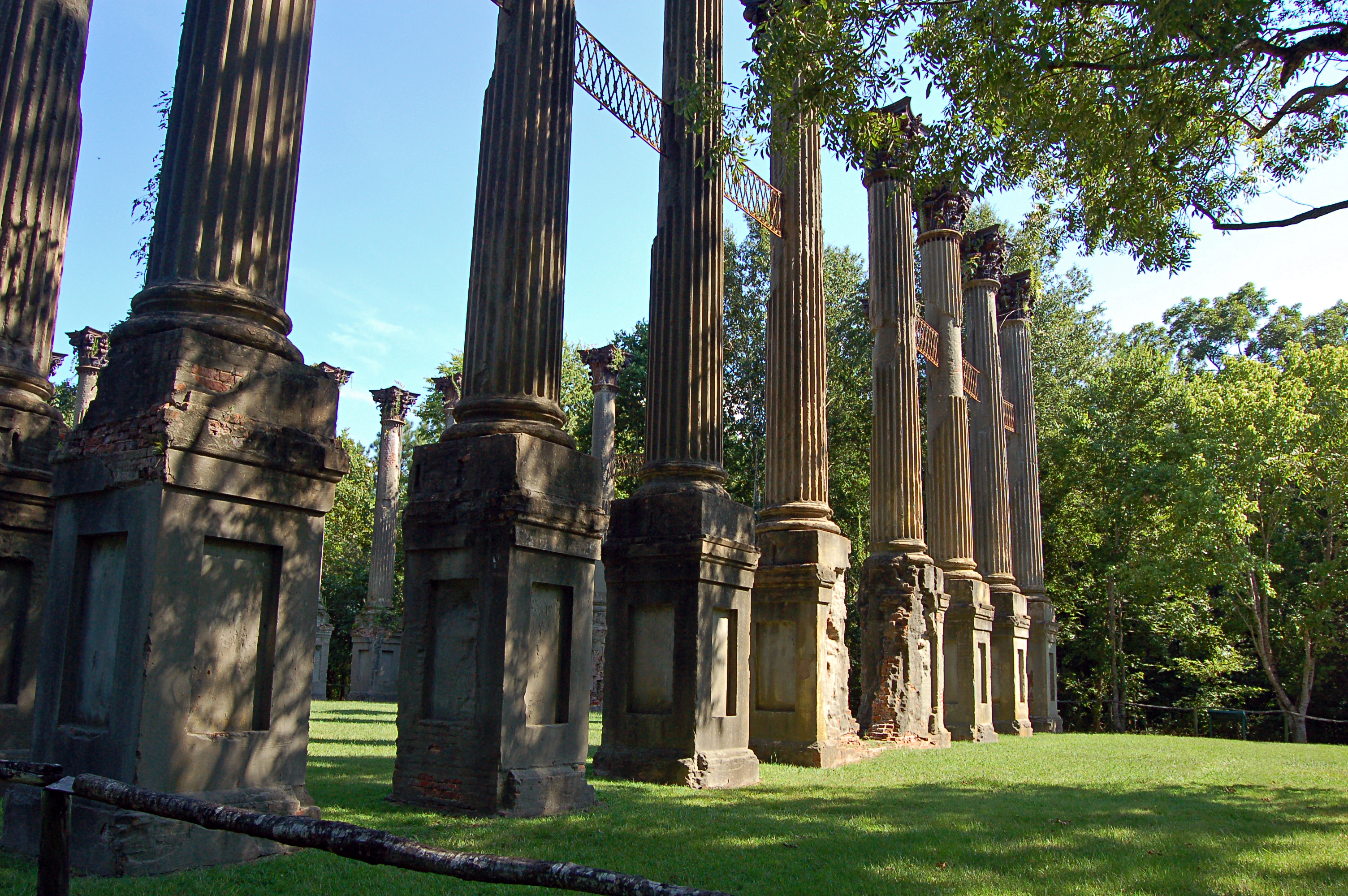
Windsor Ruins
Twenty-three columns rise forty-five feet from the red earth of Claiborne County, Mississippi, holding up nothing but sky. They are all that remain of Windsor, the largest antebellum Greek Revival mansion ever built in the state. The man who commissioned them, Smith Coffee Daniell II, was dead at thirty-four, just weeks after his masterpiece was finished. The mansion survived a war, hosted Mark Twain, and then burned to the ground one February night in 1890. What the fire left behind has become one of the most haunting landmarks in the American South -- a colonnade without a building, standing sentinel over a vanished world of cotton wealth and human bondage.
A Fortune Built on Cotton
Smith Coffee Daniell II was born in Mississippi and had amassed enormous wealth as a cotton planter by the age of thirty. In 1849 he married his cousin Catherine Freeland, and soon after began planning a mansion that would announce his status to the entire lower Mississippi Valley. He hired architect David Schroder, who also designed nearby Rosswood, and commissioned iron stairs, balustrades, and ornate Corinthian column capitals from St. Louis. New England carpenters were brought in to craft the finished woodwork. Enslaved laborers did the bulk of the construction, raising twenty-nine fluted columns to support a projected roofline that sheltered wide verandas on both the second and third floors. The seventeen-thousand-square-foot house held more than twenty-five rooms. The project cost $175,000 -- equivalent to over four million dollars today. Daniell died in 1861, mere weeks after construction was completed, leaving his young family in a mansion he barely inhabited.
The Union Hospital on the Hill
When the Battle of Port Gibson erupted on May 1, 1863, Windsor's commanding hilltop position made it an obvious asset. Union troops seized the mansion and converted it into a field hospital and observation post, its upper galleries offering sweeping views of the surrounding countryside. The Daniell family, rather than flee, was permitted to continue living on the third floor while Federal soldiers occupied the rest of the house. This pragmatic arrangement likely saved Windsor from the deliberate destruction that befell many Southern estates during the Vicksburg Campaign. Union soldier Henry Otis Dwight sketched the mansion while his unit was encamped on the grounds -- a drawing that would not surface until 1991, becoming the only known visual record of the intact building, since all original plans and photographs were lost in the fire that eventually consumed it.
Twain, Parties, and the Night It Burned
After the war, Windsor became renowned for lavish gatherings. Mark Twain reportedly attended at least one of these celebrations, having earlier mistaken the grand colonnaded structure for a college when he passed it as a riverboat pilot on the Mississippi. For a quarter century, the mansion stood as proof that something of the old planter world had survived the conflict. Then, on the night of February 17, 1890, fire destroyed the building entirely. The blaze left only the twenty-three columns still standing, along with cast iron stairways, sections of iron balustrade, and scattered pieces of bone china. Through the decades that followed, three of the surviving iron stairways quietly disappeared from the site. What remains is a skeleton of grandeur -- columns that once framed panoramic views of cotton fields now frame only open sky and the spreading canopy of old-growth trees.
Silent Columns, Lasting Memory
The Windsor Ruins were added to the National Register of Historic Places in 1971 and designated a Mississippi Landmark in 1985. The property remained in the hands of Daniell family descendants until 1974, when it was donated to the state of Mississippi. North of the columns lies a cemetery where members of the Daniell and Freeland families have been buried since the early nineteenth century; the earliest grave belongs to Frisby Freeland, an American Revolutionary War soldier who died in 1819. The ruins have appeared in two Hollywood films -- Raintree County in 1957 and Ghosts of Mississippi in 1996 -- their photogenic desolation proving irresistible to filmmakers seeking a visual shorthand for the antebellum South. From the air, the columns appear as a neat grid of pale dots in a green clearing, improbably orderly against the tangle of the surrounding landscape. They remain Mississippi's most evocative monument to the fleeting nature of wealth, ambition, and the human desire to build something that outlasts its maker.
From the Air
Windsor Ruins sit at 31.94N, 91.13W in Claiborne County, Mississippi, about 10 miles southwest of Port Gibson off Highway 252. From the air, look for a clearing with a distinctive grid pattern of columns near Alcorn State University. Nearest airports include Port Gibson's Claiborne County Airport and Natchez-Adams County Airport (KHEZ, ~30 nm south). Best viewed at 1,500-2,500 ft AGL in clear conditions. The columns cast dramatic long shadows in early morning or late afternoon light.