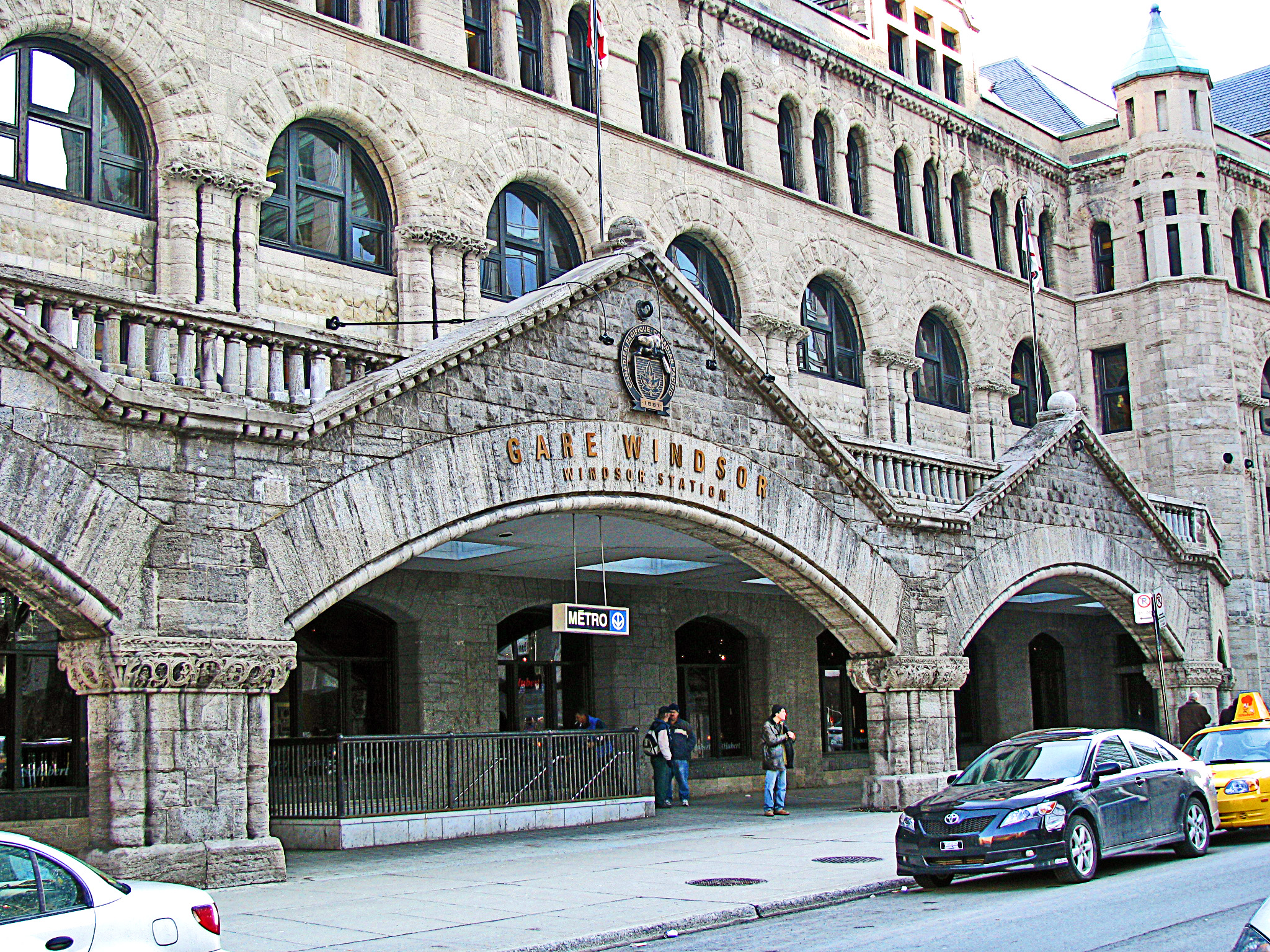
Windsor Station: The Fortress That Outlived Its Railroad
The architect submitted four versions of his plans before the treasurer of the Canadian Pacific Railway was satisfied. Bruce Price, the New York designer who would later create Quebec City's Chateau Frontenac, had been hired in 1887 to build CPR a headquarters worthy of the company that had just stitched a nation together by rail. What Price delivered on Peel Street was not a train station so much as a declaration of empire: gray Montreal limestone carved into Romanesque arches, massive columns, and a facade that announced the power of the company within. The first trains departed Windsor Station on February 4, 1889. For the next 107 years, every decision that mattered at Canadian Pacific -- the railway that built modern Canada -- was made inside these walls.
A Station That Grew Into a Skyline
Windsor Station was never meant to stay small. The original building served both as CPR's Montreal terminus and its corporate headquarters, but it was expanded three times as the railway's ambitions demanded. The first expansion came between 1900 and 1903, the second between 1910 and 1913, both by Canadian architects who extended the building along the sloping terrain -- four floors on one side, five on the other, following the natural grade. The third expansion in 1916 was the most dramatic: the firm of brothers Edward and William Maxwell added a fifteen-storey tower that transformed Montreal's skyline overnight. Windsor Station became an anchor of Dominion Square, the city's civic heart, channeling passengers into a web of streetcars, carriages, and eventually automobiles. The building sat where Windsor Street met Osborne Street -- both names now changed, to Peel and Avenue des Canadiens-de-Montreal respectively -- but the limestone walls remained.
The Tower That Almost Was
In July 1970, CPR announced it would demolish Windsor Station and replace it with a 60-storey office tower. The architects would be the same firm designing New York City's World Trade Center. The plan provoked an uproar. Windsor Station had been the gateway to Montreal for generations of travelers, the place where immigrants first set foot in the city and soldiers departed for two world wars. After several delays, the project was quietly abandoned, and in 1975 the station was designated a National Historic Site of Canada. It would later receive Heritage Railway Station status in 1990 and provincial historic monument classification in 2009 -- each designation another layer of protection for a building that had come within a boardroom vote of the wrecking ball.
Last Trains Out
The decline came gradually. Via Rail's creation in 1978 began consolidating intercity passenger services at Canadian National's Central Station across town. CP's former transcontinental routes -- The Atlantic Limited, The Canadian -- shifted to Central Station by the summer of 1979. The Via Dayliners to Quebec City held on until 1984. Amtrak's daily Adirondack service to New York City continued using Windsor Station until 1986. Local services to Ottawa via Montebello and to Mont-Laurier were cancelled entirely in 1981. After intercity service left, Windsor Station survived as a commuter rail terminal, serving suburban lines to Dorion-Rigaud and later Blainville and Delson. But even that would not last. In 1993, construction began on the Molson Centre -- now the Bell Centre -- immediately west of the station, on the very trackage that served its platforms.
Severed by a Hockey Arena
When the Bell Centre opened on March 16, 1996, it physically cut Windsor Station off from the rail network. The historic station was literally walled in. A new commuter terminal, Lucien-L'Allier Station, was built at the western end of the arena to handle the suburban trains that could no longer reach Windsor's platforms. The new station was initially called Terminus Windsor, but the name was changed in 2001 to avoid confusion with the original building and to link it with the Lucien-L'Allier metro station below. CPR had already moved its headquarters to Calgary in 1996 -- having restructured, sold its eastern trackage, and refocused on Western Canada. The company that had built Windsor Station as a monument to its continental reach simply left.
Limestone and Memory
Cadillac Fairview bought Windsor Station from CP in 2009 and redeveloped it into an office complex with restaurants and cafes. The thirteen terminal tracks and their overhead canopy were torn out and replaced by a public square. But the interior concourse remains open to the public and can be rented for events. The lower floor connects to Montreal's RESO -- the twenty-mile underground city -- linking Bonaventure metro station with the Bell Centre and the Lucien-L'Allier commuter terminal. You can still walk through the arena to reach the old station. Inside, the Angel of Victory statue stands in the main hall, a memorial to CPR employees who died in the First World War. The limestone walls are the same ones Bruce Price raised in 1889. The trains are gone, but the fortress endures.
From the Air
Windsor Station sits at 45.497N, 73.569W in downtown Montreal, immediately east of the Bell Centre arena. From the air, the Romanesque Revival building with its distinctive fifteen-storey Maxwell tower is identifiable along Peel Street, flanked by the large rectangular roof of the Bell Centre to the west and Dorchester Square to the northeast. Nearby airports include Montreal-Trudeau International (CYUL) approximately 20 km west and Montreal-Saint-Hubert (CYHU) 15 km southeast. Best viewed at 3,000-5,000 feet AGL. The station sits at the edge of Montreal's downtown core, with Mount Royal visible to the north and the St. Lawrence River waterfront to the south.