Winecoff Hotel Fire
The stationery said it plainly: "absolutely fireproof." Every guest who checked into the Winecoff Hotel at 176 Peachtree Street in Atlanta saw those words, and on the night of December 7, 1946, 304 people believed them. By dawn, 119 of those guests were dead, trapped above a fire that turned the building's single stairway into a chimney. The Winecoff disaster remains the deadliest hotel fire in American history, a catastrophe whose lessons are written into every fire exit sign, every sprinkler head, and every second stairwell in every hotel built since.
A Fireproof Trap
The Winecoff opened in 1913 as one of Atlanta's tallest buildings, a steel-framed tower rising fifteen stories above Peachtree Street. Its structure was genuinely fireproof: structural clay tile and concrete encased the steel, protecting it from collapse. But the term "fireproof" belonged to the insurance industry, concerned only with property loss. Inside those sturdy walls, corridors were lined with painted burlap fabric to wainscot height. Guest rooms wore as many as seven layers of wallpaper. Wooden doors had operable transoms above them for ventilation. And crucially, the building's H-shaped floor plan funneled all traffic through a single, unenclosed stairway. No fire doors. No sprinklers. One way out. A 1911 Atlanta building code loophole permitted buildings on small lots to have just one stair, and the Winecoff's narrow footprint qualified.
Three O'Clock in the Morning
The hotel was packed that December night. Christmas shoppers had come in from across Georgia. Others had traveled to see Disney's new film Song of the South, playing across the street. Forty high school students from the State YMCA of Georgia were staying for a youth-in-government legislative program. Around 3:15 a.m., a bellboy heading to the fifth floor noticed fire in the third-floor corridor, where a mattress and chair had been placed near the stairway. The building's fire alarm was never sounded. The night manager phoned the fire department at 3:42 a.m., nearly thirty minutes later, and by that time escape from the upper floors was already impossible. Open transoms fed fresh air to the fire, creating a flue-like effect that drove flames upward floor by floor. The burlap wallcoverings and layered wallpaper ignited in rapid flashovers, burning through doors and transoms on all but the fourteenth and fifteenth floors.
Ladders That Could Not Reach
The first engine and ladder companies arrived within thirty seconds of the call. People were already jumping from windows. Atlanta's fire department ladders could reach only partway up the fifteen-story building. Firefighters improvised, laying ladders horizontally across a ten-foot-wide alley to the neighboring Mortgage Guaranty Building. Others climbed the twelve-story building across the alley to fight the fire from above and pull survivors to safety. In total, 385 firefighters, 22 engine companies, and 11 ladder trucks responded, joined by mutual aid bringing 49 pieces of equipment. Guests tied bedsheets together and tried to descend. Some misjudged the narrow alley and attempted to leap across. Of the 119 who died, 32 fell or jumped. Among them were 30 of the 40 high school students, many placed in rear rooms with louvered shutters that blocked their view of the fire below. The hotel's builder and namesake, William Fleming Winecoff, age 76, and his wife Grace, who had lived in the hotel for 31 years, both perished.
A Pulitzer from a Last Flashbulb
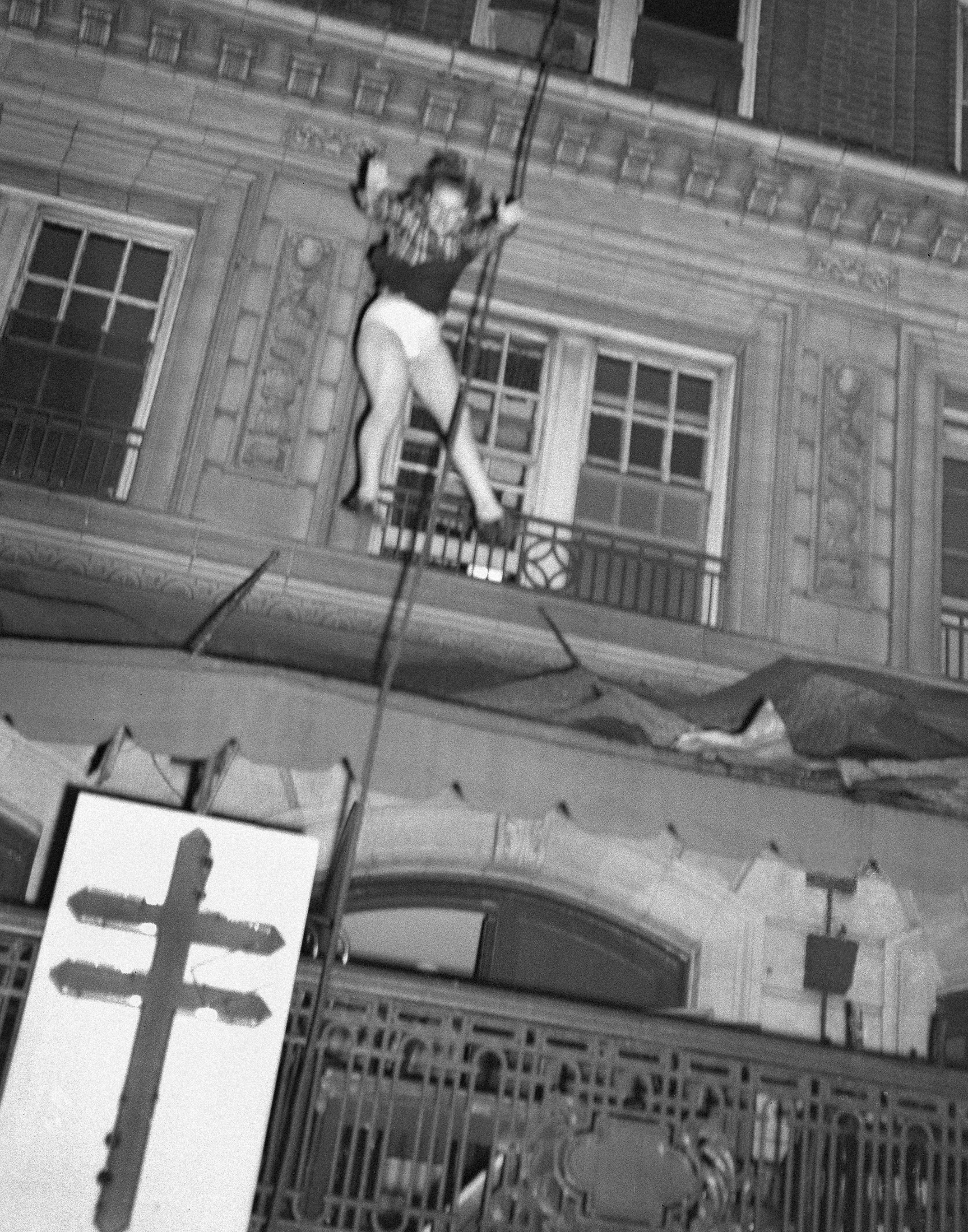
Arnold Hardy, a 24-year-old Georgia Tech graduate student returning home from a dance, heard sirens and grabbed his camera. He arrived at the fire scene with a single flashbulb left. He used it to capture the fall of Daisy McCumber from an upper window. McCumber survived. Hardy's photograph won the 1947 Pulitzer Prize for Photography, and the Associated Press bought his images for $300. The picture became one of the most reproduced news photographs of the era, a single frozen moment that condensed the horror of the night into an image the nation could not ignore.
The Code That Saved Every Hotel After
The Winecoff fire, coming six months after the La Salle Hotel fire in Chicago that killed 61, forced a national reckoning with fire safety. President Harry Truman convened a national conference on fire prevention in 1947. The National Fire Protection Association's Building Exits Code was overhauled, shifting emphasis from property protection to the protection of human life. Multiple enclosed stairways became mandatory. Operable transoms were banned. The flammability of interior finishes was codified into testing standards. The Steiner tunnel test became the ASTM-E84 standard for evaluating material fire hazard. Perhaps most significantly, the disaster sparked debate over enforcing new codes on existing buildings, previously considered an unconstitutional taking of property. The Building Exits Code was retitled the Code for Safety to Life from Fire in 1966, eventually becoming the Life Safety Code that governs buildings today. The Winecoff Hotel itself survived, its fireproof structure intact as promised. It reopened and still stands on Peachtree Street, now operating as the Ellis Hotel.
From the Air
Located at 33.7583N, 84.3878W in downtown Atlanta, Georgia, on Peachtree Street between Ellis Street and an alley. The building (now the Ellis Hotel) is surrounded by the Atlanta skyline. Best viewed at 2,000-3,000 feet AGL. Nearby airports: KATL (Hartsfield-Jackson Atlanta International, 9 nm south), KPDK (DeKalb-Peachtree Airport, 10 nm northeast), KFTY (Fulton County Airport, 8 nm northwest). Atlanta airspace is Class B, so expect ATC coordination.