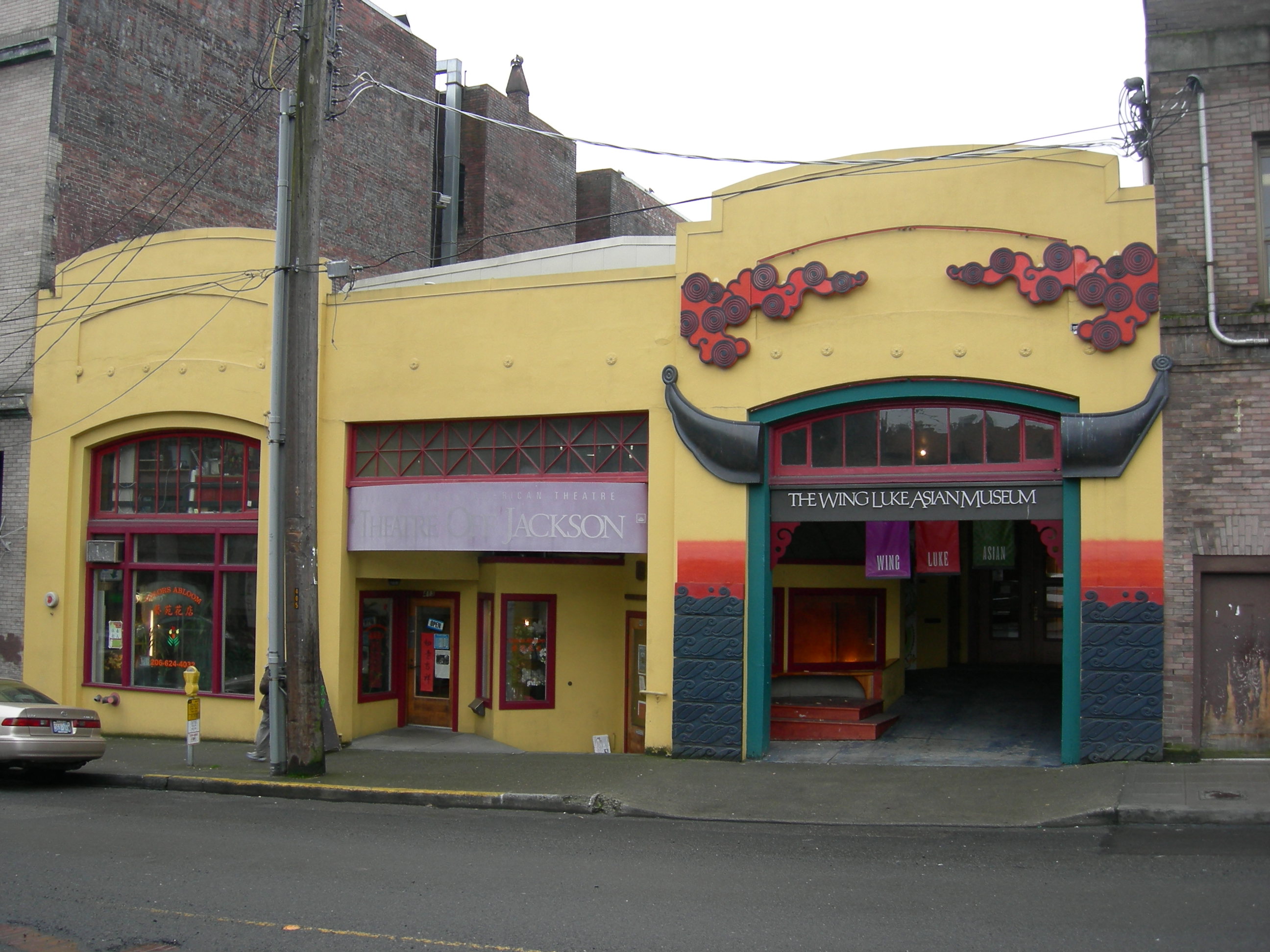
Wing Luke Museum
Wing Luke won his Seattle City Council seat in 1962 by a landslide of 30,000 votes, becoming the first Asian American to hold elected office in the Pacific Northwest and the first person of color on the council. He championed civil rights, pushed through Seattle's Open Housing Ordinance in 1963, and told anyone who would listen that the Chinatown-International District needed a museum to preserve the history of its rapidly changing streets. Then, on May 16, 1965, his small plane disappeared over the Cascade foothills. He was forty years old. The museum he envisioned opened two years later in a storefront on 8th Avenue, built on donations from the friends and supporters who refused to let his idea die with him.
A Storefront on 8th Avenue
The Wing Luke Memorial Museum, as it was first named, opened in 1967 with a focus on Asian folk art. It was small and specific, a neighborhood institution in a neighborhood that knew what it meant to be overlooked. But the collection soon outgrew its original scope. By the 1980s, community volunteers were building pan-Asian exhibits that reflected the full diversity of the district -- Chinese, Japanese, Filipino, Vietnamese, Korean, and more, over 26 ethnic groups in total. In 1987 the museum moved to larger quarters on 7th Avenue and updated its name to Wing Luke Asian Museum. Under the direction of local journalist Ron Chew in the 1990s, the museum pioneered a community-based exhibition model that placed personal stories at the center of every display. Community Advisory Committees guided each exhibit from concept to installation, a process that could take 12 to 18 months. In 1995 the model earned the museum the Institute for Museum and Library Services National Award for Museum Service.
Inside the Kong Yick Building
In 2008 the museum moved into its current home at 719 South King Street, the renovated 1910 East Kong Yick Building. The building itself is an artifact. It was funded by 170 Chinese immigrants who pooled their resources to construct it, along with its companion, the West Kong Yick Building. The East Kong Yick housed storefronts at street level and the Freeman Hotel above, where Chinese, Japanese, and Filipino immigrants lived until the 1940s. Today the museum's galleries share the structure with preserved and recreated spaces: the Gee How Oak Tin Association's meeting room, cramped hotel kitchens, a Canton Alley family apartment, and the Yick Fung Mercantile, a general store whose owner donated its entire contents. Walking through these rooms is less like visiting a museum and more like stepping through a wall into a parallel century.
Canton Alley and the Neighborhood Beyond
The museum sits next to Canton Alley in Seattle's Chinatown-International District, a narrow passage that was once the residential, commercial, and communal heart of the Chinese American community. Since 1985, the Wing has run Chinatown Discovery Tours, taking visitors through the neighborhood's significant sites and living history. In 2010 the museum adopted its full current name -- the Wing Luke Museum of the Asian Pacific American Experience -- though most people simply call it The Wing. Three years later, it was recognized as one of two dozen affiliated areas of the U.S. National Park Service, and it remains a Smithsonian Institution affiliate and the only pan-Asian Pacific American community-based museum in the country. The oral history lab inside the building captures stories from new arrivals and longtime residents alike, adding voices to a collection that grows with every generation.
Windows Broken and Rebuilt
On September 14, 2023, nine of the museum's windows along Canton Alley were destroyed in what authorities described as a racially motivated crime. The Washington State Department of Commerce and the City of Seattle responded with financial donations, and the broken panes were replaced with a decorative mural that turned damage into declaration. It was not the first time the museum had absorbed a blow and come back stronger. Wing Luke himself understood that resilience was the story -- he had immigrated from China as a child, worked his way through law school, and fought housing discrimination from a council chamber where no one who looked like him had ever sat. The museum that carries his name continues that pattern: community-funded, community-directed, community-defended.
From the Air
Located at 47.598°N, 122.323°W in Seattle's Chinatown-International District, just south of downtown. The museum is in the dense urban grid south of Pioneer Square and east of the stadiums (Lumen Field and T-Mobile Park). Boeing Field (KBFI) lies approximately 3nm to the south; Seattle-Tacoma International (KSEA) is about 10nm south-southwest. The Chinatown-International District is identifiable by its position between the elevated rail lines and the I-5/I-90 interchange. Best viewed at lower altitudes where the historic neighborhood's compact blocks contrast with the larger commercial structures to the north and the industrial district to the south.