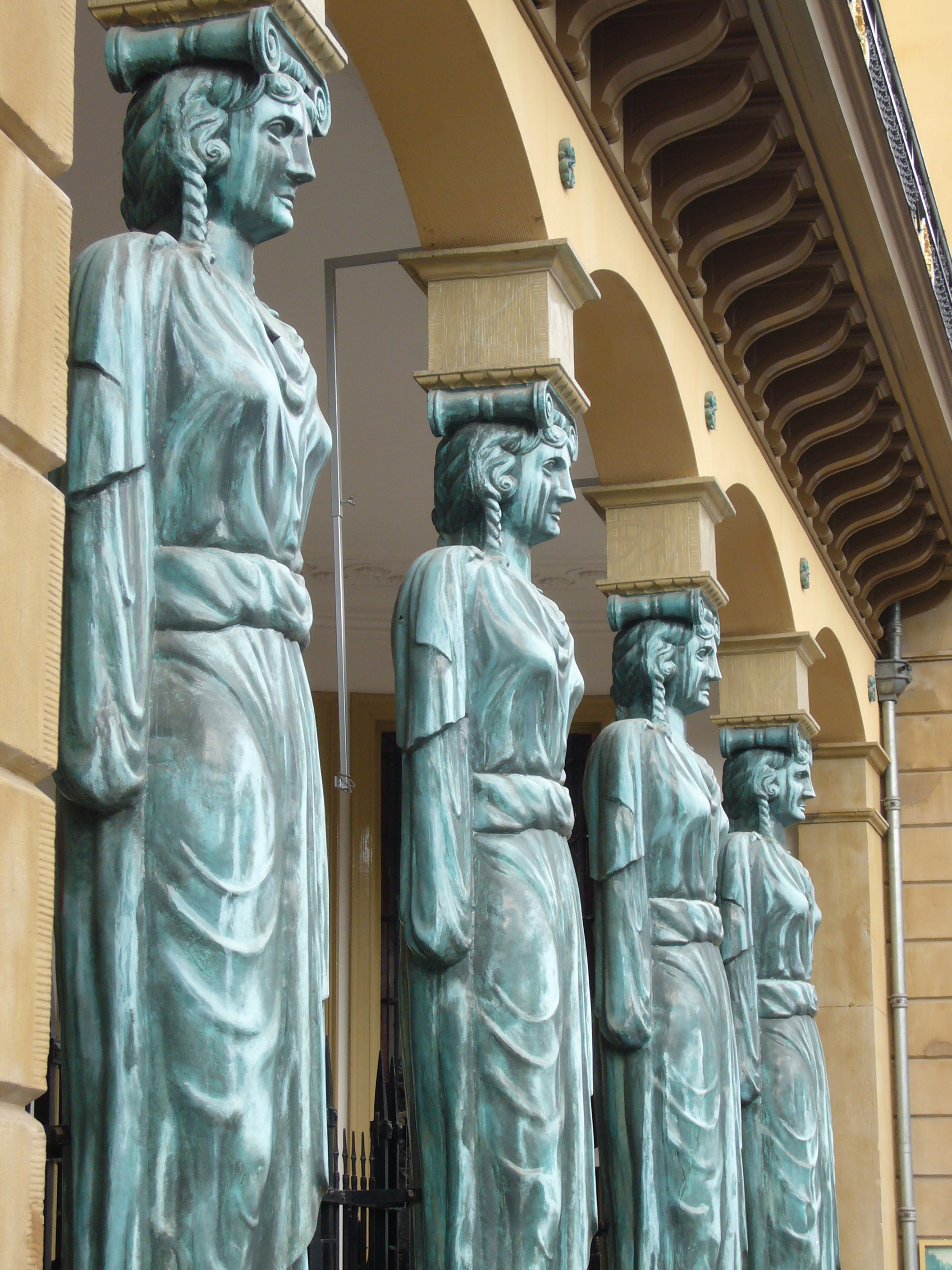
Winkel van Sinkel
On 9 September 1837, a barge tied up at the Oudegracht in Utrecht. On board was a heavy cast-iron statue of a woman, ordered from England by a draper named Anton Sinkel. As the city crane lifted her toward the wharf, something gave way at the top of the crane. The statue and a large piece of the crane went into the canal together. The crane, which had served Utrecht for two centuries, was so badly damaged that the city decided to demolish it. A mocking verse appeared almost immediately, telling Utrechters that their proud old crane had been defeated by a British whore - the locals' name for the four caryatids Sinkel had imported. Two years later, in 1839, those caryatids would hold up the facade of the first department store the Netherlands had ever seen.
Anton Sinkel of Cloppenburg
Anton Sinkel was born in 1785 in Cloppenburg, a small town in what is now Lower Saxony. Like the Brenninkmeyers (who would later found C&A) and the Cloppenburgs (Peek and Cloppenburg), Sinkel was one of a wave of German peddlers - marskramers - who walked into the Netherlands carrying packs of fabric and walked out, eventually, owning some of the most famous shops in the country. In 1822 he opened a drapery on Nieuwendijk in Amsterdam. Within a few years he had four buildings on that street alone: a fabric store, a men's workshop, a home-furnishings showroom, a fitting room. He kept buying. By 1834 he had branches in Leeuwarden, Rotterdam, Leiden - and his eye on a much larger project in Utrecht.
The Hole on the Oudegracht
In May 1824, Sinkel bought a house called The Wooden Leg on the Oudegracht. A decade later he bought the buildings of two former medieval guesthouses behind it, stretching all the way back to the Neude square, along with several other houses in between. Then he started demolishing. Construction dragged. Utrechters complained about the hole in the middle of their city center. The municipal council asked Sinkel, with growing impatience, to at least fence it off. The new building's architect was Pieter Adams, the city architect of Rotterdam - and Sinkel had picked up an idea on a trip to England that he was determined to execute. The facade would be held up not by ordinary columns, but by four enormous cast-iron caryatids in the shape of women.
Everything for Sale
On 6 May 1839, the Winkel van Sinkel finally opened. Four caryatids on the front. Four additional cast-iron figures representing commerce, prudence, seafaring, and hope. The interior was something Dutch shoppers had not seen before - many different types of merchandise, sold under one roof, in a building specifically built for the purpose. It was not quite self-service in the modern sense, but it was a department store, and it was the first in the country. Sinkel commissioned an advertising verse that went semi-viral in 1839 terms: 'In de Winkel van Sinkel is alles te koop' - 'In the Sinkel Shop, everything is for sale.' The list that followed ran from baskets of figs to pomade, hats, corsets, licorice, and, the verse concludes with characteristic Dutch directness, pills for pooping. The phrase Winkel van Sinkel entered the language as a generic term for a shop where you could buy anything.
After Anton
Anton Sinkel died in Amsterdam on 22 January 1848, less than a decade after his Utrecht store opened. An employee named Anton Povel took the business over. The Sinkel company ceased to exist in 1912, by which point Vlaer and Kol bank - later absorbed into ABN AMRO's predecessor - had already bought the building. The Rotterdam branch on the Grote Markt, also the first department store in that city, was wiped from the map by the German bombing of May 1940. The Amsterdam original on Nieuwendijk is now a HEMA. Only the Utrecht building survived intact - which is to say, the caryatids survived. They are still bolted to the facade on Oudegracht 158, still holding up the entablature, still watching the canal traffic the way they have for nearly two centuries.
Horecawarenhuis
Today the Winkel van Sinkel sells dinner instead of corsets. The building is officially called the Horecawarenhuis Winkel van Sinkel - roughly, the Restaurant and Bar Department Store - and it operates as a grand cafe, bar, wine bar, and event space spread across what were once the shop floors. The cast-iron women look down on canal-side tables on the Oudegracht. If you sit there in the evening you can see, in the pavement at your feet, a small plaque marking where the old city crane used to stand before one of those women dropped on it. The verse about a British whore conquering little Crane is still quoted occasionally, mostly by tour guides. Sinkel got his department store. Utrecht got its caryatids. The crane never came back.
From the Air
The Winkel van Sinkel building stands at Oudegracht 158 in central Utrecht at 52.0919°N, 5.1186°E, on the curving canal that follows the old course of the Rhine. From altitude, look for the medieval inner city of Utrecht with the Dom Tower at its eastern edge - the Oudegracht runs north-south through the core. Nearest airports: Amsterdam Schiphol (EHAM), 40 km northwest; Rotterdam The Hague (EHRD), 55 km southwest. Recommended viewing altitude 1,500-3,000 ft AGL for the city center.