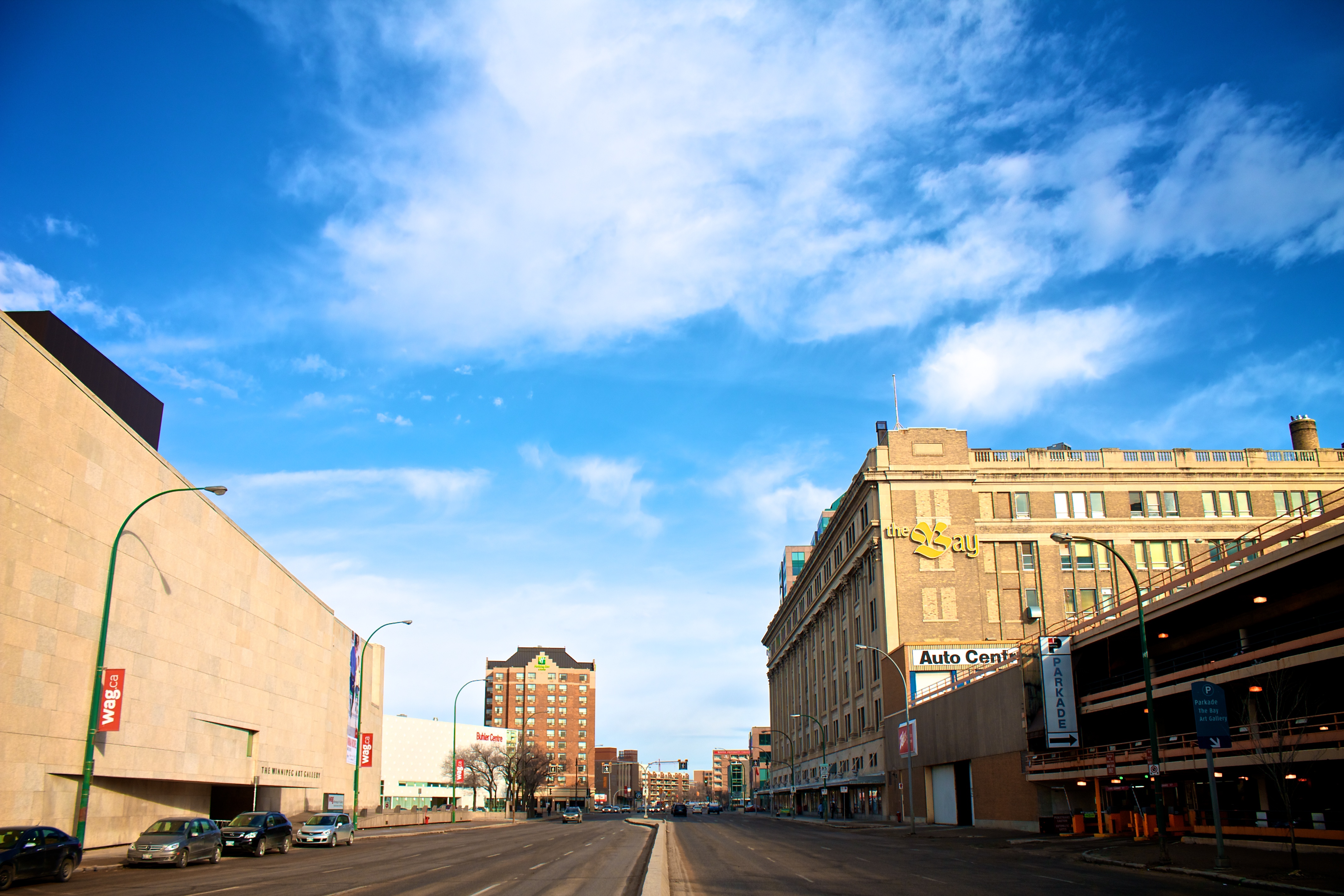
Winnipeg Art Gallery
In 2018, curators at the Winnipeg Art Gallery made a startling discovery in their own permanent collection: a lost painting by Alfred Munnings depicting Brigadier General R.W. Paterson's horse, Peggy, during the First World War. The painting had vanished shortly after a Royal Academy of Arts exhibition in 1919 and was only identified after the British National Army Museum issued a public appeal to locate it. A masterpiece hiding in plain sight for nearly a century -- it is the kind of story that could only happen at an institution with 24,000 works in its holdings, a collection so vast that surprises still surface from its depths. The Winnipeg Art Gallery, known locally as the WAG, houses the world's largest collection of Inuit art and occupies a striking modernist building on Memorial Boulevard that uses aggressive geometric angles and sloped walls designed to reflect the prairie sunlight.
From a Burning Hotel to a Triangular Plot
Winnipeg's first serious art gallery opened inside the Manitoba Hotel in the 1890s, organized by Cora Moore, who had returned from Toronto determined to bring fine art to the prairie city. She established a Winnipeg branch of the Women's Art Association of Canada and created an artists' group for men. The first exhibition took place in February 1895, featuring work from Manitoba alongside pieces from Toronto, Montreal, New York, London, and Paris. When the Manitoba Hotel burned down in 1899, the gallery burned with it. Efforts to rebuild an arts institution began in 1902 with the formation of the Manitoba Society of Artists. By 1912, the Winnipeg Museum of Fine Arts opened to the public, operated by the Winnipeg Development and Industrial Bureau. A school of arts followed in 1913. The two entities were incorporated as the Winnipeg Gallery and School of Arts in 1923, though the gallery association and the school eventually went separate ways. In 1963, the Manitoba Legislature formally incorporated the Winnipeg Art Gallery as its own institution.
Da Roza's Geometric Fortress
In 1967, the gallery acquired a triangular plot of land across from the Civic Auditorium and launched an architectural competition. Canadian architect Gustavo da Roza won the commission. Construction began in 1969, and the building opened on September 25, 1971, at a cost of approximately $4.5 million -- funded by federal and provincial governments, private donations, and a public fundraising campaign. Da Roza's design is uncompromising: sloped exterior walls that bounce sunlight, angular wedges that jut from the main mass to form entrances, and a geometric profile that reads as fortress-like from the street. The building's basement houses storage for the collections. The design earned recognition from the Winnipeg Architecture Foundation and stands as one of the city's most distinctive modernist landmarks. The gallery had fought hard for its own building -- in 1965, it had resisted a proposal to relocate inside the Manitoba Centennial Centre, declaring publicly that 'the politicians of the city have set various arts groups on each other' and that they were 'sitting tight -- but not sitting still.'
Qaumajuq: A Home for the North
The most transformative chapter began in November 2015, when the Government of Nunavut loaned its collection of 8,000 works to the WAG. Originally housed at the Prince of Wales Northern Heritage Centre in Yellowknife, this collection had been waiting for a permanent home after plans for a climate-controlled facility in Iqaluit were abandoned. The gallery commissioned Michael Maltzan Architecture to design a dedicated Inuit art centre. The result, Qaumajuq, opened to the public on March 25, 2021 -- the first museum building in the world dedicated entirely to Inuit art. The $65 million building includes a 90-seat theatre, a library, and a learning commons. Inuit carvings make up nearly two-thirds of the WAG's Inuit collection, which includes 7,500 antler, bone, ivory, and stone carvings, dozens of hand-sewn wall hangings, and 3,000 prints and drawings. The museum's first substantial acquisition of Inuit works came in 1960, when George Swinton donated 130 sculptures -- a seed collection that grew into the world's largest.
Five Centuries on the Walls
Beyond the Inuit holdings, the WAG's permanent collection spans five centuries of art-making. The Gort Collection features 19 panel paintings and 5 tapestries from Northern Renaissance artists of the 15th and 16th centuries. The Canadian collection includes 200 works from the period between 1820 and 1910, tracking the nation's artistic development from colonial landscapes to early modernism. Decorative arts holdings run to 1,500 British ceramics from the 18th and 19th centuries, nearly 1,000 Art Nouveau and Art Deco glass objects, and 500 works in silver from British and Canadian silversmiths. Approximately 70 percent of the permanent collection was gifted by private donors. The Clara Lander Library, free to access with a written request, holds books and records supporting the museum's educational mission. In 2016, the gallery expanded its community presence with WAG@The Forks, a retail space promoting Inuit art at Winnipeg's popular gathering place at the confluence of the Red and Assiniboine rivers.
From the Air
Located at 49.89N, 97.15W on Memorial Boulevard in downtown Winnipeg, Manitoba. The angular roofline and geometric profile of the da Roza building are distinctive from the air, sitting on a triangular plot. The Qaumajuq addition is adjacent. Winnipeg James Armstrong Richardson International Airport (CYWG) lies approximately 7 km to the west. The Manitoba Legislative Building and grounds are immediately to the south, and The Forks -- at the confluence of the Red and Assiniboine rivers -- is visible roughly 1 km to the southeast. The building sits within a cluster of cultural institutions including the Manitoba Museum and Centennial Concert Hall. Best viewed at 2,000-4,000 feet for architectural detail against the downtown grid.