Winnipeg General Strike
"The only thing the workers have to do to win this strike is to do nothing. Just eat, sleep, play, love, laugh, and look at the sun." That advice, printed in the daily Strike Bulletin during the summer of 1919, carried the optimism of 30,000 people who believed they could change their world by standing still. At 11 a.m. on Thursday, May 15, virtually the entire working population of Winnipeg -- then Canada's third-largest city -- walked off the job. The telephone operators, known as the "hello girls," were first out the door at 7 a.m. By noon, streetcars had stopped running, newspapers fell silent, and the city's economic life ground to a halt. What followed over the next six weeks would reshape Canadian politics, define the country's labour movement, and leave bloodstains on the pavement of Main Street.
A City Ready to Explode
Winnipeg in 1919 was a pressure cooker. Wages were low, prices were climbing, and soldiers returning from the trenches of World War I found not the better world they had fought for, but overcrowded housing, unstable employment, and employers who had grown wealthy on wartime profits. Most workers lacked union representation. Immigrants from Eastern Europe, who made up a large share of the workforce, faced open discrimination. The Russian Revolution of 1917 had electrified radical thinkers across the West, and in Calgary that March, western labour delegates called for a five-day week, a six-hour day, and the creation of the One Big Union to unite all trades under a single banner. When the Metal Trades Council and Building Trades Council both failed to secure collective bargaining contracts by late April, they struck. The Winnipeg Trades and Labour Council polled its 12,000 members on a general strike. The vote was overwhelming: 8,667 in favour, 645 against. The fuse was lit.
Hello Girls and Bread Wagons
The strike was remarkable for what it was and what it was not. It was not chaos. The Strike Committee, led by moderates like bricklayer James Winning and socialists like machinist R.B. Russell, managed the shutdown with disciplined precision. Police, who had voted to join the strike, were asked to remain on duty. Waterworks employees stayed at reduced pressure. Milk and bread deliveries continued, with small posters on the wagons reading "PERMITTED BY AUTHORITY OF STRIKE COMMITTEE" -- cards that management had actually suggested but that critics seized upon as proof the committee was trying to run the city. Helen "Ma" Armstrong, one of two women on the Strike Committee, rallied female workers from street corners and meeting halls. The Women's Labour League helped strikers pay rent. Women set up a communal kitchen serving hundreds of meals daily. On June 12, a "ladies day" at Victoria Park featured J.S. Woodsworth speaking on the emancipation of women. In city parks, the atmosphere was almost festive, with crowds gathering to hear speakers and share news.
The Citizens' Thousand Push Back
Opposition organized fast. The Citizens' Committee of One Thousand, a coalition of businessmen and professionals operating from the Board of Trade building, published their own newspaper, The Winnipeg Citizen, declaring that "the so-called general strike is in reality revolution." They pressured federal ministers Arthur Meighen and Gideon Robertson, who arrived in Winnipeg and promptly refused to meet the Strike Committee while consulting extensively with the Citizens' Committee. Meighen called the strike "a cloak for something far deeper." The federal government amended the Immigration Act to allow deportation without trial of British-born immigrants charged with sedition. On June 9, the city fired nearly its entire police force for refusing to sign a no-union, no-sympathy-strike pledge. Untrained special constables, armed with clubs, replaced them. Within hours, one of these specials charged into a group of strikers and was dragged from his horse and beaten. Newspapers resumed publication with a fiercely anti-strike stance, calling workers "aliens" and "anarchists."
Bloody Saturday
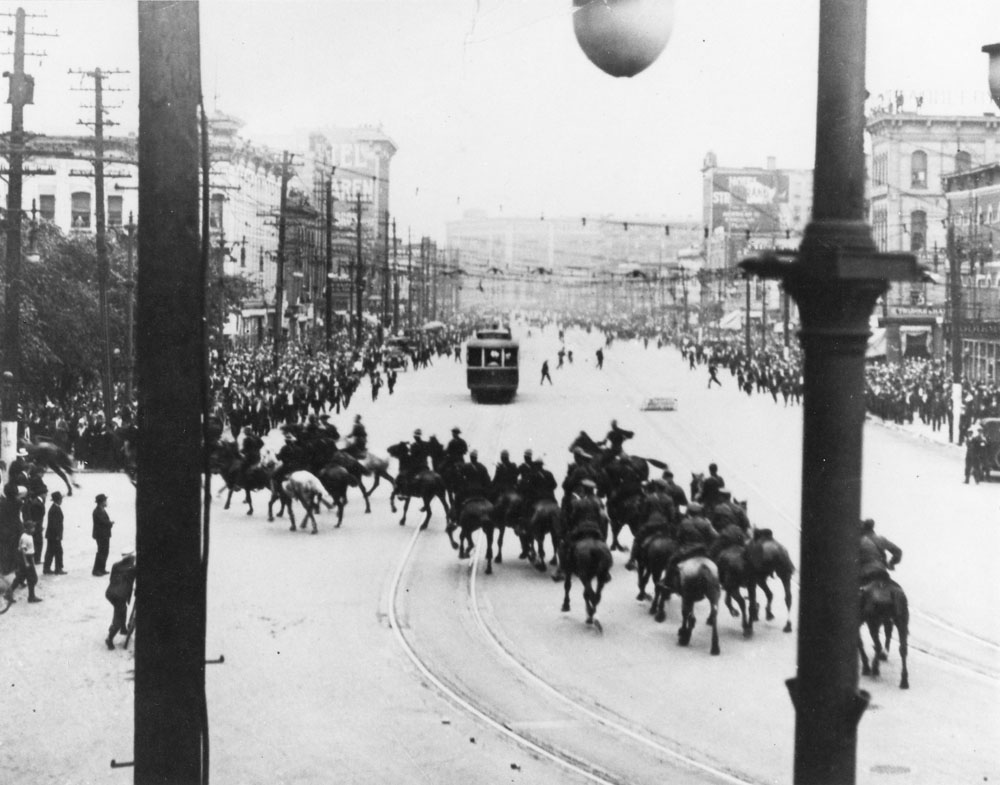
On the morning of June 17, the Royal North-West Mounted Police arrested strike leaders in their beds -- Russell, Ivens, Heaps, Queen, Armstrong, Bray, and others. The strike committee was decapitated, but the city did not submit. Returned soldiers announced a "silent parade" on Main Street for Saturday, June 21, to protest the arrests. Thousands assembled near City Hall. When the soldiers refused to disperse, Mayor Charles Gray called in the Mounties, who rode into the crowd on horseback, swinging clubs. A strikebreaker's streetcar was stopped, tipped off its tracks, and briefly set ablaze. After the Riot Act was read, the Mounties drew their .45 revolvers and fired three volleys -- about 120 shots into the crowd. Mike Sokolowski was killed instantly. Steve Szczerbanowicz died later. Hospitals recorded roughly 30 gunshot injuries. Military patrols sealed the downtown. Four days later, on June 25, the Strike Committee announced the end. The workers drifted back. Many were blacklisted.
From Prison Cells to Parliament
Seven of the eight leaders tried for seditious conspiracy were convicted. Russell received two years; most others got one year. But the courtroom was not the final verdict. While serving prison sentences, George Armstrong, William Ivens, and John Queen were elected to the Manitoba legislature in 1920. Queen went on to serve seven terms as mayor of Winnipeg. J.S. Woodsworth, whose charges were dropped after a co-accused was acquitted, won the Winnipeg Centre seat in Parliament in 1921 and held it until his death in 1942. In 1932, he co-founded the Co-operative Commonwealth Federation, forerunner of the New Democratic Party. The provincial royal commission that investigated the strike concluded it was not a foreign conspiracy and warned that if capital failed to ensure workers a contented existence, the state would need to intervene. General strikes erupted in as many as thirty other Canadian cities that same spring. Winnipeg's legacy endures in Canada's labour laws, its social democratic tradition, and the memorials that still mark the streets where Mounties fired into the crowd.
From the Air
Located at 49.884°N, 97.146°W. The strike's key locations cluster along Main Street in downtown Winnipeg, running north from Portage Avenue past City Hall. Union Station (ICAO: n/a) sits at the south end of Main Street near the Forks. Winnipeg James Armstrong Richardson International Airport (CYWG) lies approximately 5 nm west-northwest of the city centre. Approaching from the south at 3,000-5,000 feet AGL, the distinctive grid of downtown Winnipeg and the junction of the Red and Assiniboine rivers at the Forks are clearly visible. The Manitoba Legislative Building's dome is a useful landmark. Best viewed spring through fall; winter conditions can bring extreme cold and reduced visibility.