Winsor McCay
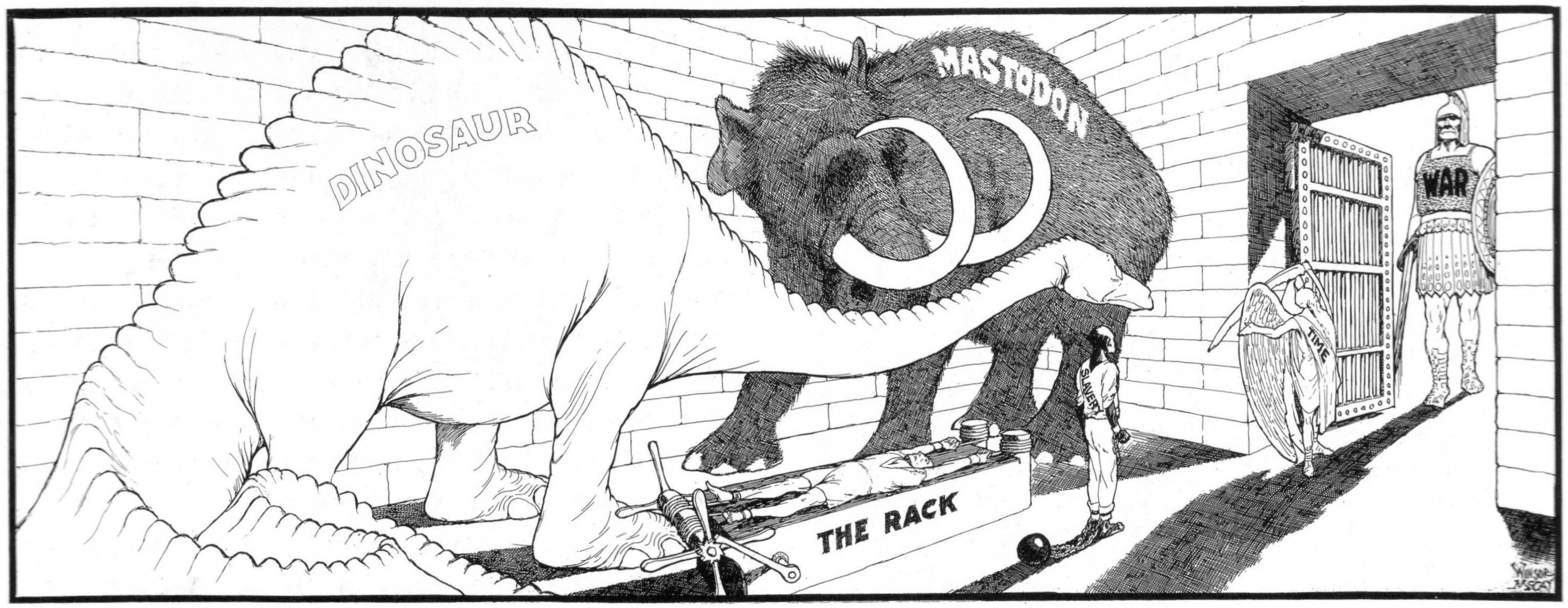
Before Walt Disney drew his first mouse, before the word 'animation' had entered common usage, a cartoonist in Brooklyn was hand-drawing thousands of frames on rice paper and projecting them onto a screen to make a dinosaur dance. Winsor McCay did not merely pioneer animation - he invented it as an art form, then watched an entire industry grow up around principles he had demonstrated years earlier. That he also created what many consider the greatest comic strip ever drawn was, for McCay, almost incidental.
Drawing Before He Could Write
Born Zenas Winsor McCay around 1866 in Michigan, McCay showed prodigious talent from childhood. Family legend holds that he made his first drawing by scratching a fire scene into the frost of a windowpane with a nail. He drew compulsively - anything he saw, with an accuracy that startled adults. His father, unimpressed, sent him to business college in Ypsilanti, but McCay rarely attended classes, preferring to catch the train to Detroit to show his drawings around. He wound up making posters for dime museums, painting signs, and performing as a quick-sketch artist, turning audience suggestions into finished drawings at speed. By 1898, he was illustrating for newspapers, and in 1903 he joined the New York Herald, where his career as a comic strip artist began in earnest.
Slumberland and the Architecture of Dreams
McCay created several popular strips - Little Sammy Sneeze, Dream of the Rarebit Fiend - but his masterpiece debuted in October 1905. Little Nemo in Slumberland followed a young boy through fantastical dreamscapes rendered in a lush Art Nouveau style that had no precedent in newspaper comics. McCay treated the comic page as architecture. Panels expanded, compressed, and reshaped themselves to match the narrative: buildings stretched to impossible heights, beds sprouted legs and walked through cities, entire landscapes melted into abstraction. His mastery of linear perspective and color was unmatched. Each Sunday page was a self-contained visual spectacle, and the strip ran for nearly a decade in its first incarnation, with a revival in the 1920s. Under contractual obligations, McCay simultaneously produced Dream of the Rarebit Fiend under the pen name 'Silas,' an adult-oriented strip in which characters experienced bizarre nightmares blamed on eating Welsh rarebit before bed.
Gertie Takes a Bow
McCay's restless creativity led him to animation. His 1911 film Little Nemo, featuring characters from the strip, required approximately 4,000 drawings. But it was Gertie the Dinosaur in 1914 that changed everything. McCay performed alongside the film in vaudeville, appearing to give commands to the animated brontosaurus, who responded with a personality no drawn character had displayed before - she was playful, stubborn, shy. McCay drew every frame himself on rice paper, a labor of thousands of hours. The illusion of a living, breathing creature with emotions and will was unprecedented. Walt Disney later cited Gertie as the film that inspired him to enter animation. McCay went on to create The Sinking of the Lusitania in 1918, a painstakingly researched depiction of the disaster that required over 25,000 drawings, making it the longest animated film produced to that date.
The Man Behind the Frames
McCay and his wife Maude lived lavishly in Brooklyn. He kept a chauffeur who doubled as a bodyguard - the sharp editorial cartoons he drew for William Randolph Hearst sometimes attracted threatening letters. His son Robert served as the model for Little Nemo and later became an artist himself, though his attempts to revive the strip after his father's death in 1934 were short-lived. McCay's original artwork has been poorly preserved; a large collection was destroyed in a fire. But his influence is beyond measurement. Robert Crumb called McCay 'the greatest artist to work in the comic strip medium.' Today, Winsor McCay Park in Brooklyn, near where he lived and worked, bears his name - a small patch of green honoring a man who could draw worlds from memory and bring dinosaurs to life with nothing but rice paper and ink.
From the Air
Located at 40.684N, 73.901W in Brooklyn, New York. Winsor McCay Park sits in the Ridgewood/Bushwick area of Brooklyn. From the air, look for the rectangular green space bounded by urban residential blocks. McCay lived and worked throughout the New York City area, with much of his career centered in Manhattan newspapers. Closest airports: KJFK (8 nm SE), KLGA (7 nm NE), KEWR (12 nm W). Best viewed at 1,500-2,500 ft AGL.