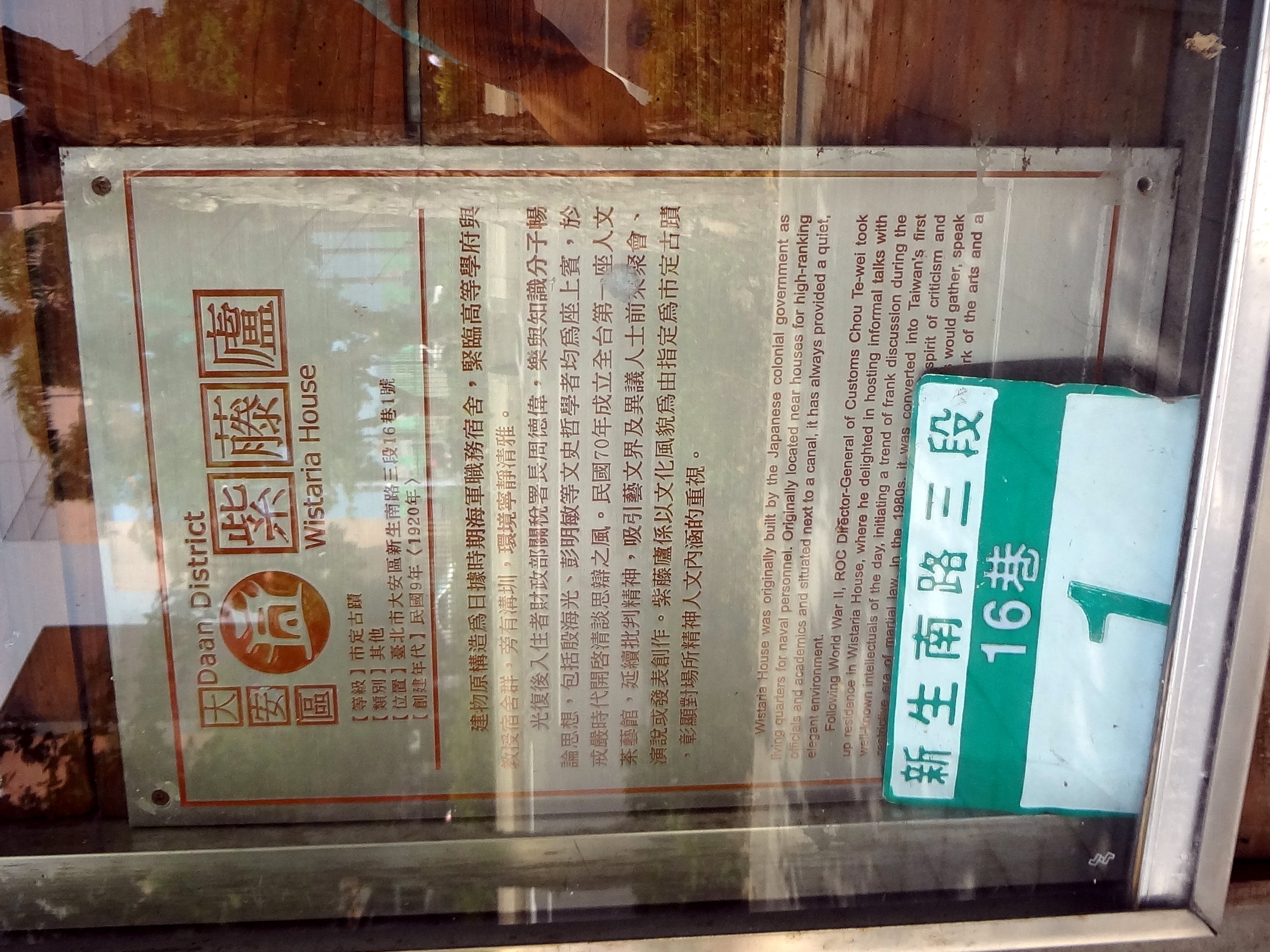
Wistaria Tea House
Three wisteria vines climb a trellis in front of a wooden house on Xinsheng South Road in Taipei's Daan District. They give the building its name: Wistaria Tea House, or in Chinese, Zitenglu. The vines have been growing since the house was built in the 1920s during the Japanese colonial period, long enough to shade a courtyard that has served as a residence for the Governor-General's officials, a dormitory for Republic of China administrators, a meeting place for political dissidents plotting democracy, and a film set for Ang Lee. The tea is excellent. The history is extraordinary.
Three Eras Under One Roof
The house was constructed in the 1920s in the Japanese wooden style that defined much of Taipei's colonial-era domestic architecture. Before 1945, it served as a residence for officials of the Governor-General of Taiwan. When the Republic of China took control of the island after World War II, the building became government dormitories, its elegant rooms subdivided for bureaucratic housing. It might have remained an unremarkable government property indefinitely, but the house had been home to Chou Te-wei, a Kuomintang-aligned economist who studied under Friedrich Hayek and gathered liberal thinkers there in the 1950s. His son Chou Yu inherited the property and in 1981 transformed it into something the authorities had not anticipated: a teahouse and gathering place for people who believed Taiwan should be a democracy.
Tea and Dissent
The building gained its present name in 1981, when it opened as a teahouse. But Wistaria was never just about tea. Under the canopy of the wisteria vines, in rooms decorated with circa-1930s furnishings, political dissidents like Lei Chen met to discuss democratic reform during the era of martial law. Lei Chen had been imprisoned for a decade for publishing a magazine that advocated multiparty democracy. The teahouse became a salon for the politically restless, a place where conversations that could not happen in public found shelter behind wooden walls and fragrant leaves. Artists, academics, and writers joined the circle. Wistaria became, in the words of those who gathered there, a space where Taipei's intellectual life could breathe.
Preservation and Performance
In 1997, the Taipei government designated Wistaria Tea House a historic monument, recognizing both its architectural significance as a surviving Japanese-era wooden structure and its role in Taiwan's democratic movement. Operation of the teahouse was turned over to the Wistaria Cultural Association by the Taipei City Cultural Bureau. A long-needed renovation shuttered the building for several years before it reopened in 2008 to considerable public attention. The restoration preserved the 1930s-era interior that gives the space its distinctive atmosphere: dark wood, low ceilings, soft light filtering through the vine-covered trellis outside.
Through the Camera Lens
The teahouse achieved international visibility when director Ang Lee used it as a filming location for Eat Drink Man Woman, his 1994 comedy-drama about a retired chef and his three daughters in Taipei. The film, which earned an Academy Award nomination for Best Foreign Language Film, showcased the kind of intimate, layered Taipei spaces that rarely appeared in Western cinema. Wistaria's wood-paneled rooms and courtyard garden provided a visual shorthand for the traditional culture that Lee's characters were navigating and, in some cases, leaving behind. The film brought a new generation of visitors to a teahouse that had already spent decades quietly accumulating stories.
Still Steeping
Today the Wistaria Tea House operates as both a functioning teahouse and a living museum. Visitors can sit in rooms where democracy was debated under martial law, drink tea brewed in traditions that predate the Japanese occupation, and look out through windows framed by vines that have been growing for a century. The neighborhood around it has changed beyond recognition, Daan District now dense with apartment towers and commercial development. But the wooden house persists, low and quiet on its stretch of Xinsheng South Road, a reminder that some of Taiwan's most consequential conversations happened not in government buildings or on protest streets but in a tearoom, over cups of oolong, beneath wisteria.
From the Air
Located at 25.0246°N, 121.534°E in Taipei's Daan District, on Xinsheng South Road. The teahouse is a single-story wooden structure invisible from any meaningful altitude -- it is the kind of place you must come down to earth to find. Nearest airport is Taipei Songshan (RCSS), approximately 4 km northeast. Taoyuan International (RCTP) is 30 km southwest. The National Taiwan University campus lies nearby to the south, a useful visual reference.