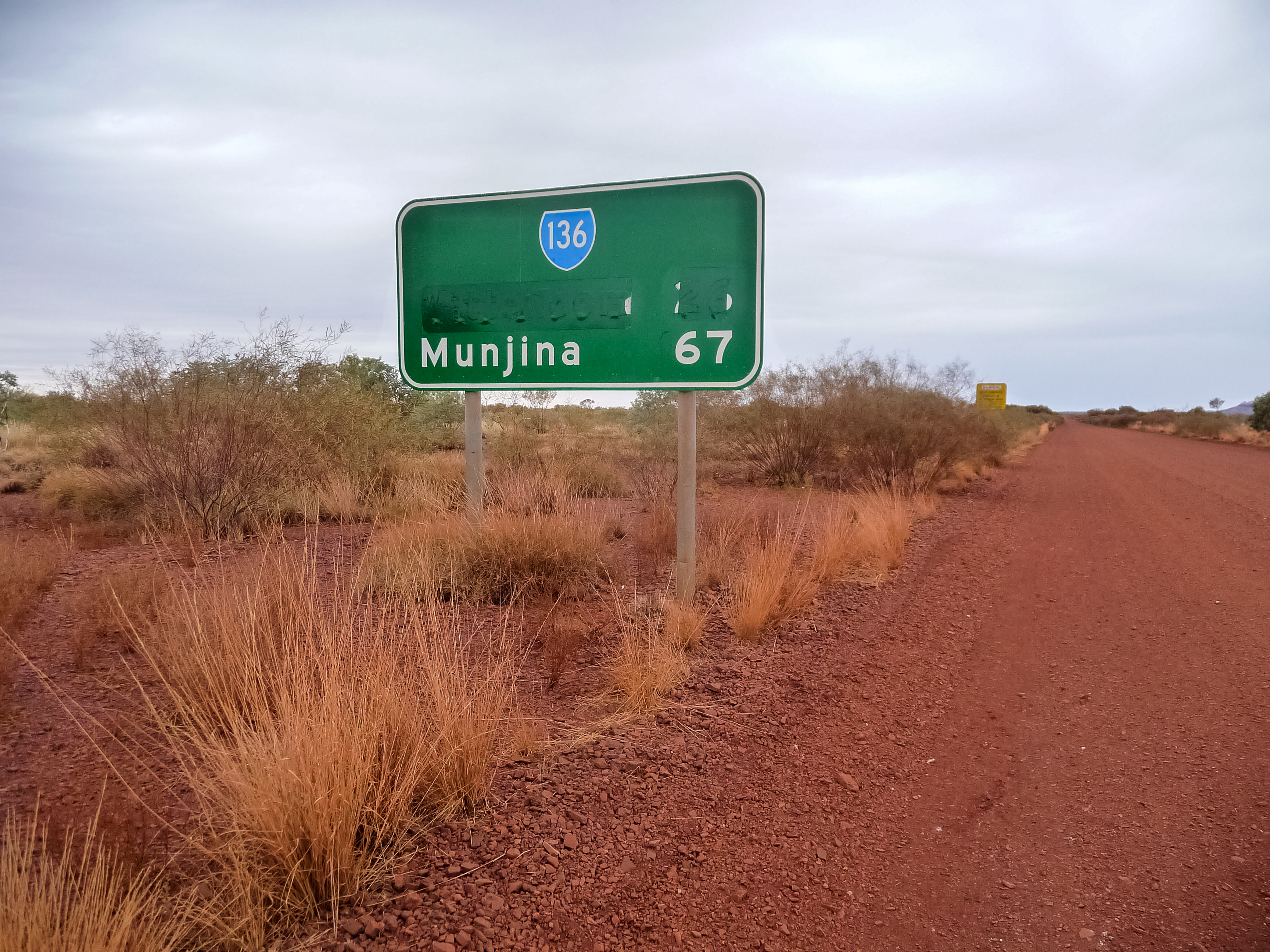
Wittenoom, Western Australia
The road signs for Wittenoom were removed. The town's name was taken off official maps. In 2007, the Western Australian government formally degazetted it — erased its administrative existence — as if a place could be cancelled by bureaucratic procedure. But the buildings remained, slowly crumbling in the Hamersley Range, and the asbestos tailings remained, and the invisible fibres in the soil remained. And, for decades, the last few residents remained, refusing to leave a place the government had declared too dangerous to inhabit. The last was evicted in September 2022. In May 2023, demolition of the surviving buildings began.
The Blue Asbestos
Crocidolite — blue asbestos — was first recorded in the Hamersley Ranges by the Mines Department in 1917. In the early 1930s, mining entrepreneur Lang Hancock discovered Wittenoom Gorge on his Mulga Downs property and recognised the deposit's commercial potential. During the 1950s and early 1960s, Wittenoom became Australia's only supplier of blue asbestos. The mine and processing mill ran through 1966, when they were closed — not because crocidolite was understood to be the most lethal form of asbestos, with fibres that spear into lung tissue and stay there, but because the operation had become unprofitable. The health consequences took longer to kill than the economics. As of 2024, more than 2,000 of approximately 20,000 former mine workers and residents had died of asbestos-related diseases including mesothelioma.
The Town After the Mine
The mill processed ore by milling it and blowing the fibres through the air to separate them. Asbestos dust settled everywhere — in houses, gardens, streets, the airport runway. Wittenoom Gorge Airport's runways were partly surfaced with gravel and asbestos tailings; it was later closed specifically as a health hazard. The town persisted through the 1960s and 1970s even as the death toll from mesothelioma began climbing and the scale of the contamination became impossible to ignore. About 100 people were still living there in 1979, when the state government first proposed closure. The government removed services, disconnected power, compulsorily acquired properties, and eventually — over four decades — chipped away at the population until only a handful remained. By 2017, four people still lived there. By 2022, one.
The Panyjima People
The Panyjima, also known as the Banjima, are the Aboriginal Australian people of this area of the Pilbara. They hold Native Title over the land. The Panyjima petitioned the Western Australian Parliament not only to remove Wittenoom's remaining buildings but to remediate the land entirely — to remove the asbestos tailings still lying near the former mine. The government's demolition programme, begun in May 2023, buried debris on site. It did not commit to cleaning up the asbestos tailings. The question of what 'remediation' means for a 46,840-hectare contaminated site in a remote desert, where any disturbance of the soil risks releasing fibres, remains without a clear answer.
What Wittenoom Became
In the years after closure, Wittenoom acquired a strange cultural gravity. Midnight Oil wrote the song Blue Sky Mine about it. Tim Winton set portions of his novel Dirt Music there. A digital poet named Jason Nelson created an interactive work about the town's death that won the Newcastle Poetry Prize in 2009. Thousands of visitors came each year despite the health warnings, drawn by the category of 'extreme tourism' the place had invented for itself. In 2018 it was called Australia's Chernobyl. The comparison is apt in one sense: both places demonstrate what happens when an industrial hazard is so severe and so spatially dispersed that it exceeds the capacity of any remediation budget. Wittenoom is not a monument to a disaster that happened. It is a disaster that is still happening, in the lungs of everyone who breathed the air.
From the Air
Wittenoom lies at approximately 22.24°S, 118.33°E in the Hamersley Range of the Western Australian Pilbara, 1,420 km north-northeast of Perth. Access roads have been closed and the townsite is legally off-limits to the public. From altitude, the surrounding Hamersley Range is visible as a dissected plateau of reddish rock. The Wittenoom Gorge itself — narrow, dramatic, contaminated — runs south from the former town. Nearest airport: Tom Price (YTMP), approximately 90 km southwest. Do not land at or near the former Wittenoom Gorge Airport.